9 Photos That Prove the Shoebill Is Uganda’s Weirdest Bird
Uganda is famous for mountain gorillas, tree-climbing lions, chimpanzees, and spectacular landscapes. There is one bird that often leaves visitors speechless before they have even lifted a camera. Standing over four feet tall with a shoe-shaped bill piercing pale eyes, and movements that seem frozen in time, the shoebill looks unlike anything else in Africa. It appears ancient, mysterious, and strangely calm, making every sighting feel more like a privilege than a simple wildlife encounter.
Many travelers arrive expecting a birdwatching excursion and leave with hundreds of photographs of a creature that seems borrowed from another age. Every image tells a story. Some capture patience; others reveal surprising strength, while a few freeze moments that hardly seem real. Together they explain why this remarkable species has become one of Uganda’s wildlife attractions.
Every Picture Reveals Something
The beauty of photographing a shoebill is that no two moments are ever identical. Although the bird spends periods standing perfectly still, every subtle movement carries meaning. A slight turn of the head, a blink or the sudden launch into flight can transform an ordinary photograph into an unforgettable memory.
Than seeing only a strange-looking bird these photographs help people understand why Ugandas wetlands remain among Africas most valuable ecosystems.
Photo One: The Motionless Hunter
The first photograph shows the shoebill standing without moving in water. At glance it almost resembles a sculpture placed carefully among papyrus reeds. After watching for several minutes do you notice tiny movements of the eyes or a gentle adjustment of its posture.
This extraordinary patience is one of the birds hunting advantages. Fish often swim closer because they fail to recognize any danger. Of wasting energy chasing prey the shoebill lets opportunity come naturally. The lesson hidden in this image is surprisingly simple: patience often produces results than constant movement.
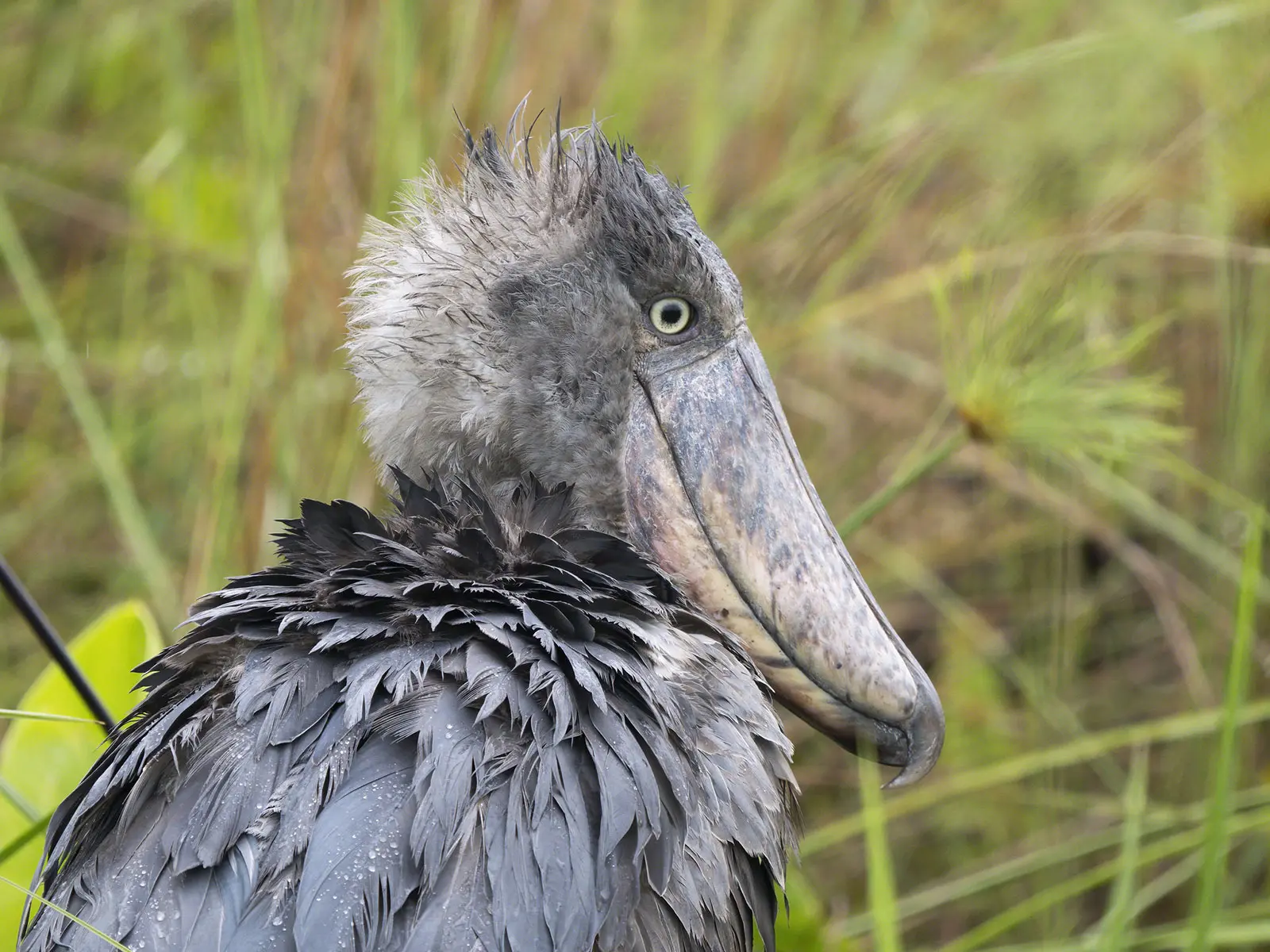
Photo Two: A Bill Unlike Any
A close-up image of the shoebills enormous bill immediately explains where its name comes from. The broad curved shape resembles a wooden shoe making it one of the most recognizable bills in the bird world.
Yet this remarkable feature is far more than an appearance. It functions as a hunting tool capable of gripping slippery lungfish, catfish, frogs and even young reptiles. Looking closely at the tip reveals how perfectly designed it is, for catching difficult prey hidden beneath muddy water.
Visitors often spend minutes studying this feature alone amazed that nature could produce such an unusual design.
Photo Three: Eyes That Never Look Away
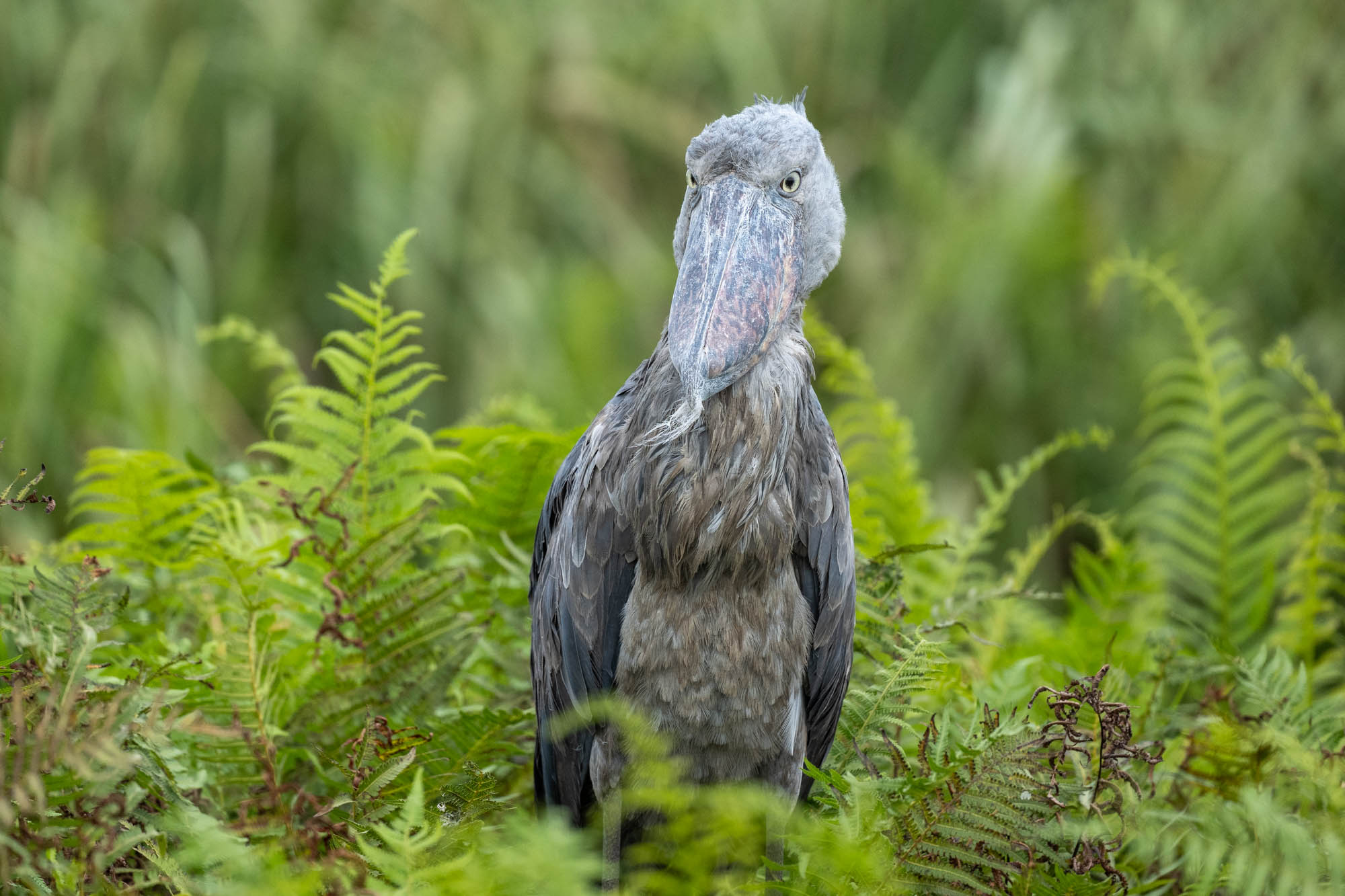
One of the striking photographs captures the shoebill looking directly into the camera. Those pale prehistoric eyes create an unforgettable impression. They seem focused, intelligent and completely undisturbed by presence.
Unlike birds that constantly dart their gaze around the shoebill often fixes its attention on one point for extended periods. That intense concentration helps it detect the slightest movement beneath the waters surface.
Looking into those eyes reminds photographers that wildlife is not performing for people. Instead humans are observers witnessing life exactly as nature intended.
More Than a Strange Appearance
Many people initially become fascinated by the shoebill because of its face. However spending time in Ugandas wetlands reveals something deeper. Every photograph reflects behaviors developed over millions of years through adaptation and survival.
This is why 9 Photos That Prove the Shoebill Is Ugandas Weirdest Bird becomes much more than a collection of unusual images. It becomes a story about evolution, patience and resilience.
Photo Four: The Famous Bow
One memorable photograph captures the moment a shoebill lowers its head in what appears to be a bow. Visitors often smile because it almost looks like the bird is greeting them personally.
Researchers believe this behavior forms part of communication especially during courtship or interactions with other shoebills. Whatever the scientific explanation, seeing it in person leaves an impression.
Photographers quickly discover that timing matters. A single second can separate a portrait from an extraordinary wildlife photograph.
Photo Five: Walking Through Papyrus
Another beautiful image shows the bird carefully stepping between papyrus stems. Despite its height every movement is surprisingly slow and deliberate.
Watching the shoebill walk reveals balance. Long legs allow it to move quietly through marshes while disturbing little water. That silence keeps prey unaware until the perfect hunting moment arrives.
For visitors these peaceful scenes become favorite memories because they reveal how perfectly the bird belongs within Ugandas wetlands.
Photo Six: The Unexpected Flight
Many people assume the shoebill rarely flies because photographs often show it standing motionless. Then comes the surprise.
A timed image captures enormous wings spreading wide before the bird lifts effortlessly above the swamp. Its wingspan, reaching over two meters creates an impressive silhouette against the morning sky.
Seeing such a large bird become graceful, in flight changes every expectation. What seemed heavy and awkward suddenly appears elegant and powerful.
Photographers often describe these seconds as the highlight of their entire expedition.
The Final Images Tell an Even Bigger Story
As remarkable as the shoebill’s appearance may be, the final photographs reveal something even more important. They remind us that every unforgettable wildlife encounter depends on healthy wetlands, dedicated conservation efforts, and local communities that understand the value of protecting this extraordinary bird. Looking through these images becomes more than admiring unusual features. It becomes an appreciation of an entire ecosystem working in harmony.
Photo Seven: The Perfect Strike
One of the most dramatic photographs captures the exact moment the shoebill lunges toward the water. The stillness disappears instantly as the bird unleashes surprising speed. Water splashes into the air while the massive bill closes around its target with remarkable precision.
Many people are shocked to learn that a bird capable of standing motionless for twenty minutes can attack in less than a second. That contrast is part of what makes the shoebill such a fascinating hunter. Every successful strike is the result of careful observation rather than constant pursuit.
Images like this remind photographers that wildlife photography often rewards patience more than quick reactions. Sometimes the most exciting moment arrives only after long periods of waiting.
Photo Eight: A Shoebill Against the Sunrise
Another unforgettable image shows a lone shoebill standing in shallow water as the first rays of sunlight spread across the swamp. Mist drifts gently above the reeds while the bird’s silhouette creates a scene that feels timeless.
Early morning is often the most rewarding time to search for shoebills in Uganda. The wetlands are calm, birds are active, and soft golden light creates ideal conditions for photography. Even visitors using smartphones can capture beautiful images when nature provides such perfect conditions.
Beyond the technical quality of the photograph lies a deeper message. Every sunrise over Uganda’s wetlands represents another opportunity for conservation to succeed. Protected habitats allow the shoebill and countless other species to continue thriving where they have lived for generations.
Photo Nine: The Bird That Leaves Everyone Smiling
The final photograph may not be the most dramatic, yet it is often the most meaningful. It shows visitors quietly watching a shoebill from a respectful distance while experienced local guides paddle a canoe through narrow channels of papyrus.
No one is rushing to take the perfect picture. Instead, there is a shared appreciation for the rare privilege of seeing one of Africa’s most unusual birds in its natural home.
This image captures something impossible to measure with a camera. It reflects curiosity, respect, and wonder. The shoebill has a remarkable ability to slow people down. Conversations become quieter, cameras click less frequently, and attention shifts entirely to the bird standing before them.
That feeling often becomes the strongest memory people carry home from Uganda.
Why Uganda Is the Best Place to Experience the Shoebill
Uganda has earned its reputation as one of the world’s finest destinations for observing shoebills in the wild. Wetlands such as Mabamba Swamp provide excellent habitat, offering abundant fish, thick papyrus vegetation, and relatively undisturbed breeding areas.
Local guides play a vital role in making each excursion successful. Years of experience help them interpret bird behavior, recognize fresh movements through the wetlands, and position visitors without disturbing the wildlife. Their knowledge often makes the difference between simply searching for a shoebill and enjoying an unforgettable encounter.
Responsible tourism also contributes directly to conservation. Revenue generated from birdwatching supports local livelihoods and encourages communities to protect the wetlands instead of converting them for other uses. Every visitor who values these habitats becomes part of that positive cycle.
It is this combination of spectacular wildlife, dedicated conservation, and community involvement that gives 9 Photos That Prove the Shoebill Is Uganda’s Weirdest Bird a deeper meaning. The photographs celebrate not only an extraordinary bird but also the people and places working to ensure its future.
Every Photograph Inspires Conservation
A single picture of an animal can go a long way. It can be shared with friends and family or with people online. This way thousands of people can see a species they never knew existed.
This is important because the shoebill is facing problems. The shoebill is losing its home. The wetlands are getting damaged. People are also disturbing the shoebill. Every picture that makes people like the shoebill can also inspire people to protect it.
People who come to take pictures often leave with something valuable. They start to care about the wetlands in Uganda and the many different species that live there.
A Collection Worth Remembering
These nine pictures show us more than a strange bird. They tell us a story about being patient, precise and able to adapt. They capture moments that’re real and experiences that stay with us long after we leave.
The shoebill is a special bird. It has a bill and can stare at us without blinking. It can fly beautifully. Hunt in amazing ways. The shoebill can look scary, elegant, old and peaceful all at the time.
It is no wonder that photographers want to come to Uganda to see the shoebill again. Every time they visit they see something. The light is different the shoebill behaves differently. They might see something extraordinary.
By the time we look at all the pictures we realize that the title 9 Photos That Prove the Shoebill Is Ugandas Weirdest Bird is not a simple title. It reminds us that some of the things in nature cannot be fully seen in just one picture. The pictures make us curious. Being in a Ugandan wetland watching the shoebill in silence is something that no camera can fully capture.
For people who want to go on a wildlife adventure 9 Photos That Prove the Shoebill Is Ugandas Weirdest Bird is a reason to try something new. Sometimes the best experience is not with the animal or the biggest mammal but with a quiet bird like the shoebill that has been amazing people, for centuries.