
The Ugly Five: Why Safari Guides Love Wildebeest and Warthogs
When travellers plan an African safari, they often dream of seeing lions, elephants, leopards and giraffes. These famous animals attract attention because of their strength, beauty and impressive size. However, experienced safari guides are equally interested in animals that receive far less admiration.
Meet Africa’s Ugly Five: the wildebeest, warthog, spotted hyena, marabou stork and lappet-faced vulture. Their unusual appearances have earned them an unflattering nickname, but each plays an important role in the natural environment.
Understanding the Ugly Five on safari helps you appreciate wildlife beyond the famous Big Five. These animals display fascinating behaviour, contribute to healthy habitats and provide excellent opportunities for wildlife observation.
Whether you are exploring Uganda, Kenya or Tanzania, discovering why guides appreciate wildebeest and warthogs can completely change how you look at African wildlife.
What Are Africa’s Ugly Five Animals?
The Ugly Five is an informal safari nickname given to five African wildlife species considered unusual or less attractive in appearance.
The group includes animals with distinctive facial features, unusual body proportions or feeding habits that some people find unpleasant.
However, beauty is subjective, and the nickname does not reflect the animals’ ecological importance.
| Ugly Five Animal | Distinctive Feature | Ecological Role |
|---|---|---|
| Wildebeest | Large head, curved horns and sloping body | Grazing and nutrient cycling |
| Warthog | Facial protrusions and prominent tusks | Grazing and soil disturbance |
| Spotted hyena | Powerful jaws and sloping back | Predation and scavenging |
| Marabou stork | Bare head and large throat pouch | Scavenging and feeding on small animals |
| Lappet-faced vulture | Bare head and fleshy facial folds | Removing animal remains |
Safari guides appreciate these animals because their behaviour reveals how ecosystems function.
1. Wildebeest: The Unusual-Looking Migration Stars
Wildebeest are among Africa’s most recognisable grazing animals.
Their large heads, curved horns, shaggy manes and relatively slender legs create an unusual appearance. Some travellers initially mistake them for oddly shaped cattle.
However, wildebeest are remarkably successful herbivores.
They move across grasslands in search of suitable grazing conditions and water.
Why Safari Guides Love Wildebeest
Wildebeest are central to one of Africa’s most famous wildlife events: the Great Migration.
Across the Serengeti-Mara landscape of Tanzania and Kenya, large numbers of wildebeest move seasonally alongside zebras and other herbivores.
Their movements respond primarily to rainfall patterns and the availability of nutritious grass.
During migration, guides may observe enormous herds, newborn calves and interactions between grazing animals and predators.
Wildebeest also influence grassland ecosystems through grazing, nutrient redistribution and their role as prey.
Lions, hyenas and crocodiles depend on large herbivores, including wildebeest, for food.
Where Can You See Wildebeest?
The Serengeti National Park in Tanzania and Maasai Mara National Reserve in Kenya are particularly well known for wildebeest sightings.
However, the exact locations of migrating herds change throughout the year.
If you want to observe a specific migration stage, discuss seasonal expectations with your safari operator before travelling.
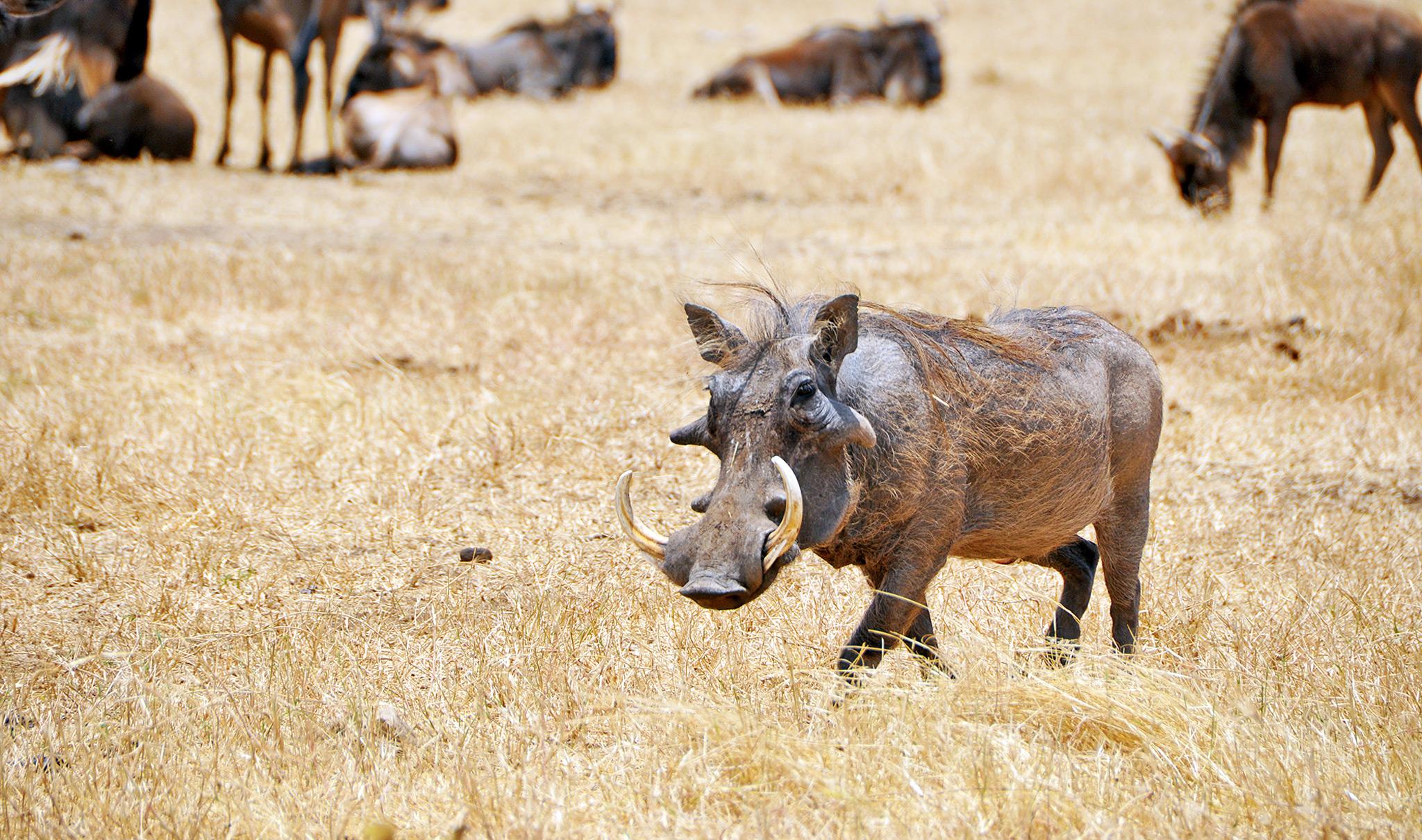
2. Warthogs: Africa’s Surprisingly Entertaining Wild Pigs
Warthogs often make safari visitors smile.
Their broad snouts, prominent tusks, facial protrusions and thin tails give them a distinctive appearance.
Despite their unusual looks, warthogs are well adapted to life in African grasslands.
They commonly graze on short grasses, sometimes kneeling on their front legs to reach food more comfortably.
Why Safari Guides Love Warthogs
Warthogs display interesting social behaviour and practical survival strategies.
Family groups usually consist of females and their young, while adult males may spend more time alone.
When threatened, warthogs can run surprisingly quickly, often holding their tails upright.
They also use burrows for shelter, frequently occupying holes originally excavated by aardvarks.
Warthogs may enter these burrows backwards, leaving their tusks facing the entrance.
Guides enjoy explaining these behaviours because they demonstrate how animals adapt to predators and their surroundings.
Where Can You See Warthogs?
Warthogs occur in several East African wildlife destinations, including Queen Elizabeth National Park and Murchison Falls National Park in Uganda, as well as the Serengeti and Maasai Mara.
They are often observed grazing in open areas or moving through grassland vegetation.
3. Spotted Hyenas: Intelligent Hunters and Scavengers
Spotted hyenas are frequently misunderstood.
Their sloping backs, broad heads and powerful jaws have contributed to their unusual reputation.
Wildlife films sometimes portray them as cowardly scavengers that depend entirely on other predators.
In reality, spotted hyenas are skilled hunters and highly social animals.
They live in groups called clans, which can have complex social relationships.
Why Safari Guides Love Spotted Hyenas
Hyenas are fascinating because of their intelligence, communication and hunting strategies.
Their powerful jaws allow them to crush bones and consume parts of carcasses that many other carnivores leave behind.
This feeding behaviour helps recycle nutrients.
Spotted hyenas also hunt prey themselves, sometimes working together during pursuits.
Their vocalisations include whoops, growls and calls that can sound like laughter.
Safari guides may use these sounds to explain communication between clan members.
Spotted hyenas can be observed in destinations such as the Serengeti, Maasai Mara and selected Ugandan savannah parks.
4. Marabou Storks: The Savannah’s Unusual Large Birds
The marabou stork has a very different appearance from the colourful birds that many travellers expect to see in Africa.
It has a large bill, a bare head, dark wings and a prominent throat pouch.
Its appearance is often considered unattractive, but its feeding behaviour makes it an important bird.
Why Safari Guides Love Marabou Storks
Marabou storks are opportunistic feeders.
They consume carrion, insects, fish and various small animals.
Their bare heads are useful when feeding on animal remains because feathers around the head could become heavily soiled.
In Uganda, marabou storks are familiar sights in some urban areas, including Kampala, where they often search for discarded food.
They also occur in suitable natural habitats.
Guides use marabou storks to explain how birds adapt to different food sources and environments.
Observing these birds can introduce travellers to wildlife that thrives outside traditional game-viewing areas.
5. Lappet-Faced Vultures: Powerful Wildlife Cleaners
The lappet-faced vulture is a large African bird recognised by its powerful bill, broad wings and fleshy folds around the head and neck.
Although its appearance may seem unusual, it performs an important ecological function.
Why Safari Guides Love Lappet-Faced Vultures
Lappet-faced vultures feed mainly on carrion.
Their strong bills allow them to tear through tough animal skin, making food accessible to other scavenging birds.
Vultures help remove carcasses from the environment, supporting nutrient cycling and reducing the persistence of decaying animal remains.
Guides often watch the movement of vultures because gatherings can suggest feeding activity in an area.
However, circling vultures do not always indicate a recent kill. They may also be travelling or using rising air currents.
Lappet-faced vultures occur in parts of East Africa, including suitable savannah habitats in Kenya and Tanzania.
Their conservation is important because African vultures face threats such as poisoning, habitat changes and collisions with infrastructure.
Why the Ugly Five Matter to African Wildlife
Every animal has a function within its natural habitat.
Wildebeest and warthogs influence vegetation through grazing, while hyenas contribute through hunting and scavenging.
Marabou storks and lappet-faced vultures consume animal remains and other food sources.
These relationships help maintain ecological processes.
Without grazing animals, vegetation patterns would change. Without predators and scavengers, food webs and nutrient cycling would function differently.
For safari guides, the Ugly Five provide opportunities to explain these natural relationships.
Their behaviour can be just as interesting as that of lions or elephants.
The Ugly Five vs the Big Five
The Big Five and Ugly Five are popular safari groupings, but they represent different ideas.
| Big Five | Ugly Five |
|---|---|
| African lion | Wildebeest |
| African elephant | Warthog |
| African leopard | Spotted hyena |
| African buffalo | Marabou stork |
| Rhinoceros | Lappet-faced vulture |
The term Big Five originated in big-game hunting, referring to animals considered particularly difficult and dangerous to hunt on foot.
Today, the name is widely used in wildlife tourism.
The Ugly Five is a light-hearted safari expression rather than a scientific classification.
Both groups can help visitors develop an interest in Africa’s remarkable wildlife diversity.
Best Places to See the Ugly Five in East Africa
Different East African destinations offer opportunities to observe members of the Ugly Five.
| Safari Destination | Country | Possible Ugly Five Sightings |
|---|---|---|
| Serengeti National Park | Tanzania | Wildebeest, warthogs, hyenas, vultures |
| Maasai Mara National Reserve | Kenya | Wildebeest, warthogs, hyenas, vultures |
| Queen Elizabeth National Park | Uganda | Warthogs, hyenas, marabou storks |
| Murchison Falls National Park | Uganda | Warthogs, hyenas, marabou storks |
| Tarangire National Park | Tanzania | Wildebeest, warthogs, vultures |
| Nairobi National Park | Kenya | Warthogs, hyenas and scavenging birds |
Species distributions and sightings vary. You should not expect every member of the Ugly Five in every destination.
How to Enjoy Watching the Ugly Five on Safari
When you encounter these animals, spend time observing their behaviour.
Watch how warthogs graze, how wildebeest interact within a herd or how hyenas communicate.
If you encounter vultures, observe how different birds feed and interact around available food.
Ask your guide questions about diet, social behaviour and survival adaptations.
Photograph animals from a respectful distance and avoid disturbing them to create dramatic pictures.
You may discover that some of your most interesting wildlife encounters involve animals you initially overlooked.
Final Thoughts: Appreciate Africa’s Most Misunderstood Wildlife
The Ugly Five remind us that wildlife deserves appreciation regardless of appearance.
Wildebeest support remarkable seasonal migrations, warthogs demonstrate clever survival behaviour, hyenas are effective hunters, and scavenging birds contribute to healthy environments.
Learning about the Ugly Five on safari can make your African journey more educational and rewarding.
During your next game drive in Uganda, Kenya or Tanzania, pay attention when your guide stops beside a warthog or points towards a circling vulture.
You may find that Africa’s so-called ugly animals provide some of your most memorable safari experiences.




No comment