
Termite Mounds: Why Mongooses, Lizards and Plants Rely on Them
The morning sun rises over Uganda’s Lake Mburo National Park, illuminating the open grasslands and scattered acacia trees. Beside a narrow safari track stands a tall reddish-brown termite mound.
At first, the structure appears lifeless.
Then a small mongoose climbs onto its highest point and stands upright, scanning the surrounding grass. A lizard emerges from a crack, while a nearby shrub grows from soil that looks different from the surrounding ground.
Although these animals and plants are very different, they share one important connection: the termite mound.
Termite mounds in African savannah ecosystems are far more than homes for termites. They provide shelter, improve soil conditions, influence vegetation and create feeding opportunities for numerous animals.
Researchers describe termites as ecosystem engineers because their activities change the physical environment in ways that benefit other species.
For travellers exploring Uganda, Kenya, Tanzania or Rwanda, understanding these structures reveals an extraordinary wildlife story hiding in plain sight.
1. What Is a Termite Mound?
A termite mound is a structure built by certain termite species using soil particles, saliva and other materials.
The visible mound may form only part of a much larger colony containing underground chambers and tunnels.
Termites are social insects that live in organised colonies with specialised roles.
Depending on the species, colonies may contain a queen, king, workers and soldiers.
Workers construct and maintain the nest, collect food and care for developing termites.
Soldiers help defend the colony.
Not all termites build tall mounds. Some live in underground nests, wood or other concealed locations.
Termite Mound Quick Facts
| Feature | Description |
|---|---|
| Builders | Social insects called termites |
| Materials | Soil, saliva and other binding substances |
| Main purpose | Colony shelter and suitable internal conditions |
| Internal features | Chambers, galleries and passages |
| Common habitat | Savannah, woodland and tropical landscapes |
| Other users | Mongooses, lizards, insects and other wildlife |
| Ecological role | Soil modification and nutrient cycling |
Mounds vary greatly in shape, size and internal organisation.
2. Why Do Termites Build Such Large Structures?
Termites require suitable conditions for survival, reproduction and food processing.
Mound-building species construct complex nests that help protect colonies and regulate their internal environment.
Some African termites, particularly members of the genus Macrotermes, cultivate fungi in specialised chambers.
These fungi help process plant material collected by termite workers.
The colony must maintain conditions suitable for both termites and their fungal partners.
Mound architecture can influence temperature, moisture and gas exchange.
However, not every termite mound operates in exactly the same way.
Different species use different building designs and environmental strategies.
3. Why Are Termite Mounds Important to Other Animals?
A large mound changes the surrounding landscape.
Its raised surface provides a place to observe nearby activity.
Cracks, abandoned chambers and openings may offer shelter.
The surrounding soil can support different vegetation from the neighbouring grassland.
Insects and other small animals may gather around these productive patches.
Together, these features create opportunities for many species.
How Different Animals Use Termite Mounds
| Animal | Potential Benefit |
|---|---|
| Dwarf mongoose | Lookout points and shelter |
| Banded mongoose | Denning opportunities |
| Lizards | Basking sites and hiding places |
| Snakes | Shelter and possible prey |
| Small mammals | Refuge in suitable cavities |
| Birds | Perches and nearby feeding opportunities |
| Insect-eating wildlife | Access to concentrated prey |
Not every mound supports all these animals. Its condition, size, location and available openings matter.
4. Why Do Mongooses Like Termite Mounds?
Mongooses are among the most recognisable animals associated with termite mounds.
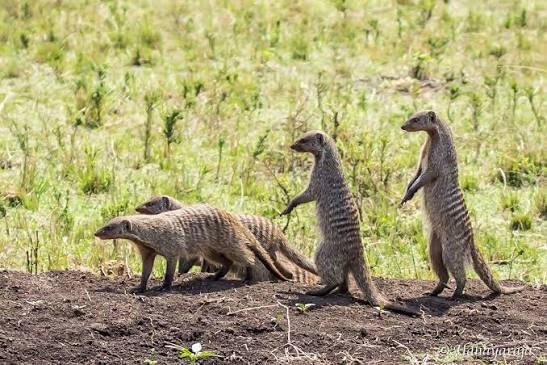
Dwarf mongooses frequently use raised structures as lookout points.
An individual may stand upright on top of a mound while other group members forage nearby.
This behaviour helps the group remain alert to approaching predators.
Banded mongooses can use suitable termite mounds as dens, particularly where accessible chambers provide shelter.
However, mongooses do not construct the termite mounds themselves.
They take advantage of structures originally created by insects.
Mongooses and Termite Mounds
| Behaviour | Advantage |
|---|---|
| Standing on the mound | Improved visibility |
| Using a cavity | Shelter |
| Resting near entrances | Access to cover |
| Group vigilance | Earlier detection of possible danger |
| Foraging nearby | Opportunities to find insects and other prey |
Mongooses may also use rock crevices, hollow logs and other suitable shelters.
5. Do Mongooses Eat the Termites?
Some mongooses eat termites, but their diets are much broader.
They may consume beetles, larvae, grasshoppers and other invertebrates.
Certain species also feed on small vertebrates and other available foods.
A mongoose standing on a termite mound is therefore not necessarily hunting termites.
It may simply be watching for danger.
Mongooses can benefit from the structure as a lookout point even when the termite colony remains active.
This distinction is important because a mound can serve several ecological functions at the same time.
6. Why Do Lizards Use Termite Mounds?
Lizards depend on environmental conditions to regulate their body temperature.
As ectothermic animals, they obtain much of their heat from external sources.
A termite mound can provide a mixture of exposed surfaces, shaded areas and hiding places.
A lizard may bask on a sunlit section before moving into nearby cover.
Cracks and abandoned cavities may offer refuge from predators or extreme conditions.
Mounds may also attract insects that some lizards feed upon.
Research on reptiles in several environments confirms that termite mounds can provide useful basking, refuge and feeding habitats.
However, not every African lizard species depends on termite mounds.
7. Can Termite Mounds Help Lizards Avoid Extreme Temperatures?
Large termite mounds may have more stable internal temperatures than the surrounding air.
A scientific study published in 2018 investigated temperature fluctuations inside African savannah termite mounds.
Researchers found that larger mounds generally maintained more stable internal temperatures than smaller structures.
This helps explain why mound cavities can represent distinctive microhabitats.
However, the conditions experienced by a lizard on the outer surface may differ greatly from those deep inside the nest.
A sun-exposed mound can become hot during the day.
Lizards must select suitable locations according to their temperature requirements.
8. Why Do Plants Grow Around Termite Mounds?
Termites move soil particles and organic material while constructing and maintaining their nests.
This activity can change the concentration and distribution of nutrients.
In some savannahs, mound soils contain more calcium, potassium, nitrogen and other nutrients than the surrounding ground.
Plants growing in these areas may therefore experience different soil conditions.
The result can be patches of vegetation that contrast with neighbouring grassland.
How Termite Activity Changes Soil
| Change | Possible Effect |
|---|---|
| Soil movement | Mixes materials from different depths |
| Nutrient concentration | Alters plant nutrient availability |
| Clay accumulation | Changes soil texture |
| Organic material processing | Supports nutrient cycling |
| Tunnel construction | May improve soil infiltration |
| Surface erosion | Spreads mound material into nearby soil |
These changes explain why researchers sometimes call mounds islands of fertility.
9. Are Termite Mounds Always More Fertile?
Not necessarily.
Their effects depend on termite species, geological conditions, mound size and surrounding soil.
A study published in 2017 found that large termite mounds in nutrient-poor granite landscapes could act as important fertility hotspots.
However, similar effects were less apparent in some basalt-derived soils.
This means that termite mounds are not universally richer than every surrounding habitat.
The impact must be considered in its ecological context.
For safari visitors, the practical lesson is that a mound may support unusually green or woody vegetation, but this cannot be assumed from appearance alone.
10. How Do Termite Mounds Support Trees and Shrubs?
Certain woody plants can establish on or near termite mounds.
Differences in soil nutrients, drainage and texture may provide favourable growing conditions.
Over time, some mound sites develop distinctive groups of trees or shrubs.
These plants can provide shade and shelter for other animals.
Their leaves may also attract browsing mammals.
In Uganda’s Lake Mburo landscape, thickets are frequently associated with termite mound sites.
However, some mound vegetation may be less attractive to browsers than plants growing elsewhere.
The relationship between termites, plants and herbivores is therefore complex.
11. Can Termite Mounds Attract Larger Wildlife?
Yes.
Termite mound vegetation can influence where grazing and browsing animals feed.
In some habitats, the surrounding plants contain nutrients that make them attractive to herbivores.
Animals may also visit mounds to consume mineral-rich soil, a behaviour known as geophagy.
A 2026 study in Lake Mburo National Park examined how grazing mammals consuming mound soil can influence mound properties.
This research demonstrates that the relationship works in both directions.
Termites change conditions for mammals, while mammals can also change the mound environment through their activities.
12. How Do Termite Mounds Support Insects and Their Predators?
Termite mounds can create productive patches within grassland habitats.
Higher plant productivity may support greater numbers of herbivorous insects.
These insects then provide food for spiders, lizards, birds and other predators.
A 2010 study of an African savannah found that insect abundance and biomass declined with increasing distance from termite mounds.
The study also documented changes in the abundance and reproductive output of insect-eating predators.
This suggests that the distribution of termite mounds can influence ecological productivity across an entire landscape.
13. Are Old Termite Mounds Still Useful?
Yes.
An abandoned termite mound may continue serving ecological functions long after its original colony has disappeared.
Its soil can retain distinctive chemical and physical properties.
Plants may continue growing around it.
Cracks and cavities may provide shelter for other animals.
However, abandoned mounds gradually change through erosion, vegetation growth and disturbance.
Some eventually collapse or become difficult to distinguish from surrounding soil.
The ecological value of an old mound depends on its condition and location.
14. Where Can You See Termite Mounds in East Africa?
Termite mounds occur in many East African savannah and woodland habitats.
Their shape and abundance vary with rainfall, soil, vegetation and termite species.
East African Safari Destinations
| Country | Destination | What to Look For |
|---|---|---|
| Uganda | Lake Mburo National Park | Mounds associated with savannah thickets |
| Uganda | Queen Elizabeth National Park | Termite structures in suitable grasslands |
| Uganda | Murchison Falls National Park | Mounds across woodland and savannah |
| Kenya | Maasai Mara ecosystem | Mounds and wildlife using raised lookout points |
| Kenya | Tsavo ecosystem | Structures in dry woodland habitats |
| Tanzania | Serengeti National Park | Mongooses and termite mound landscapes |
| Tanzania | Tarangire National Park | Large mounds in savannah woodland |
| Rwanda | Akagera National Park | Mounds in suitable savannah environments |
A guide can help distinguish active termite structures from eroded soil formations.
15. How to Observe Termite Mound Wildlife on Safari
Termite mounds reward patient observation.
Start by scanning the top for small animals standing upright.
Dwarf mongooses are particularly interesting because they may take turns keeping watch.
Look carefully along cracks and the mound base for lizards.
Observe surrounding shrubs and grasses to see whether vegetation differs from nearby areas.
Wildlife Observation Checklist
- Watch the mound summit for mongooses.
- Scan sunny surfaces for lizards.
- Examine nearby vegetation for unusual growth.
- Look for birds using raised perches.
- Keep a safe distance from possible animal dens.
- Avoid disturbing active termite colonies.
- Use binoculars or a telephoto lens for close observation.
Never break open a mound to see what lives inside.
16. Why Should Termite Mounds Be Protected?
Termite mounds contribute to healthy savannah ecosystems.
They support soil processes, create habitat variation and influence the distribution of plants and animals.
Destroying a mound can remove shelter and disturb the termite colony.
Repeated damage may also alter local soil and vegetation conditions.
While some termites can become agricultural pests, this does not mean that every mound is harmful.
In natural protected areas, termite activity is an important ecological process.
Conservation planning should recognise the value of the insects and the habitats they create.
Frequently Asked Questions
Why Do Mongooses Stand on Termite Mounds?
Raised mounds provide useful lookout points from which mongooses can watch for predators while other group members forage.
Do Lizards Live Inside Termite Mounds?
Some reptiles use suitable cracks, openings or abandoned cavities, while others use the outer surface for basking.
Are Termite Mounds Good for Plants?
They can be. Termites often alter soil nutrients and texture, creating favourable growing conditions for some plants.
Are All Termite Mounds Active?
No. Some contain living colonies, while others have been abandoned.
Do Termite Mounds Benefit Large Animals?
Yes. Their vegetation and mineral-rich soils can influence the feeding behaviour of grazing and browsing mammals.
Small Insects, Big Changes
Termite mounds are among the most remarkable structures in African savannah landscapes.
Although termites build them to support their colonies, the results extend far beyond the insects themselves.
Mongooses may use mounds as lookout points and shelters. Lizards can find useful basking surfaces, hiding places and feeding opportunities.
Plants can benefit from changes in soil nutrients, while larger herbivores may be attracted to the surrounding vegetation.
Scientific research shows that these structures can influence entire food webs by creating patches of productivity within grasslands.
For safari visitors, this transforms an ordinary-looking mound into something worth examining.




No comment