
How Elephants Dig for Water in Dry Riverbeds
The afternoon sun shines over Kenya’s Tsavo National Park. The riverbed ahead appears completely dry, with nothing but pale sand, scattered stones and a few patches of vegetation.
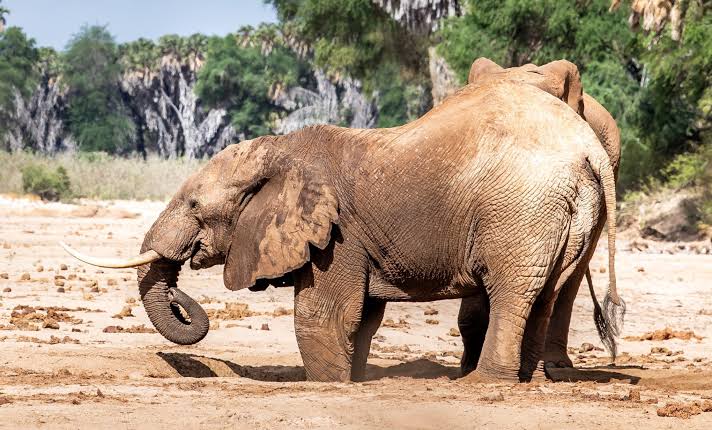
A large African elephant walks slowly across the sand, lowers its trunk and begins investigating the ground. After selecting a particular spot, it scrapes away sand with its feet and trunk. Gradually, a small depression appears.
The elephant continues digging until moisture begins collecting at the bottom. Soon, a shallow pool forms, and the animal draws water into its trunk before pouring it into its mouth.
This remarkable behaviour explains how elephants dig for water in dry riverbeds, one of the most impressive survival strategies found in Africa’s semi-arid landscapes.
Elephants do not always need a flowing river or visible waterhole to drink. Under suitable conditions, they can reach water trapped beneath layers of sand.
Their digging can also help other wildlife survive the dry season by exposing water that smaller animals cannot easily reach.
For travellers exploring Kenya’s Tsavo ecosystem and other African drylands, watching elephants create these temporary wells reveals their strength, adaptability and importance to the wider environment.
1. Why Do Elephants Dig for Water?
African elephants need regular access to substantial quantities of water.
Their drinking requirements vary according to body size, temperature, diet and activity.
During the rainy season, elephants may find water in rivers, seasonal pools and natural depressions.
However, when rainfall declines, many temporary water sources disappear.
Some seasonal rivers stop flowing altogether, leaving only sand and stones visible on the surface.
Water may still remain beneath the riverbed.
Elephants can sometimes reach this hidden supply by digging.
Interestingly, researchers have also documented elephants digging wells when surface water is available, suggesting that water quality may influence their choices.
2. How Can Water Exist Beneath a Dry Riverbed?
A river can appear dry even when water remains trapped beneath the surface.
During rainfall, water enters the river channel and moves through layers of sand and gravel.
Some remains in spaces between the grains after the visible flow stops.
This subsurface water may persist for weeks or months, depending on local conditions.
Surface Water vs Underground Water
| Feature | Surface Water | Water Beneath River Sand |
|---|---|---|
| Visibility | Usually visible | Hidden beneath sediment |
| Evaporation | Often exposed | Partly protected by sand |
| Access | Animals can drink directly | Digging may be required |
| Water quality | Can collect contamination | May be naturally filtered |
| Dry-season availability | May disappear | Can remain in suitable riverbeds |
Not every dry riverbed contains accessible water.
The depth of the water table, sediment type and previous rainfall determine whether digging will be successful.
3. How Do Elephants Find Hidden Water?
Elephants have an exceptionally strong sense of smell and remarkable sensitivity through their trunks.
They may investigate damp patches, familiar river channels and places where underground moisture is relatively close to the surface.
Experienced elephants also use knowledge of the landscape when moving between water sources.
Research on elephant movements in Kenya’s Tsavo ecosystem suggests that elephants possess information about the locations of dispersed water supplies.
However, scientists have not established that elephants can always smell underground water from a particular distance.
Their success probably involves several factors, including environmental cues, exploration and experience.
4. How Do Elephants Actually Dig a Well?
Elephants use a combination of physical strength and highly controlled trunk movements.
The process can involve several stages.
The Elephant Water-Digging Process
| Stage | What Happens |
|---|---|
| 1. Select a location | Elephant investigates a sandy area |
| 2. Loosen sediment | Feet or tusks disturb compacted material |
| 3. Remove sand | Trunk shifts loose sand and gravel |
| 4. Deepen the depression | Elephant continues excavating |
| 5. Expose saturated sand | Water begins seeping into the hole |
| 6. Collect water | Elephant draws water into its trunk |
| 7. Drink | Water is transferred into the mouth |
The exact technique varies with individual animals and ground conditions.
Some elephants rely heavily on their feet and trunks, while tusks may help loosen more compacted material.
5. How Do Elephant Trunks Help With Digging?
The elephant’s trunk combines strength with remarkable flexibility.
It contains a complex arrangement of muscles that allows the animal to lift, twist, pull and manipulate objects.
During digging, an elephant may use its trunk to push sand aside or investigate the bottom of a depression.
The trunk also acts as a powerful water-collecting organ.
Once sufficient water gathers, the elephant draws it into the trunk and transfers it to its mouth.
Contrary to a common misconception, elephants do not drink water directly through the trunk into their stomachs.
They use the trunk to collect and deliver water.
6. Do Elephants Dig With Their Tusks?
Yes, tusks can help elephants excavate compacted soil and sand.
They may be used to loosen material before the trunk or feet remove it.
However, tusks are not required for every water-digging action.
Researchers have documented elephants digging wells with their feet and trunks.
This matters because not every elephant has equally developed tusks.
Young elephants and some tuskless individuals may still be capable of moving loose sediment.
The exact technique depends on the animal and the physical characteristics of the riverbed.
7. How Deep Are Elephant-Dug Wells?
Elephant wells vary in depth.
Some are shallow depressions that expose water only a short distance below the surface.
Others can reach approximately one metre or more under suitable conditions.
The depth depends on the water table, the type of sediment and how much digging is necessary.
In Namibia, researchers documented elephant wells reaching depths of around one metre.
These are not permanent engineered wells.
They are temporary excavations that may collapse, fill with sediment or dry out as conditions change.
8. Why Do Elephants Sometimes Prefer Water They Have Dug?
At first, digging a well beside an existing pool might seem unnecessary.
However, research suggests that water quality can help explain the behaviour.
A study of desert-dwelling African elephants in Namibia compared water collected from elephant-dug wells with water from nearby surface sources.
The researchers found evidence that elephant wells could provide water with lower levels of faecal bacterial contamination.
Sand can act as a natural filter as water moves through it.
This suggests that digging may provide access to cleaner water under certain conditions.
However, underground water is not automatically safe or free from harmful microorganisms.
9. What Did Research in Tanzania Discover?
Scientists studying large mammals in Tanzania’s Ruaha National Park investigated wildlife digging behaviour during three dry seasons.
The research took place between 2011 and 2013.
Elephants, zebras, warthogs and yellow baboons were recorded digging for water.
Several additional species drank from the resulting holes.
The researchers found that digging became more likely when river water stopped flowing.
It was also associated with higher bacterial contamination in available surface water.
Importantly, animals sometimes dug even when surface water remained.
These findings support the idea that water quality, rather than simple absence of water, can influence digging behaviour.
10. Why Are Elephant Wells Important to Other Animals?
Elephant-dug wells can benefit animals that would struggle to excavate deep holes themselves.
Once an elephant leaves, smaller mammals and birds may approach the exposed water.
The wells can become especially valuable when other drinking places are scarce.
Wildlife That May Benefit
| Animal Group | Possible Benefit |
|---|---|
| Antelopes | Access to exposed drinking water |
| Zebras | Additional water source |
| Warthogs | Drinking and use of excavated pools |
| Baboons | Access to water in dry habitats |
| Smaller mammals | Use of shallow exposed water |
| Birds | Drinking where water is accessible |
Access depends on well depth and shape.
A deep, steep-sided excavation may be difficult or unsafe for some smaller animals to use.
11. Why Are Elephants Called Ecosystem Engineers?
An ecosystem engineer is an organism that changes its surroundings in ways that influence other species.
Elephants are classic examples.
They open vegetation, move seeds, disturb soil and create paths through habitats.
Water digging provides another example.
By exposing underground water, elephants can create temporary drinking opportunities that did not previously exist at the surface.
These benefits can extend beyond the elephants themselves.
Their influence is especially noticeable during dry periods when water becomes scarce.
12. Do Elephant Families Learn Where to Dig?
Elephants have long lives and complex social relationships.
Older females, particularly experienced matriarchs, can hold valuable knowledge about seasonal resources.
Research has shown that elephant family leadership can influence responses to environmental challenges.
Young elephants also spend years observing older family members.
It is therefore reasonable to consider how experience may influence the selection of digging locations.
However, scientific studies have not established a complete, universal process by which every elephant learns well-digging from its mother.
Both individual exploration and social experience may contribute.
13. Do Baby Elephants Try to Dig for Water?
Young elephants are naturally curious and frequently investigate the environment with their trunks.
They may move sand, splash water or imitate some activities performed by adults.
A calf standing beside its mother at a dry riverbed may investigate the newly exposed water.
However, very young calves do not possess the same strength or trunk coordination as mature elephants.
Their ability to handle sand and collect water improves as they grow.
Watching these interactions can provide an interesting perspective on calf development.
14. Where Can Visitors See Elephants Digging for Water?
Kenya’s Tsavo ecosystem is one of the best-documented places for this behaviour.
Researchers have recorded elephants digging wells in seasonal riverbeds, including the Voi and Mbololo systems.
Other suitable semi-arid habitats may also provide opportunities.
Wildlife Destinations and Research Areas
| Destination | Country | Significance |
|---|---|---|
| Tsavo East National Park | Kenya | Documented elephant wells in seasonal riverbeds |
| Tsavo West ecosystem | Kenya | Dryland elephant habitats and seasonal watercourses |
| Samburu region | Kenya | Semi-arid landscapes where elephants depend on seasonal water |
| Ruaha National Park | Tanzania | Scientific records of wildlife digging for water |
| Northwestern Namibia | Namibia | Well-studied elephant water excavation |
These locations are not guarantees of a sighting.
The behaviour depends on rainfall, groundwater levels and the availability of surface water.
15. What Happens During Severe Drought?
Drought reduces surface water and can place considerable pressure on elephant populations.
Animals may travel farther between feeding and drinking areas.
Where subsurface water remains accessible, digging may help them survive.
However, this behaviour has limits.
If the water table falls too deeply or riverbed sediments are unsuitable, elephants may be unable to reach sufficient water.
A prolonged drought can also reduce food supplies.
Water-digging is therefore an important adaptation, but it cannot protect elephants from every consequence of severe drought.
16. Can Elephant Wells Help People and Livestock?
In some dryland communities, people have historically recognised the value of water exposed by elephants.
Herders may use accessible water sources in seasonal riverbeds for livestock.
However, sharing water sources can also create risks and competition.
Elephants are dangerous to approach at close range, especially when drinking.
Wildlife wells may also contain contaminated water unsuitable for human consumption without testing and treatment.
Human use should follow local safety and conservation guidance.
Protecting natural water systems is important for both wildlife and neighbouring communities.
17. What Are Sand Dams, and How Do They Help?
A sand dam is a structure built across a suitable seasonal river channel to help retain water within accumulated sand.
During rainfall, sediment collects upstream of the structure.
Water remains stored between sand particles as surface flow declines.
In Kenya’s Tsavo Conservation Area, Tsavo Trust has worked with partners to construct sand dams intended to improve dry-season water availability.
Elephants may excavate these sandy deposits to reach stored water.
Sand Dam Benefits
| Benefit | Explanation |
|---|---|
| Water storage | Retains water within sand |
| Reduced evaporation | Water is sheltered beneath the surface |
| Wildlife access | Elephants can dig into suitable deposits |
| Habitat support | May improve nearby vegetation conditions |
| Community resilience | Can support managed water availability |
Sand dams require suitable locations and careful planning.
They are not a universal solution to drought.
18. Do Elephants Dig Waterholes in Other Ways?
Yes. Elephants can also create or enlarge depressions by digging into soil.
In Tsavo, conservationists have observed elephants excavating abandoned termite mounds while seeking minerals.
Over time, these depressions can become larger.
When rain falls, some fill with water and become temporary drinking or bathing places.
This is different from digging down to subsurface water within a dry riverbed.
Both behaviours demonstrate how elephants reshape their environment.
19. How to Photograph Elephants Digging for Water
Elephant well-digging is an unusual wildlife photography opportunity.
The most rewarding photographs show the entire sequence rather than one isolated movement.
Watch how the elephant investigates the ground, removes sand and collects water.
A longer lens allows photography from a safe distance.
Photography Tips
- Remain inside the safari vehicle where required.
- Use a telephoto lens to avoid approaching.
- Photograph the movement of sand from the trunk.
- Capture the elephant collecting water.
- Include the dry riverbed to show the habitat.
- Keep a safe distance from calves and family groups.
- Never block an elephant’s route to water.
Do not ask your guide to drive into a dry riverbed or approach an elephant closely for a photograph.
20. Why Protecting Dry Riverbeds Matters
Seasonal riverbeds may look empty, but they can contain essential water reserves.
They also provide movement corridors, shade and feeding habitat for wildlife.
Human activities such as excessive water extraction, sand removal and poorly planned infrastructure can affect these systems.
Conservation planning must therefore protect both visible rivers and the underground water stored in seasonal channels.
For elephants, maintaining access to these habitats supports movement and survival during dry periods.
For other animals, the benefits may extend to temporary water sources created through elephant digging.
Protecting elephants also helps preserve their role as ecosystem engineers.
Frequently Asked Questions
Can Elephants Really Dig Water From Dry Sand?
Yes. Elephants can excavate sandy riverbeds to expose water stored beneath the surface.
How Do Elephants Know Where Water Is?
They may use environmental cues, their sense of smell, exploration and knowledge of familiar water sources. The precise mechanisms are still being studied.
Do Elephants Dig With Their Trunks or Tusks?
They can use their trunks, feet and sometimes tusks, depending on the conditions.
Why Do Elephants Dig When Water Is Already Available?
Studies suggest that water exposed through sand may sometimes contain fewer bacteria than nearby surface pools.
Do Other Animals Drink From Elephant Wells?
Yes. Research has documented several wildlife species using wells excavated by elephants and other animals.
Elephants as Nature’s Water Finders
Elephants are among the most remarkable survivors of Africa’s dryland ecosystems.
Their ability to dig into apparently dry riverbeds reveals an extraordinary combination of physical strength, environmental awareness and flexible behaviour.
By using their feet, trunks and sometimes tusks, they expose water that can remain hidden beneath the sand long after a river stops flowing.
Scientific research also suggests that these wells may provide access to water with less bacterial contamination than some surface sources.
Perhaps most importantly, elephants do not always benefit alone.
The temporary wells they create can provide drinking opportunities for antelopes, zebras, birds and other wildlife.
For safari travellers exploring Tsavo or other African drylands, witnessing this behaviour is a reminder that elephants influence the landscape in ways that go far beyond their enormous size.





No comment