
Hirola: One of Africa’s Rarest Antelopes and the Fight to Save It
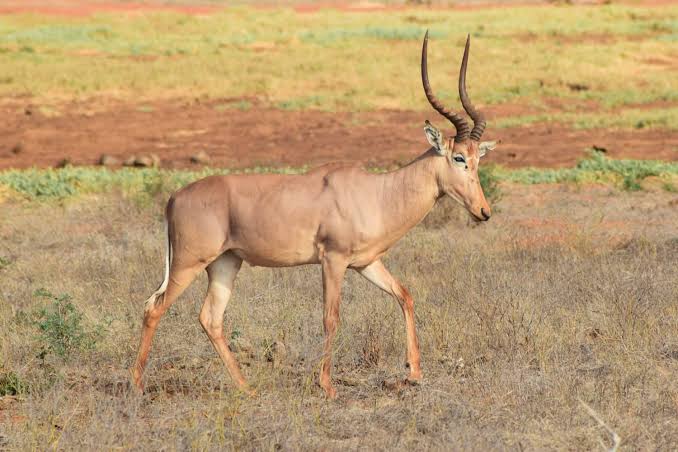
In the dry grasslands of Kenya’s Garissa County, a small group of antelopes moves quietly between scattered bushes. Their sandy-brown coats blend into the surrounding landscape, but their long, dark horns and distinctive white markings around the eyes make them immediately recognisable.
These are hirolas, among the rarest mammals in Africa.
Unlike the impalas and gazelles regularly encountered during East African safaris, hirolas survive in remarkably small numbers. Their natural range has contracted, and the species faces serious threats from habitat change, drought, predation and historical population declines.
Yet the hirola antelope conservation efforts in Kenya offer reasons for cautious hope.
Local communities, researchers and wildlife organisations are restoring grazing habitats, protecting breeding populations and working to secure the future of this extraordinary species.
This guide explores what makes the hirola unique, why its population declined and how conservation programmes are fighting to prevent its extinction.
1. What Is a Hirola Antelope?
The hirola (Beatragus hunteri) is a medium-sized antelope native to northeastern Kenya and historically neighbouring southern Somalia.
It belongs to the family Bovidae and is sometimes called Hunter’s hartebeest.
Although it resembles a hartebeest, it is classified in its own genus, Beatragus.
This makes it particularly important from an evolutionary perspective.
Hirola Quick Facts
| Feature | Description |
|---|---|
| Common name | Hirola |
| Other name | Hunter’s hartebeest |
| Scientific name | Beatragus hunteri |
| Conservation status | Critically Endangered |
| Natural range | Eastern Kenya and historically southern Somalia |
| Main habitat | Dry grassland and open savannah |
| Diet | Primarily grasses |
| Horns | Present in both sexes |
| Distinctive feature | White markings around the eyes |
| Major conservation area | Ishaqbini Community Conservancy |
The species is one of East Africa’s most important conservation priorities.
2. How Can You Identify a Hirola?
Hirolas have slender bodies, relatively long legs and sandy-brown coats.
Their faces feature distinctive white lines around the eyes, creating an appearance sometimes compared to spectacles.
This is why they are occasionally described as spectacled antelopes.
Their horns are dark, strongly ridged and curve upwards.
Both males and females carry horns, although males generally have heavier ones.
The ears are relatively long, and the animal’s overall appearance resembles a smaller, more delicate hartebeest.
Main Identification Features
| Body Feature | Appearance |
|---|---|
| Coat | Sandy-brown to reddish-tan |
| Face | Pale markings around the eyes |
| Horns | Dark, ridged and curved |
| Body | Slim and long-legged |
| Underside | Paler than the back |
| Ears | Long and pointed |
These characteristics are particularly useful when identifying hirolas in wildlife photographs.
3. Where Do Hirolas Live?
The hirola’s natural range is concentrated in eastern Kenya, particularly Garissa County near the Kenya–Somalia border.
Historically, the species also occurred in southern Somalia.
However, reliable information about its present status there is limited.
Its preferred habitat includes open grasslands with scattered bushes and relatively low tree cover.
Hirolas depend on suitable grazing vegetation and are adapted to semi-arid environments.
A separate population was introduced to Tsavo East National Park in Kenya as part of earlier conservation efforts.
Important Hirola Conservation Locations
| Location | Conservation Importance |
|---|---|
| Garissa County | Core natural range |
| Ishaqbini Community Conservancy | Community-led habitat protection |
| Ishaqbini Hirola Sanctuary | Protected breeding population |
| Arawale area | Historic range and restoration efforts |
| Tsavo East National Park | Translocated conservation population |
Hirola sightings should never be considered guaranteed, even within these areas.
4. Why Are Hirolas So Rare?
The species experienced a dramatic population collapse during the twentieth century.
Historical accounts suggest that the population numbered approximately 10,000–15,000 animals during the 1970s.
A severe decline occurred during the 1980s.
Disease outbreaks, including rinderpest, contributed to the collapse, alongside wider environmental pressures.
The surviving population became small and fragmented.
Further threats continued to restrict its recovery.
Today, the species remains highly vulnerable because a relatively small number of animals occupy a limited geographical area.
5. How Many Hirolas Are Left?
Conservation organisations generally estimate that fewer than 500 hirolas remain.
However, an exact global population figure is difficult to establish.
The animals occupy extensive, sometimes remote landscapes, making comprehensive counting challenging.
Different surveys also use different dates and methods.
Understanding Hirola Population Figures
| Period | Reported Situation |
|---|---|
| 1970s | Population estimated in the thousands |
| 1980s | Severe decline |
| Early 2000s | Small surviving populations |
| 2012 | Protected breeding sanctuary established |
| Recent conservation assessments | Global population estimated below 500 |
These figures should not be interpreted as a continuous annual census.
The exact number changes with births, deaths, surveys and conservation management.
6. What Are the Main Threats to Hirolas?
Hirolas face several connected conservation challenges.
Their survival depends on suitable grassland, limited disturbance and successful reproduction.
Major Threats
| Threat | Possible Effect |
|---|---|
| Habitat degradation | Reduces suitable grazing |
| Bush encroachment | Converts open grassland into denser vegetation |
| Drought | Reduces food and increases mortality risk |
| Predation | Threatens small populations |
| Illegal hunting | Removes breeding individuals |
| Livestock pressure | Can increase competition for resources |
| Small population size | Increases vulnerability to local losses |
These pressures can interact.
For example, drought may reduce available grass and concentrate animals in smaller areas where predation risks increase.
7. Why Is Bush Encroachment a Serious Problem?
One of the hirola’s most important habitat requirements is open grassland.
In some areas, shrubs and trees have gradually expanded into former grazing habitats.
This process is called bush encroachment.
As grassland becomes denser, suitable feeding areas decline.
Hirolas may have difficulty obtaining enough nutritious grass.
Researchers and conservationists have therefore identified vegetation restoration as an important part of the species’ recovery.
However, removing woody plants requires careful ecological planning.
The goal is to restore suitable habitat without damaging other important wildlife communities.
8. What Do Hirolas Eat?
Hirolas are primarily grazers.
They feed mainly on grasses found in semi-arid savannah ecosystems.
Their feeding behaviour is influenced by rainfall, vegetation quality and seasonal availability.
Fresh grass growth can provide important nutrition.
When suitable grass becomes scarce, survival and reproduction may become more difficult.
Feeding Requirements
| Requirement | Importance |
|---|---|
| Open grassland | Provides primary feeding habitat |
| Suitable grass species | Supports nutrition |
| Seasonal rainfall | Influences plant growth |
| Habitat connectivity | Allows movement between feeding areas |
| Reduced disturbance | Supports regular feeding |
Protecting the hirola therefore requires protecting the landscape, not only individual animals.
9. How Do Hirolas Live in Groups?
Hirolas may form small social groups containing females and their young.
Males can defend territories, especially during reproductive activity.
The exact group structure varies with season and habitat conditions.
Young males may associate outside established breeding groups.
Like other antelopes, hirolas use alertness, movement and social behaviour to respond to potential threats.
However, their small population makes detailed behavioural research difficult.
Observations must therefore be interpreted carefully rather than assuming they behave exactly like more common hartebeests.
10. How Do Hirolas Reproduce?
Female hirolas generally give birth to a single calf after a pregnancy of approximately eight months.
Young calves depend on their mothers for milk and protection.
They gradually begin feeding on vegetation while developing the strength needed to move with other animals.
Successful reproduction is essential for population recovery.
However, births alone do not guarantee growth.
Calves must survive drought, predators and other environmental pressures.
Conservation teams therefore monitor breeding success alongside overall population numbers.
11. What Is Ishaqbini Hirola Sanctuary?
Ishaqbini Hirola Sanctuary is one of the most important conservation projects for the species.
Located within Ishaqbini Community Conservancy in eastern Kenya, the sanctuary was established in 2012.
Its purpose was to provide a safer breeding environment for a small founder population.
Approximately 48 hirolas were introduced to the fenced sanctuary.
The protected area was designed to reduce the impact of large predators and other immediate threats.
The population subsequently increased, demonstrating the potential of carefully managed protection.
However, later droughts, population management and releases into surrounding habitat have caused changes in the numbers remaining inside the enclosure.
12. Has the Sanctuary Been Successful?
Yes, the sanctuary has achieved important breeding results.
The founder population increased substantially after protection measures were introduced.
However, conservation success cannot be measured by one population figure alone.
Animals released outside the protected enclosure may encounter predators and other hazards.
Drought can also affect survival.
This means the sanctuary’s long-term success depends on establishing healthy populations in suitable natural habitat.
Conservation Progress
| Achievement | Significance |
|---|---|
| Establishment of breeding sanctuary | Protected founder animals |
| Successful births | Increased population potential |
| Wildlife monitoring | Improved conservation information |
| Habitat restoration | Supports long-term grazing |
| Community ranger programmes | Strengthened local protection |
| Planned reintroductions | May help restore natural populations |
Maintaining genetic diversity and reducing mortality remain major priorities.
13. How Are Local Communities Helping?
Community participation is central to hirola conservation.
Ishaqbini Community Conservancy was established through the efforts of local communities seeking to protect wildlife and improve livelihoods.
Community members participate in habitat management, wildlife monitoring and protection activities.
Conservation initiatives have also supported education, water access and livelihood projects.
This approach recognises that effective wildlife protection depends on cooperation with people living alongside endangered species.
When communities benefit from healthy ecosystems, conservation can become more sustainable.
14. What Is the Hirola Conservation Programme?
The Hirola Conservation Programme is a Kenya-based organisation dedicated to preventing the extinction of the species.
Its work combines scientific research, local partnerships and direct habitat protection.
Key activities include grassland restoration, monitoring, anti-poaching efforts and environmental education.
The programme also supports research into habitat change and the threats affecting free-ranging populations.
Its long-term aim is to create conditions in which hirolas can survive and reproduce beyond fenced sanctuaries.
15. Can Hirolas Be Reintroduced to the Wild?
Reintroduction is one possible conservation strategy.
Animals raised in protected areas may eventually be released into carefully selected habitats.
However, the process carries risks.
A hirola that has spent much of its life without exposure to large predators may respond differently after release.
Researchers are studying predator awareness and behaviour to improve future reintroductions.
Appropriate habitat, population monitoring and community support are also essential.
Reintroduction should therefore be understood as a carefully managed process rather than simply opening a sanctuary gate.
16. Why Is Losing the Hirola Especially Serious?
The hirola is the only surviving member of the genus Beatragus.
If the species disappears, its entire living genus would also become extinct.
That makes its protection particularly important.
The loss would remove a distinct part of Africa’s evolutionary and ecological heritage.
It would also represent the disappearance of a specialised grazing animal from an already threatened landscape.
Conserving the hirola helps protect the broader grassland environment and other species that depend on it.
17. Can Tourists See Hirolas in Kenya?
Seeing a hirola is much more difficult than observing common antelopes in the Maasai Mara or Amboseli.
Its natural range lies mainly in remote parts of eastern Kenya.
Tourist infrastructure is limited, and access to conservation areas may require advance permission.
Specialist conservation visits may sometimes be possible through authorised arrangements.
However, the welfare of the animals must remain the priority.
Visitors should never enter restricted breeding areas or encourage disturbance for photographs.
A general Kenyan safari itinerary should not promise a hirola sighting.
18. How Can Travellers Help Save the Hirola?
Tourists can contribute to conservation even without visiting the species’ habitat.
Supporting credible organisations helps fund monitoring, ranger operations, community programmes and grassland restoration.
Travellers can also promote awareness of the species through responsible wildlife education.
Practical Ways to Support Conservation
- Learn about the hirola and its conservation status.
- Support established conservation organisations.
- Respect restricted wildlife habitats.
- Choose responsible safari operators.
- Share accurate information about threatened species.
- Support community-led habitat protection.
- Avoid activities that disturb breeding animals.
Conservation is most effective when it benefits both wildlife and neighbouring communities.
19. Hirola vs Hartebeest: What Is the Difference?
The hirola resembles a hartebeest, which explains its alternative name, Hunter’s hartebeest.
However, it is classified in a separate genus.
Hirola and Hartebeest Comparison
| Feature | Hirola | Common Hartebeest |
|---|---|---|
| Scientific genus | Beatragus | Alcelaphus |
| Conservation status | Critically Endangered | Varies by species or subspecies |
| Main range | Eastern Kenya and historically Somalia | Several African regions |
| Facial appearance | Distinctive pale eye markings | Long face without the same spectacled pattern |
| Habitat | Dry grassland | Savannah grassland |
| Safari sightings | Extremely rare | More accessible in suitable parks |
These differences help explain why seeing a hirola is a particularly unusual wildlife experience.
20. Frequently Asked Questions
Is the Hirola the Rarest Antelope in Africa?
It is among the world’s rarest antelopes and is frequently described as one of the most endangered.
Where Are Hirolas Found?
Their natural range is concentrated in eastern Kenya, with a historic distribution extending into southern Somalia. A translocated population also exists in Tsavo East.
Why Are Hirolas Endangered?
Historical disease-related losses, habitat degradation, bush encroachment, drought, predation and other pressures have contributed to their decline.
How Many Hirolas Are Left?
Conservation organisations generally estimate fewer than 500 individuals, although current numbers are uncertain.
Can Hirolas Recover?
Recovery is possible, but it depends on successful breeding, habitat restoration, protection and long-term conservation management.
Saving One of Africa’s Last Great Antelope Lineages
The hirola is one of Africa’s most remarkable and threatened antelopes.
Its beautiful facial markings, graceful horns and unusual evolutionary history make it a special part of East Africa’s wildlife heritage.
Yet its survival has become increasingly uncertain after decades of population decline.
The work of community conservancies, researchers and conservation organisations is helping address the threats.
Protected breeding areas have demonstrated that populations can increase under suitable conditions.
The next challenge is securing healthy, self-sustaining populations across the hirola’s natural grasslands.




No comment