
Black-Backed Jackals: Small Predators Worth Watching
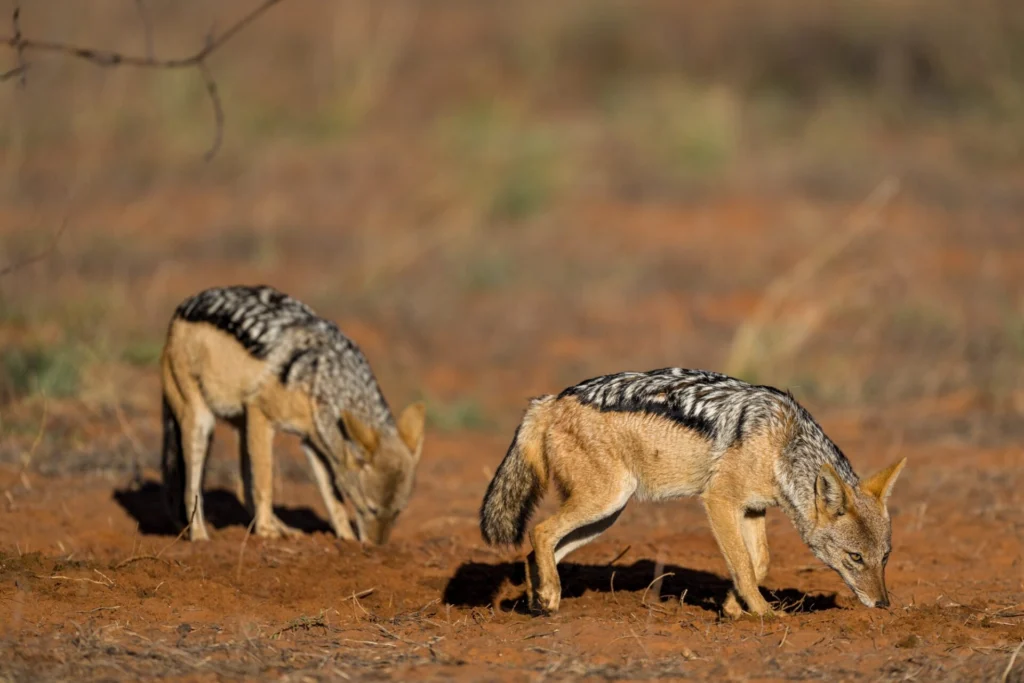
The morning sun rises over Kenya’s Maasai Mara, where a small, reddish-brown animal moves carefully through the grass. Its large ears point forward, and a dark saddle of fur stretches across its back. While nearby safari vehicles concentrate on lions, this alert predator searches the ground for its next meal.
Black-backed jackals on safari are among East Africa’s most interesting but frequently overlooked carnivores. Although much smaller than lions, leopards and hyenas, these animals are intelligent hunters, devoted parents and highly adaptable survivors.
Their lives involve territorial partnerships, cooperative hunting, scavenging and raising young in challenging environments. Watching a jackal for several minutes can reveal fascinating details about how smaller predators survive alongside Africa’s famous big cats.
1. What Is a Black-Backed Jackal?
The black-backed jackal, scientifically known as Lupulella mesomelas, is a medium-sized wild canine native to eastern and southern Africa.
Older scientific publications use the name Canis mesomelas, which travellers may still encounter in wildlife books.
Its most distinctive feature is a black-and-silver saddle extending from the shoulders towards the tail.
The rest of the body is generally reddish-brown, with lighter colouring underneath.
Black-backed jackals have long legs, pointed ears, narrow muzzles and bushy tails.
Adults generally weigh approximately 6–12 kilograms, making them considerably smaller than spotted hyenas.
2. How to Identify a Black-Backed Jackal
Black-backed jackals can resemble small foxes or domestic dogs when seen from a distance.
However, their coat pattern provides an excellent identification clue.
Main Physical Features
- Black-and-silver saddle across the back.
- Reddish-brown legs and sides.
- Large, pointed ears.
- Narrow muzzle.
- Slender body.
- Bushy tail with a dark tip.
- Alert, quick movements.
The dark saddle is usually visible even when the animal stands partly hidden in grass.
Its colouring helps it blend into dry savannah vegetation.
3. Why Are Black-Backed Jackals Successful Predators?
Unlike specialised predators that rely on a narrow range of prey, black-backed jackals can exploit many different food sources.
They hunt small animals, scavenge from carcasses and consume seasonal plant foods.
This dietary flexibility helps them survive when particular prey becomes scarce.
Their keen hearing and sense of smell assist them in locating food.
They can also adjust their movements according to local conditions and competition from larger carnivores.
These characteristics explain why black-backed jackals occupy such varied habitats.
4. What Do Black-Backed Jackals Eat?
Black-backed jackals are opportunistic omnivores.
They consume a wide range of animal and plant foods depending on availability.
| Food | Typical Feeding Behaviour |
|---|---|
| Rodents | Caught through stalking and pouncing |
| Hares | Pursued individually or occasionally cooperatively |
| Insects | Collected from vegetation and the ground |
| Birds and eggs | Taken when opportunities arise |
| Small antelopes | Sometimes hunted cooperatively |
| Carrion | Scavenged from carcasses |
| Fruits and berries | Eaten when available |
Jackals may also feed on remains left by lions, cheetahs and other predators.
However, describing them only as scavengers would be inaccurate.
They are capable hunters in their own right.
5. Do Black-Backed Jackals Hunt Together?
Yes. Black-backed jackals sometimes cooperate when hunting.
A mated pair may search for food together and coordinate movements while pursuing prey.
Larger prey can provide opportunities for cooperation, although many hunts involve individual animals.
For example, one jackal may distract prey while another attempts to approach from a different direction.
However, jackals do not always follow organised hunting strategies.
Their behaviour depends on prey size, terrain and the number of participating animals.
6. Why Do Jackals Follow Lions and Other Predators?
Black-backed jackals occasionally appear near large predator kills.
A lion pride feeding on a wildebeest may attract jackals hoping to collect scraps.
These smaller carnivores remain alert because lions and hyenas can pose serious threats.
Jackals often wait for opportunities rather than attempting to challenge larger animals directly.
Their ability to exploit leftovers reduces food waste within the ecosystem.
What Can Safari Visitors Observe?
Near a large carcass, you may notice jackals:
- Watching larger predators from a distance.
- Moving cautiously around feeding animals.
- Searching for discarded pieces of meat.
- Retreating when threatened.
- Returning after larger predators leave.
These interactions reveal how different carnivore species share food resources.
7. Black-Backed Jackals Form Strong Pair Bonds
One of the most interesting aspects of black-backed jackal behaviour is their social organisation.
Adult males and females commonly establish long-term pair bonds.
Mated partners cooperate in defending territories, finding food and raising pups.
Both individuals may participate in scent marking and responding to intruders.
Their partnership differs from the large clans formed by spotted hyenas.
Why Is Pair Cooperation Important?
Working together can improve territorial defence and parental care.
When pups are born, both parents contribute to feeding and protection.
A stable partnership can therefore provide important advantages during reproduction.
However, not every jackal lives permanently with a partner, and social arrangements can change.
8. How Black-Backed Jackals Raise Their Pups
Jackal pups are usually born in sheltered dens.
These may include underground burrows or protected spaces beneath vegetation.
A litter commonly contains several pups.
During their earliest weeks, the young remain close to the den while their parents search for food.
As they grow, pups begin exploring, playing and learning important behaviours.
Older offspring sometimes remain with their parents and help care for younger siblings.
This cooperative family structure can improve pup survival.
9. How Do Jackals Communicate?
Black-backed jackals communicate through vocalisations, scent marking and body language.
Their calls include yelps, howls, barks and other sounds.
Pairs may produce vocal exchanges that help maintain contact or advertise their territory.
Scent markings also provide information to neighbouring jackals.
Common Jackal Signals
| Signal | Possible Function |
|---|---|
| Howling | Long-distance contact and territorial communication |
| Barking | Alarm or agitation |
| Yelping | Social communication |
| Scent marking | Territorial advertisement |
| Tail and ear movements | Communication during interactions |
A particular sound may serve different purposes depending on the situation.
10. Black-Backed Jackals vs Side-Striped Jackals
East Africa supports more than one jackal species.
Black-backed and side-striped jackals can be confused by inexperienced visitors.
| Feature | Black-Backed Jackal | Side-Striped Jackal |
|---|---|---|
| Back markings | Distinct black-and-silver saddle | Pale horizontal stripe along each side |
| Body colour | Reddish-brown | Generally greyish |
| Habitat | Often open savannah and woodland | Often more wooded or moist habitats |
| Feeding | Strongly opportunistic, often carnivorous | Broad omnivorous diet |
| Appearance | Contrasting dark saddle | More subdued colouring |
The coat pattern is usually the most reliable field identification clue.
11. Where Can You See Black-Backed Jackals in East Africa?
Several East African safari destinations provide opportunities to observe these small predators.
| Destination | Country | Viewing Habitat |
|---|---|---|
| Maasai Mara National Reserve | Kenya | Open grassland and savannah |
| Amboseli National Park | Kenya | Grasslands and scattered woodland |
| Serengeti National Park | Tanzania | Extensive plains and woodland |
| Ngorongoro Conservation Area | Tanzania | Grassland and open habitats |
| Tarangire National Park | Tanzania | Savannah and woodland |
Black-backed jackals also occur in parts of Uganda, but sightings are more localised and less predictable than in some well-known Kenyan and Tanzanian safari areas.
Travellers should confirm recent sightings with their guides.
12. What Is the Best Time to See Jackals?
Black-backed jackals may be active during daylight and at night.
Early morning and late afternoon are useful periods for observation.
During cooler hours, visitors may see them travelling, searching for food or interacting with partners.
Their activity depends on temperature, food availability and disturbance.
In some areas, jackals become more nocturnal when human activity or competition increases.
There is no particular season that guarantees sightings.
13. Why Are Jackals Important to the Ecosystem?
Although smaller than many famous predators, jackals contribute to healthy ecosystems.
They help regulate populations of small prey animals and consume carrion.
Their feeding activities connect different parts of the savannah food web.
Jackals may also compete with other small carnivores for food.
These ecological roles demonstrate why protecting biodiversity requires attention to more than Africa’s largest mammals.
Small predators are important parts of the same habitats supporting lions, elephants and antelopes.
14. Are Black-Backed Jackals Endangered?
The black-backed jackal is currently classified as Least Concern on the IUCN Red List.
Its broad diet and adaptability help the species survive in different environments.
However, local populations may face threats from persecution, road accidents, disease and conflict with livestock owners.
Some jackals are killed because they occasionally prey on domestic animals.
Conservation approaches that reduce livestock losses while protecting wildlife are important.
15. Tips for Photographing Black-Backed Jackals
Jackals are attractive photography subjects because of their pointed ears, alert expressions and distinctive coats.
During a safari:
- Watch open grasslands and road edges carefully.
- Use optical zoom rather than approaching closely.
- Photograph the dark saddle when visible.
- Look for pairs interacting naturally.
- Remain quiet during hunting behaviour.
- Never use food to attract animals.
- Avoid approaching occupied dens.
Patience can reveal interesting moments involving feeding, communication and family relationships.
Why Jackals Deserve Your Attention
Black-backed jackals are among Africa’s most adaptable small predators.
Their distinctive markings, strong pair bonds, cooperative parental care and flexible feeding habits make them fascinating animals to observe.
Although they rarely receive the attention given to lions and leopards, jackals play important roles in savannah ecosystems.
The next time your safari vehicle passes a small reddish-brown canine moving through the grass, ask your guide to stop and observe.
Sometimes the smaller predators reveal just as much about life in the African wilderness as the biggest carnivores.





No comment