
Spotted Hyena Clans: Why Females Run the Group
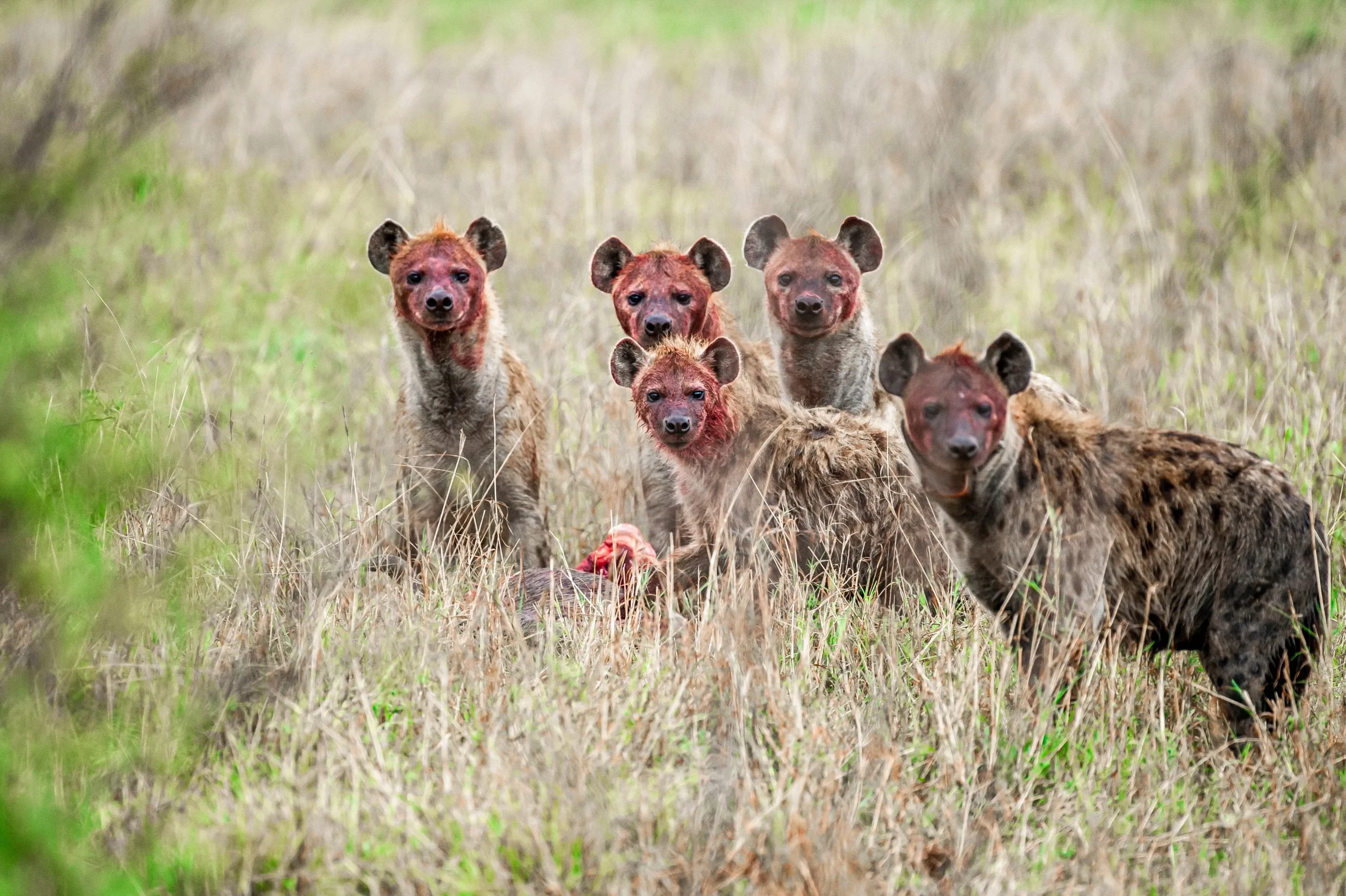
The morning sun rises over Kenya’s Maasai Mara, where a group of spotted hyenas gathers around a freshly killed wildebeest. Several adults compete for access to the meat, while younger animals wait nearby. Suddenly, a large female approaches, and another hyena moves aside. Although a male is standing nearby, he makes no attempt to challenge her.
Understanding spotted hyena clan behaviour reveals one of Africa’s most remarkable animal societies. Unlike many other large carnivores, spotted hyenas live in female-dominated groups where social position, family relationships and cooperation strongly influence daily life.
Female hyenas are generally larger than males, but physical strength alone does not explain their dominance. Research has shown that inherited social rank, maternal support and relationships between clan members play important roles.
For safari travellers, observing these interactions offers a fascinating introduction to the social lives of one of Africa’s most misunderstood predators.
1. What Is a Spotted Hyena Clan?
Spotted hyenas, scientifically known as Crocuta crocuta, live in organised social groups called clans.
A clan contains several adult females, their offspring and adult males.
Group size varies considerably according to habitat, food availability and local conditions. Some clans contain fewer than twenty individuals, while large groups can exceed eighty.
Unlike lion prides, spotted hyena clans have a flexible social structure.
Members frequently travel, hunt and rest in smaller groups before gathering with other clan members.
This arrangement is called a fission-fusion society.
Although individuals may spend time apart, they recognise clan companions and maintain long-term social relationships.
2. Why Do Female Hyenas Dominate Males?
Female dominance is one of the most distinctive characteristics of spotted hyena society.
In established clans, adult females generally outrank adult males that have immigrated from other clans.
This social position gives females priority during many competitive interactions, particularly around food.
However, females do not dominate simply because they are physically larger.
The Importance of Social Support
Researchers have discovered that social relationships help determine dominance.
High-ranking females receive support from relatives and other allies during conflicts.
Young hyenas learn which individuals they can challenge and which ones they should avoid.
Males generally leave their birth clans when they mature. After joining another clan, they usually enter near the bottom of its hierarchy.
This difference in social position helps explain why resident females dominate immigrant males.
3. Are Female Spotted Hyenas Bigger Than Males?
Yes. Spotted hyenas display an unusual form of sexual size difference.
Adult females are, on average, somewhat larger and heavier than adult males.
This contrasts with lions, where adult males are generally substantially larger than females.
However, size differences between individual spotted hyenas overlap.
A large male may outweigh a smaller female, but that does not automatically make him socially dominant.
| Feature | Female Spotted Hyena | Male Spotted Hyena |
|---|---|---|
| Average body size | Generally larger | Generally smaller |
| Social position | Usually above immigrant males | Usually subordinate after immigration |
| Clan membership | Usually remains in birth clan | Commonly leaves birth clan |
| Reproduction | Gives birth and nurses cubs | Competes for mating opportunities |
| Hunting | Active hunter | Active hunter |
Both sexes have powerful jaws and can participate successfully in hunting.
4. What Is an Alpha Female?
A spotted hyena clan usually has a highest-ranking adult female, often called the alpha female.
She occupies the leading position in the female dominance hierarchy.
However, she does not direct every hunt or decide where all clan members must travel.
Her influence is mainly expressed through social rank and relationships.
A high-ranking female may gain better access to food and receive support from other clan members.
Her offspring can also benefit from her position.
Unlike the popular image of a leader commanding followers, a hyena clan operates through a complex network of established relationships.
5. How Hyena Cubs Inherit Their Mother’s Rank
One of the most fascinating discoveries in spotted hyena research concerns maternal rank inheritance.
Young hyenas often acquire social positions closely related to their mothers’ ranks.
This does not mean dominance is simply inherited through genes.
Instead, mothers and other relatives support cubs during social interactions.
How Does Rank Inheritance Work?
When a cub challenges a lower-ranking individual, its mother may intervene to support it.
Over time, the cub learns which clan members will retreat and which individuals are more dominant.
Researchers studying spotted hyenas in Kenya found that maternal intervention and coalition support help establish these relationships.
A cub born to a high-ranking female can therefore develop considerable social influence even before reaching adulthood.
In many clans, daughters maintain these advantages throughout their lives.
6. Why Do High-Ranking Females Have Advantages?
Social rank can influence access to important resources.
High-ranking females may feed more successfully during competition around carcasses.
Better access to food can support pregnancy, nursing and the growth of dependent cubs.
However, high rank does not guarantee survival or reproductive success.
Environmental conditions, disease, prey availability and individual circumstances also matter.
Benefits Associated With High Rank
| Potential Advantage | Why It Matters |
|---|---|
| Priority at carcasses | Can improve access to food |
| Support from relatives | Helps during social conflicts |
| Higher-ranking offspring | May provide lasting social advantages |
| Strong social connections | Support cooperation and stability |
| Reduced competitive pressure | Can improve feeding opportunities |
A female’s position is maintained through relationships and behaviour, not simply by being the largest animal.
7. Do Female Hyenas Do All the Hunting?
No. Both female and male spotted hyenas hunt.
They are efficient predators capable of capturing animals ranging from small antelopes to large wildebeest.
Spotted hyenas often hunt independently or in small groups.
Larger hunting groups may form when pursuing difficult prey.
The belief that hyenas survive entirely by stealing food from lions is incorrect.
In many ecosystems, spotted hyenas obtain substantial portions of their diet through hunting.
They also scavenge when opportunities arise.
Their flexible feeding behaviour contributes to their success across African savannah habitats.
8. Who Eats First in a Hyena Clan?
Dominance can strongly influence access to meat.
Higher-ranking females generally have advantages during feeding competition.
Immigrant males may wait or feed at less desirable positions when dominant females are present.
However, feeding order is not completely fixed.
The size of the carcass, number of animals present and relationships between individuals all influence competition.
A large carcass may accommodate many animals simultaneously.
Smaller kills can produce more intense competition.
Young cubs from high-ranking families may gain access even when older, lower-ranking animals are nearby.
9. Why Are Female Hyenas So Aggressive?
Female spotted hyenas can display assertive behaviour during competition.
However, it is misleading to describe them as constantly aggressive.
They also groom, greet, cooperate and care for offspring.
Aggression is one way animals negotiate access to food and social position.
Researchers have shown that support from allies can be more important than body size alone in determining the outcome of conflicts.
This means social intelligence plays an important role in hyena society.
Watching how one animal approaches another may reveal more about their relationship than a dramatic confrontation.
10. How Do Spotted Hyenas Raise Their Cubs?
Female hyenas usually give birth in secluded dens before moving their young to communal den sites.
A communal den may be used by several mothers and their offspring.
However, each female normally nurses her own cubs.
Spotted hyena milk is exceptionally rich in nutrients, helping cubs grow while remaining dependent on their mothers for an extended period.
What Happens at a Communal Den?
Visitors may observe:
- Cubs playing near the den entrance.
- Mothers returning from hunting.
- Young hyenas greeting adults.
- Cubs exploring nearby vegetation.
- Social interactions between different families.
These activities provide opportunities to observe how young hyenas gradually become integrated into clan society.
Never approach a den or attempt to attract cubs outside.
11. Why Do Male Hyenas Leave Their Birth Clans?
Most male spotted hyenas eventually disperse from the clans where they were born.
They may travel considerable distances before joining another group.
Immigration allows males to seek reproductive opportunities outside their close family networks.
However, entering a new clan usually involves accepting a low social position.
Immigrant males commonly behave submissively towards resident females.
Over time, males may develop relationships with females and improve their position among other immigrant males.
These patterns help explain why female relatives form the stable foundation of spotted hyena society.
12. How Do Hyenas Communicate Within a Clan?
Spotted hyenas communicate through vocalisations, scent markings and body movements.
Their sounds include whoops, growls, grunts and giggle-like calls.
The famous hyena giggle is not simply an expression of happiness.
It often occurs during excitement, feeding competition or stressful interactions.
Long-distance whooping calls help animals communicate across the landscape.
Clan members also perform elaborate greeting ceremonies that contribute to maintaining social relationships.
Researchers use these behaviours to understand cooperation and dominance.
13. Are Spotted Hyenas More Intelligent Than Other Predators?
Spotted hyenas demonstrate sophisticated social abilities.
They can recognise familiar individuals, maintain long-term relationships and respond to complex social situations.
Research has compared aspects of their social behaviour with that of monkeys and other group-living mammals.
However, intelligence cannot be reliably ranked using one behaviour.
Lions, wild dogs and hyenas have developed different abilities suited to their social systems and environments.
For spotted hyenas, recognising allies and understanding dominance relationships can be particularly important.
14. Where Can You Observe Spotted Hyena Clans?
Several East African safari destinations support spotted hyena populations.
| Destination | Country | Viewing Opportunities |
|---|---|---|
| Maasai Mara National Reserve | Kenya | Large clans and active den sites |
| Serengeti National Park | Tanzania | Hunting and clan interactions |
| Ngorongoro Crater | Tanzania | Hyenas around open grasslands |
| Queen Elizabeth National Park | Uganda | Spotted hyenas in suitable savannah habitats |
| Murchison Falls National Park | Uganda | Hyenas in woodland and grassland |
| Kidepo Valley National Park | Uganda | Hyenas in remote savannah landscapes |
Sightings depend on animal movements and local conditions.
Early morning and late afternoon game drives may provide opportunities to observe active hyenas.
However, they can also be active at night and during daylight.
15. How to Watch Hyena Clan Behaviour on Safari
Watching a clan requires patience because social interactions can change quickly.
Observe which individuals approach a carcass confidently and which ones move away.
Look for greetings, cub interactions and group responses to unfamiliar animals.
Do not assume the largest hyena is the clan’s highest-ranking member.
Your guide may recognise individuals or explain behaviour based on repeated observations.
Remain inside your safari vehicle where required and never approach communal dens on foot.
Avoid interfering with hunting or feeding.
Why Female Hyenas Run the Clan
Spotted hyena clan behaviour reveals an extraordinary social system in which females occupy powerful positions.
Their dominance is supported by family relationships, inherited social rank and cooperation rather than physical strength alone.
Female hyenas maintain stable family lines, raise cubs and compete for important resources.
Males contribute to hunting and reproduction but usually occupy lower social positions after joining new clans.
Understanding these relationships challenges the idea that hyenas are merely aggressive scavengers.





No comment