
Gorilla habituation experience vs regular trek: Which should you choose?
Uganda offers two ways to experience mountain gorillas in their natural habitat: regular gorilla trekking and the gorilla habituation experience. Both take visitors into the forests of Bwindi Impenetrable National Park, but they differ in duration, group size, cost and the nature of the encounter.
A regular gorilla trek gives you one hour with a fully habituated gorilla family. The habituation experience allows you to spend up to four hours with a gorilla family that is still undergoing the process of becoming accustomed to human presence. You also join researchers, trackers and rangers who work with the family.
Choosing between them depends on what you want from your visit. If you want the classic mountain gorilla encounter at a lower permit cost, regular trekking is an excellent choice. If you have more time, a higher budget and a strong interest in gorilla behaviour and conservation, habituation may be more suitable.
Neither experience guarantees an easier walk, closer contact or better photographs. Both require patience, physical preparation and respect for the gorillas.
What is regular gorilla trekking?
Regular gorilla trekking is the most common way to see mountain gorillas in Uganda. Visitors join a small group led by Uganda Wildlife Authority rangers and guides, who take them into the forest to locate a fully habituated gorilla family.
Habituated gorillas have become accustomed to the controlled presence of people through a gradual process. This allows visitors to observe their natural behaviour without the family reacting to human presence as it normally would with unfamiliar visitors.
The trek begins with a briefing at the park headquarters. Rangers explain the rules, introduce the group to the assigned gorilla family and provide information about the forest conditions. You then follow experienced trackers and guides into the forest.
The time required to find the gorillas varies. Some groups reach their assigned family after a relatively short walk, while others spend several hours hiking through steep, muddy or thick vegetation. The trackers use information about the gorillas’ previous movements to help locate them.
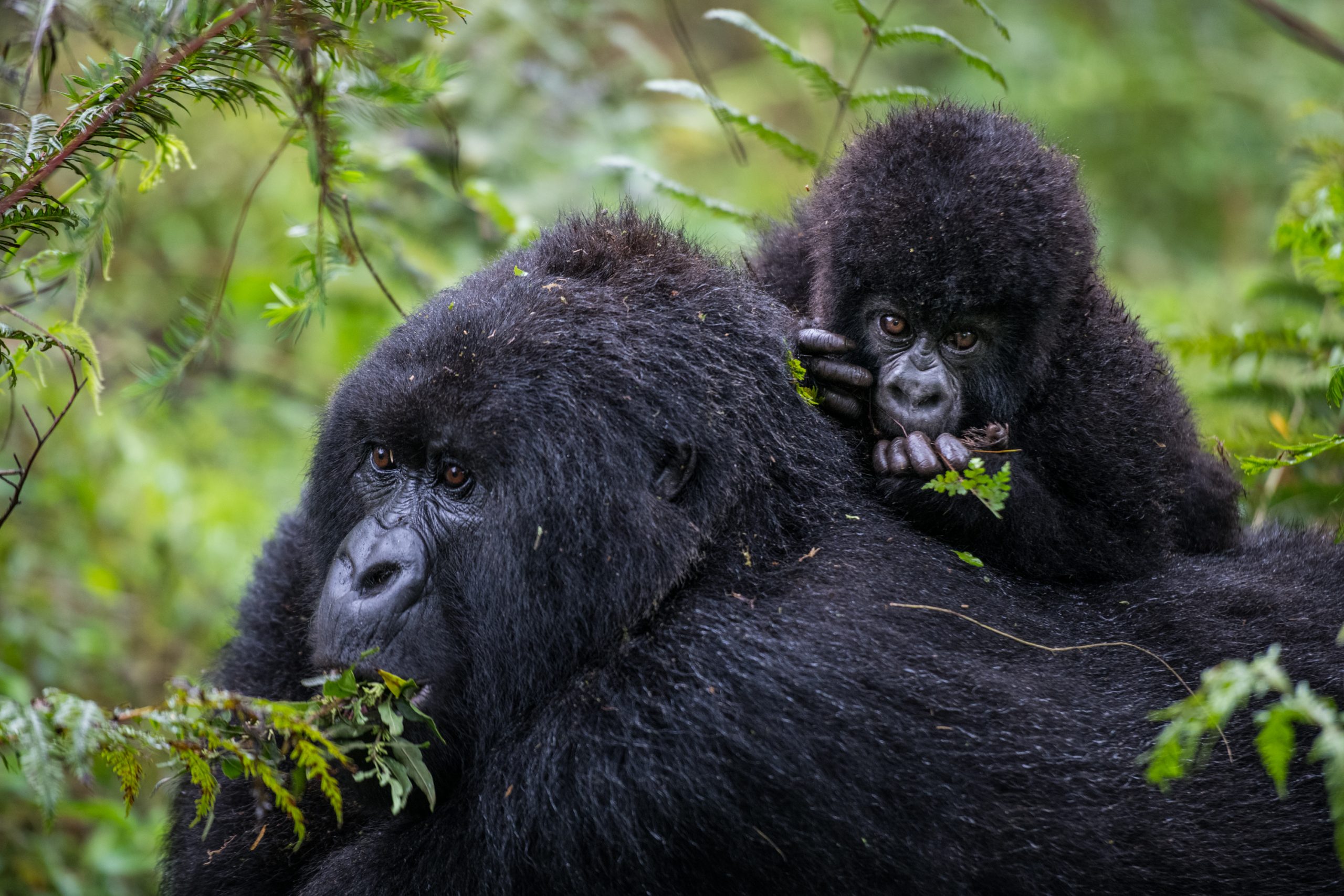
Once you find the family, you are allowed one hour to observe the gorillas. You may see a silverback resting, mothers caring for infants, juveniles playing or several family members feeding on vegetation. After the observation period, the guides lead you back to the starting point.
Regular gorilla trekking takes place in Bwindi Impenetrable National Park and Mgahinga Gorilla National Park. Bwindi has four main sectors: Buhoma, Ruhija, Rushaga and Nkuringo. Each has its own accommodation options, trekking routes and gorilla families.
What is the gorilla habituation experience?
The gorilla habituation experience gives visitors an opportunity to spend more time with a mountain gorilla family that is still undergoing habituation. The process involves gradually helping wild gorillas become accustomed to the presence of researchers and other authorised human observers.
Gorillas are naturally cautious around unfamiliar people. Researchers and trackers therefore approach them carefully, following established procedures to reduce disturbance and allow the animals to become familiar with controlled human presence.
The work requires regular visits over an extended period. Trackers observe the family’s behaviour, monitor its movements and help researchers understand how the gorillas respond to people. Habituation is a gradual conservation and research process, not an activity that simply makes gorillas tame.
Visitors taking part in the experience accompany the habituation team into the forest. They can observe the work involved in monitoring the family and learn more about gorilla behaviour from the people who follow the animals regularly.
The visitor experience allows up to four hours with the gorillas, compared with one hour during regular trekking. The smaller group size also creates a quieter observation setting.
In Uganda, the gorilla habituation experience is offered in the Rushaga sector of Bwindi Impenetrable National Park. It is not available in Mgahinga or all four Bwindi sectors.
Gorilla habituation vs regular trekking: Key differences
The most important differences concern the time spent with the gorillas, the group size, the permit cost and the type of experience.
Time with the gorillas
Regular trekking provides one hour with a fully habituated family. The habituation experience allows up to four hours with a family still undergoing habituation.
The longer period gives you more time to observe different behaviours. You may watch the gorillas feeding, resting, moving through the forest and interacting with one another. However, the additional time does not mean that the gorillas will remain in one place or perform particular behaviours for visitors.
Group size
Regular trekking allows up to eight visitors per gorilla family. The habituation experience is limited to four visitors per group.
A smaller group can make it easier to hear explanations from the researchers and trackers. It can also provide a quieter environment for observing the animals.
Both activities operate under controlled visitor limits designed to reduce disturbance to mountain gorillas.
Gorilla family status
Regular trekking visits a fully habituated gorilla family. The habituation experience visits a family that is still in the process of becoming accustomed to human presence.
This difference affects the nature of the encounter. During habituation, the gorillas may respond differently to visitors because they are not yet as accustomed to human observers as families used for regular trekking.
Location
Regular trekking is available in Bwindi and Mgahinga. Visitors can choose among the four Bwindi sectors or travel to Mgahinga, depending on permit availability and their itinerary.
The habituation experience takes place in the Rushaga sector of southern Bwindi. This means your accommodation and transport arrangements should be based around Rushaga if you choose this activity.
People accompanying you
Regular trekking is led by park guides, rangers and trackers who help locate the gorillas and manage the visit.
During habituation, visitors accompany the habituation team, including researchers and trackers involved in the ongoing process. This provides additional opportunities to learn about monitoring and the behaviour of the gorilla family.
Permit cost
The habituation permit costs more than the regular trekking permit. The difference reflects the extended visitor experience and its limited availability.
The applicable price depends on nationality and residency category. You should confirm the current Uganda Wildlife Authority tariff before making payment, especially when booking for travel dates near a tariff change.
How long does each experience take?
The time spent with the gorillas is fixed by the activity rules, but the overall duration of the day depends on where the family is located.
A regular trek may involve a few hours of walking, although some groups spend considerably longer in the forest. Uganda Wildlife Authority advises visitors to prepare for treks that can last several hours.
The one-hour observation period begins once the group reaches the gorilla family. You then return through the forest with the guides.
The habituation experience also involves an early start and a search through the forest. Once the family is located, visitors can spend up to four hours observing it. The longer observation period means you may spend much of the day in the forest.
Do not assume that habituation takes four times as much total time as regular trekking. The search for the gorillas can be long in either activity. The main difference is the permitted observation time after you find the family.
Which experience is more physically demanding?
Both activities require reasonable physical fitness. The terrain in Bwindi can be steep, uneven, muddy and covered with thick vegetation. Some routes involve climbing slopes, crossing streams and walking through areas without clearly defined paths.
The difficulty depends on the location of the assigned family, recent weather conditions, altitude and the route selected by the trackers.
Habituation can be more demanding because the observation period is much longer. After reaching the gorillas, you may spend several hours standing, crouching or sitting in the forest. You also need enough energy for the return walk.
Regular trekking may be more suitable if you prefer a shorter observation period or have limited time. However, it is not necessarily an easy walk. A regular trek can still involve several hours of challenging hiking.
If you have concerns about your fitness or mobility, discuss them with your tour operator before booking. You can also ask about available support arrangements, including hiring porters and requesting a walking stick. Park staff may be able to assist with group allocation, but no particular trek duration or terrain can be guaranteed.
Which experience is better for photography?
Both experiences offer excellent photography opportunities, but the longer observation period during habituation can provide greater flexibility.
With regular trekking, you have one hour to observe and photograph the gorillas. This can feel brief, particularly when the family is moving through vegetation or when the light is changing. You need to prepare your camera settings before reaching the animals so that you can make the most of the permitted time.
The habituation experience gives you up to four hours. This allows more time to observe different members of the family and wait for suitable photographic opportunities. You may have more chances to photograph feeding, resting, grooming and social interactions.
However, a longer visit does not guarantee better photographs. Dense vegetation, low light, rain and the gorillas’ movements can make photography difficult in either activity.
Use a camera that performs well in low light, and avoid relying on flash photography. Follow all ranger instructions about positioning, distance and camera use. Your photographs should never take priority over the safety and comfort of the gorillas.
Which experience offers better conservation learning?
The habituation experience has a stronger research and educational focus because visitors accompany a team involved in the ongoing habituation process.
You can learn how researchers monitor the family, observe its behaviour and assess its response to human presence. The experience may also help you understand why habituation takes time and why the process must be managed carefully.
Regular trekking also provides conservation education. Park guides explain the gorillas’ behaviour, the importance of protecting their habitat and the rules that visitors must follow. You can learn about the threats facing mountain gorillas and the work carried out by rangers and conservation organisations.
If you are mainly interested in seeing mountain gorillas, regular trekking provides a complete visitor experience. If you want to understand more about the research and monitoring work behind gorilla tourism, habituation may be more rewarding.
How much do gorilla trekking and habituation permits cost?
The permit price is one of the main differences between the two activities.
For foreign non-residents, the published Uganda Wildlife Authority tariff for regular gorilla trekking is US$800 per person, while the habituation experience is listed at US$1,500 per person under the tariff covering July 2024 to June 2026. These figures should not be treated as automatically applicable to every 2026 or 2027 booking. Uganda Wildlife Authority has announced revised tariffs for future periods, including a higher habituation rate taking effect from 1 January 2027.
The prices also differ for foreign residents and East African citizens. Your nationality and qualifying residency status determine the category that applies to you.
| Permit category | Regular trekking | Habituation experience |
|---|---|---|
| Foreign non-resident | US$800 under the July 2024 to June 2026 tariff | US$1,500 under the July 2024 to June 2026 tariff |
| Foreign resident | US$700 under the same tariff | US$1,000 under the same tariff |
| East African citizen | UGX 300,000 under the same tariff | UGX 750,000 under the same tariff |
Always request confirmation of the price that applies to your actual trekking date before paying. The tariff period matters, particularly for bookings in late 2026 and from January 2027.
The permit covers the authorised gorilla activity and specified park services. It does not normally include your accommodation, meals, transport to Bwindi, personal porter fees or other safari activities.
Where can you do regular gorilla trekking in Uganda?
Regular gorilla trekking takes place in Bwindi Impenetrable National Park and Mgahinga Gorilla National Park. Your choice of park or sector should consider the accommodation location, transport route, permit availability and the wider safari itinerary.
Bwindi Impenetrable National Park
Bwindi is divided into four main sectors. Each offers access to habituated gorilla families, but the trekking experience can differ depending on the forest terrain and the location of the assigned family.
Buhoma is in the northern part of the park and has a well-established range of accommodation. It is often included in itineraries that combine gorilla trekking with Queen Elizabeth National Park.
Ruhija is in the eastern part of Bwindi. It offers a forest setting and can work well for travellers approaching from the direction of Kibale or Queen Elizabeth National Park, depending on their route.
Rushaga is in southern Bwindi and has several habituated gorilla families. It is the only sector where the gorilla habituation experience is offered, making it particularly suitable for visitors who want either activity.
Nkuringo is in the southwestern part of Bwindi. It is known for challenging terrain and dramatic scenery, although the actual difficulty of a trek depends on the gorilla family’s location.
Mgahinga Gorilla National Park
Mgahinga is located in southwestern Uganda within the Virunga volcanic landscape. It offers regular gorilla trekking and is also known for golden monkey tracking.
The park has a different setting from Bwindi, with bamboo forest, montane vegetation and volcanic slopes. It can be a good option for travellers who want to combine gorilla trekking with golden monkey tracking or explore the wider Virunga region.
The habituation experience is not offered in Mgahinga, so visitors interested in that activity need to book in Rushaga, Bwindi.
Can you do both experiences on one Uganda safari?
Yes. Travellers with enough time and budget can book regular gorilla trekking and the habituation experience on separate days.
One practical approach is to stay in the Rushaga area and arrange the habituation experience on one day, followed by regular trekking on another day if permits and family assignments allow. This gives you two different opportunities to observe mountain gorillas.
However, doing both activities is not necessary for every visitor. The experiences involve similar forest terrain, early starts and considerable walking. If your itinerary is short, you may prefer to use the additional days for chimpanzee tracking in Kibale, wildlife viewing in Queen Elizabeth National Park or a visit to Lake Bunyonyi.
A combined experience is most suitable for repeat visitors, dedicated wildlife photographers, conservation enthusiasts and travellers who want to spend as much time as possible observing mountain gorillas.
What should you pack for each experience?
The packing requirements are broadly similar because both activities take place in Bwindi’s forest environment.
Waterproof hiking boots are essential. The forest floor can become slippery, especially after rain, and you may need to walk through thick vegetation.
Wear long trousers and long-sleeved clothing to protect your skin from nettles, insects and branches. Gaiters can help prevent mud and vegetation from entering your boots. Gardening gloves are useful when holding vegetation for support, although you should never damage plants or clear a path unnecessarily.
Carry a lightweight rain jacket because rain can occur throughout the year. A small backpack should hold drinking water, snacks, a packed lunch where required, sunscreen and personal medication.
For photography, bring a camera with suitable low-light performance, spare batteries and enough memory cards. A heavy camera bag can become uncomfortable during a long trek, so carry only the equipment you need.
A walking stick can help on steep and uneven paths. You can usually obtain one at the park headquarters, while a porter can assist with your backpack or provide support during the walk.
What are the health and safety rules?
Mountain gorillas are vulnerable to some human respiratory and other infectious diseases. Visitors must follow the health precautions provided by Uganda Wildlife Authority and the guides.
Do not participate if you are unwell with symptoms such as a cough, flu or another potentially infectious illness. Inform your operator or the park authorities if you develop symptoms before the trek.
Maintain the required distance from the gorillas and follow the ranger’s instructions throughout the encounter. Uganda’s gorilla guidelines specify a minimum viewing distance, commonly stated as seven metres, although gorillas may occasionally move closer. If this happens, remain calm and follow the guide’s directions.
Avoid sudden movements, loud noises and direct attempts to attract the animals’ attention. Never touch a gorilla, even if it approaches you.
Eating, drinking and other activities near the gorillas are controlled by the guides. Do not leave rubbish in the forest, and avoid using flash photography.
These rules apply to both regular trekking and habituation. The longer duration of habituation makes consistent compliance especially important.
When should you book your permit?
Book your gorilla permit as early as possible, particularly if you plan to travel during the busy months of June to September or December to February.
Regular trekking permits are limited because each habituated gorilla family can receive only a restricted number of visitors per day. The habituation experience has even fewer places, with a maximum of four visitors per group.
If you want the habituation experience, secure the permit before finalising your accommodation. Since it is only available in Rushaga, you need to organise your overnight stay and transport around that sector.
For regular trekking, you have more flexibility because permits are available in several Bwindi sectors and Mgahinga. However, you should still check availability before confirming non-refundable travel arrangements.
When booking through a tour operator, provide your full passport details and confirm the permit category, trekking date and sector. Your permit should match your identity and the activity you intend to do.
Which experience should you choose?
Choose regular gorilla trekking if:
You are visiting mountain gorillas for the first time and want the classic experience. One hour is enough for many visitors to appreciate the animals, observe their family interactions and take photographs.
It is also the better option if you have a limited budget or only one day available for gorilla activities. The lower permit cost leaves more room in your safari budget for accommodation, transport and other national parks.
Regular trekking is suitable for travellers who want a meaningful gorilla encounter without committing to a longer observation period.
Choose the gorilla habituation experience if:
You have a strong interest in wildlife behaviour and conservation research. The opportunity to spend up to four hours with a family still undergoing habituation offers a different perspective on gorilla tourism.
It is also worth considering if you are a wildlife photographer, a repeat gorilla trekking visitor or someone who wants a smaller group and more time in the forest.
You should be prepared for the higher permit cost, limited availability and potentially long day in challenging terrain.
Consider both if:
You have several days in Bwindi, a suitable budget and enough physical stamina. Experiencing regular trekking and habituation on separate days allows you to compare the encounters and understand the differences between visiting a fully habituated family and joining a habituation team.
Final recommendation
For most first-time visitors to Uganda, regular gorilla trekking is the best starting point. It provides a remarkable opportunity to observe mountain gorillas in the wild, and the one-hour encounter is often sufficient to create a memorable experience.
The gorilla habituation experience is better suited to travellers who want a longer, more research-focused visit and are willing to pay more for it. Its smaller group and extended observation period offer a different experience, but they do not guarantee an easier trek or closer interaction.
Your decision should come down to your budget, fitness, available time and interest in conservation work. If seeing mountain gorillas is your main goal, regular trekking is an excellent choice. If you want to spend more time understanding how researchers work with a wild gorilla family, choose habituation in Rushaga.




No comment