
Photographing Elephants Close Up: Composition and Safety
Photographing elephants close up is one of the most rewarding experiences on an African wildlife safari. Their enormous bodies, expressive eyes, long trunks and textured skin provide excellent opportunities for memorable photographs. Whether you are visiting Amboseli National Park in Kenya, Tarangire National Park in Tanzania or Queen Elizabeth National Park in Uganda, elephants are fascinating subjects for wildlife photography.
However, getting a close-up photograph requires patience, suitable camera equipment and careful attention to safety. Elephants are powerful wild animals, and their behaviour can change quickly. An adult African elephant may weigh several tonnes, making unsafe encounters particularly dangerous.
Successful elephant photography depends on capturing interesting details while respecting the animal’s space. Understanding composition, lighting, camera settings and elephant behaviour will help you return home with beautiful photographs without disturbing wildlife.
Why Elephants Are Excellent Photography Subjects
Elephants have several physical characteristics that make them particularly interesting to photograph.
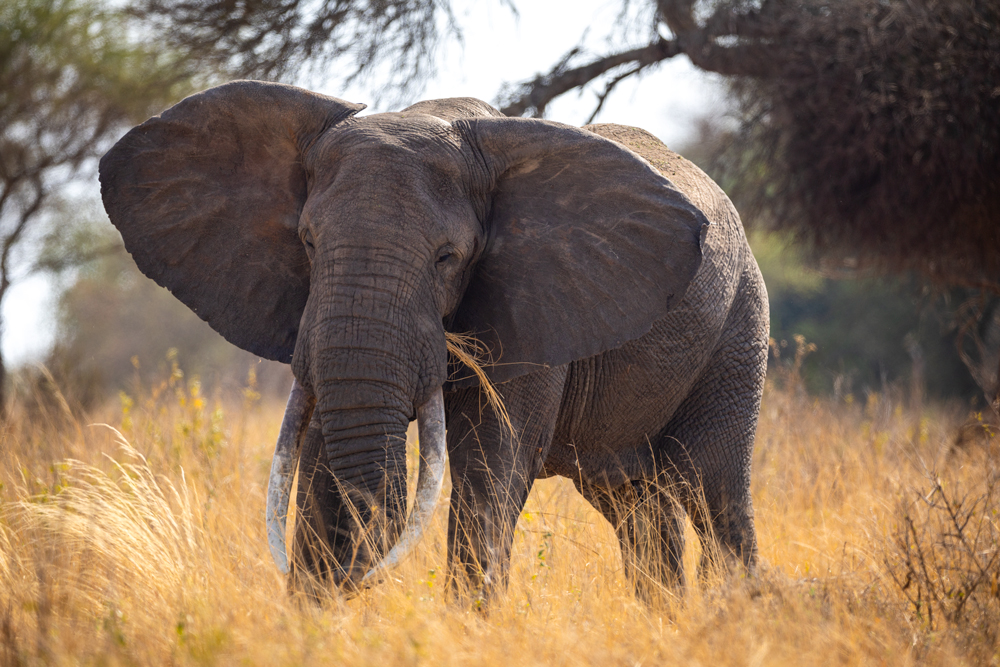
Their wrinkled skin creates natural textures, while their ears, trunks and tusks provide distinctive shapes. Their eyes can produce intimate portraits, especially when photographed in soft morning light.
Elephants also display a wide range of natural behaviours.
You may observe them feeding, bathing, communicating or caring for young calves. These activities provide opportunities to capture photographs that tell a story about their daily lives.
Unlike smaller wildlife species, elephants can fill your camera frame even when photographed from a considerable distance.
This means you can capture impressive close-up compositions without moving dangerously near them.
1. Choosing the Right Lens for Elephant Photography
Your camera lens determines how much detail you can capture while maintaining a safe distance.
A telephoto zoom lens is generally the most practical option for photographing elephants during game drives.
Recommended Lens Options
| Lens | Best use | Main advantage |
|---|---|---|
| 70–200 mm | Elephant groups and portraits | Flexible framing |
| 100–400 mm | Close-ups and behaviour | Good reach without approaching |
| 150–600 mm | Detailed portraits at longer distances | Strong magnification |
| 24–70 mm | Wide environmental photographs | Captures elephants within landscapes |
| 400 mm prime | Detailed wildlife portraits | Excellent reach and image quality |
A 100–400 mm lens is particularly useful because it allows you to change compositions without moving your safari vehicle.
Remember that lens focal length does not determine a safe viewing distance.
Your guide should decide where the vehicle stops based on local regulations and the elephants’ behaviour.
2. Composition Techniques for Elephant Close-Ups
Composition determines how viewers experience your photograph.
A strong elephant portrait should direct attention towards a particular feature or behaviour.
Focus on the Eyes
Elephants have relatively small eyes compared with their enormous heads.
However, their eyes can create powerful close-up portraits.
Position the eye near one of the intersections suggested by the rule of thirds.
Use a wide enough aperture to soften distracting vegetation while keeping the eye sharp.
If the elephant turns its head slightly towards your camera, you may capture more facial detail.
Avoid making sudden movements or noises to attract its attention.
Photograph the Trunk
An elephant’s trunk is an excellent subject because it performs many activities.
You might photograph an elephant collecting grass, drinking water or lifting its trunk naturally.
A tightly framed photograph showing the trunk and mouth can reveal interesting details.
Try capturing the moment when the trunk curls around vegetation.
These images communicate natural feeding behaviour.
Include the Tusks
Elephant tusks can create strong visual lines within a photograph.
A side-profile composition often works well because it reveals the relationship between the tusks, trunk and head.
However, avoid cropping the tusks awkwardly at the edge of the frame.
If the tusks are important to your composition, leave enough space to include them completely.
3. Photographing Elephant Skin and Texture
Elephant skin contains wrinkles, folds and rough surfaces that photograph beautifully.
These textures become particularly visible when sunlight reaches the animal from one side.
Use Directional Lighting
Morning and late afternoon light can create small shadows across the elephant’s skin.
This makes the surface appear more detailed.
Photographing an elephant directly under strong midday sunlight may create harsh highlights and deep shadows.
However, these conditions can still work for dramatic black and white images.
Capture Small Details
Consider photographing individual features such as:
The wrinkles surrounding an elephant’s eye.
The textured surface of its trunk.
The edges of its large ears.
Mud drying across its skin.
The trunk holding grass or leaves.
The feet and toenails of a walking elephant.
These photographs can complement wider images of the entire animal.
4. Best Camera Settings for Elephant Photography
Elephants often move slowly, but their trunks, ears and heads can move unexpectedly.
Using a suitable shutter speed helps keep important details sharp.
Suggested Camera Settings
| Photography situation | Shutter speed | Aperture | ISO |
|---|---|---|---|
| Resting elephant | 1/500 second | f/4–f/5.6 | Auto ISO |
| Walking elephant | 1/1000 second | f/5.6 | Auto ISO |
| Elephant drinking | 1/1000 second | f/5.6–f/8 | Auto ISO |
| Elephant spraying water | 1/1600 second | f/4–f/5.6 | Auto ISO |
| Elephant herd | 1/800 second | f/8 | Auto ISO |
These are starting settings. Adjust them according to available light, your lens and the elephant’s movement.
Continuous autofocus can help track moving elephants.
For portraits, place the focus point on the nearest visible eye.
Shooting in RAW format gives you additional flexibility when adjusting exposure and shadows later.
5. Photographing Elephants in Different Safari Destinations
East Africa offers several excellent destinations for elephant photography.
Amboseli National Park, Kenya
Amboseli is well known for its elephant populations and views of Mount Kilimanjaro.
Photographers can capture elephants walking through open landscapes, sometimes with the mountain visible in the background.
The relatively open terrain also provides opportunities for clean compositions.
Tarangire National Park, Tanzania
Tarangire is famous for its elephants and large baobab trees.
During the dry season, elephants frequently gather around available water sources.
Photographing elephants beside baobabs can provide a strong sense of scale.
Queen Elizabeth National Park, Uganda
Queen Elizabeth National Park offers opportunities to photograph elephants in savannah habitats and around the Kazinga Channel.
Boat trips may provide views of elephants approaching the water.
Always follow the boat guide’s instructions and avoid encouraging the vessel to approach animals too closely.
Murchison Falls National Park, Uganda
Murchison Falls National Park supports elephants in grassland and woodland habitats.
Game drives and suitable boat excursions can offer different photographic perspectives.
6. Understanding Elephant Behaviour Before Taking Photographs
Elephants communicate through body movements, sounds and physical contact.
Recognising changes in behaviour is important for photography safety.
A relaxed elephant may continue feeding or walking without paying much attention to nearby vehicles.
However, an elephant that becomes uncomfortable may display warning behaviour.
Possible warning signs include:
Repeatedly facing or closely watching a vehicle.
Ears held out in combination with other signs of agitation.
Head shaking or sudden changes in posture.
Loud trumpeting during an unsettled encounter.
Moving directly towards a vehicle in a threatening manner.
Protective behaviour around calves.
No single behaviour always indicates an approaching charge. Elephants also spread their ears, trumpet and move their heads during ordinary social activities.
Your guide should interpret the complete situation.
Never assume that an elephant is harmless simply because it appears calm.
7. Essential Safety Rules for Elephant Photography
Safety must always take priority over getting a photograph.
Remain Inside Your Safari Vehicle
During normal game drives, remain inside the vehicle unless your guide confirms that stopping and exiting is permitted and safe.
Never step outside to photograph an elephant more closely.
Maintain a Safe Distance
There is no universal distance that guarantees safety around elephants.
The appropriate distance depends on the setting, park regulations and animal behaviour.
Allow your guide to determine how close the vehicle should approach.
If an elephant begins showing signs of distress, the vehicle should give it additional space.
Never Block an Elephant’s Path
Elephants often follow familiar routes between feeding areas and water sources.
Avoid positioning your vehicle directly in their path.
Be particularly careful around herds containing calves.
Avoid Flash Photography
Do not use flash to photograph elephants at close range.
Sudden bright light may disturb wildlife, particularly in low-light conditions.
Use available natural light and suitable camera settings instead.
Keep Noise to a Minimum
Avoid shouting, clapping or making noises to encourage elephants to look towards your camera.
Allow their natural behaviour to determine your photographs.
8. Photographing Elephant Mothers and Calves
Elephant mothers and calves provide opportunities to capture interesting social behaviour.
You may observe calves walking beneath adults, touching family members with their trunks or attempting to feed.
However, females can be particularly protective around young calves.
Never request that a guide separate a calf from its herd or position the vehicle between family members.
A telephoto lens allows you to photograph these interactions without interfering.
For composition, try including both the calf and an adult elephant.
This provides scale and helps viewers understand the relationship.
9. Using Light and Backgrounds Effectively
Natural light strongly influences the appearance of elephant photographs.
Early morning provides softer illumination, while late afternoon can create warmer tones and longer shadows.
Backlighting can work well when elephants walk through dust.
For close-up portraits, choose backgrounds that do not compete with the subject.
Distant vegetation, open grassland or shaded areas can provide suitable backgrounds.
If possible, photograph when the elephant is clearly separated from nearby trees and bushes.
This creates a cleaner image.
10. Common Elephant Photography Mistakes
Several mistakes can reduce the quality of your photographs.
Cropping too tightly: Leave enough space around trunks, tusks and ears.
Using a slow shutter speed: Even slow movements can cause blurred photographs.
Ignoring the background: Branches and vegetation may distract attention from the elephant.
Overediting skin texture: Excessive sharpening can make elephant skin appear unnatural.
Photographing only full-body views: Include portraits and behavioural details for variety.
Getting too close: Never compromise safety for a close-up image.
Careful observation and patience will usually produce better results than rushing.
11. Editing Elephant Close-Up Photographs
Editing should improve the photograph without changing the animal’s natural appearance.
Start by adjusting exposure and white balance.
Recover details in bright areas, particularly around tusks and sunlit skin.
Slightly increasing texture may help reveal wrinkles and skin patterns.
However, avoid excessive clarity or sharpening.
For portraits, use selective adjustments to improve visibility around the eyes.
Black and white conversion can also work particularly well for elephants because their skin contains strong textures and natural tonal variations.
Keep the final image realistic.
Photographing elephants close up requires good composition, appropriate equipment and a careful understanding of wildlife safety.
Their eyes, trunks, tusks and textured skin provide many opportunities for detailed photographs. Natural behaviour, including feeding, drinking and family interactions, can make these images even more interesting.
Use a telephoto lens to maintain distance, choose suitable lighting and follow your guide’s instructions throughout the encounter.
With patience and responsible photography practices, you can capture memorable elephant portraits while allowing these remarkable animals to continue their natural activities undisturbed.




No comment