
Mount Kenya’s climbing routes: Sirimon, Chogoria and Naro Moru compared
Mount Kenya is one of Africa’s most impressive mountain destinations and a major attraction for hikers, climbers and adventure travellers visiting Kenya. Rising to 5,199 metres at Batian Peak, it is the continent’s second-highest mountain after Kilimanjaro. Its dramatic peaks, glaciers, alpine valleys, volcanic formations and high-altitude lakes create a landscape that is very different from the savannah environments usually associated with Kenyan safaris.
There are several routes for climbing Mount Kenya, but Sirimon, Chogoria and Naro Moru are among the most popular choices for reaching the mountain’s higher trekking areas. Each offers a different experience in terms of scenery, difficulty, accommodation, altitude gain and approach to the summit region. Sirimon is often preferred for its gradual ascent, Chogoria for its spectacular scenery, and Naro Moru for its direct and challenging approach.
Choosing the right route is important because Mount Kenya is a high-altitude mountain where preparation, acclimatisation and weather conditions influence the success and safety of a climb. The best route is not necessarily the shortest or most popular one. It should match your fitness, experience, available time and interest in scenery.
Understanding Mount Kenya’s climbing routes
Mount Kenya is located near the equator, approximately 150 kilometres north of Nairobi. The mountain is protected within Mount Kenya National Park, a UNESCO World Heritage Site recognised for its exceptional landscapes, biodiversity and ecological importance.
The mountain has several peaks, but Batian and Nelion are technical climbing summits that require mountaineering experience and specialised equipment. Point Lenana, at approximately 4,985 metres, is the most commonly reached trekking summit. It does not require the same technical rock-climbing skills as Batian or Nelion, but the altitude, steep terrain and cold conditions still make it a demanding mountain objective.
The Sirimon, Chogoria and Naro Moru routes provide different approaches to the mountain. Climbers can use one route for the ascent and another for the descent, creating a varied itinerary rather than retracing the same path.
A common combination is ascending through Sirimon and descending via Chogoria, or ascending through Chogoria and descending via Sirimon. Naro Moru can also be combined with other routes, depending on the itinerary and the arrangements made with the mountain operator.
Sirimon route: gradual ascent and scenic highlands
The Sirimon route approaches Mount Kenya from the northwest and is often recommended for trekkers who prefer a relatively gradual ascent. It begins near Nanyuki and passes through forest, bamboo vegetation, heathland and high-altitude moorland before reaching the higher mountain areas.
One of its main advantages is the opportunity to gain altitude progressively. Although the route still involves substantial climbing, its general profile can make acclimatisation easier to manage than on a faster ascent.
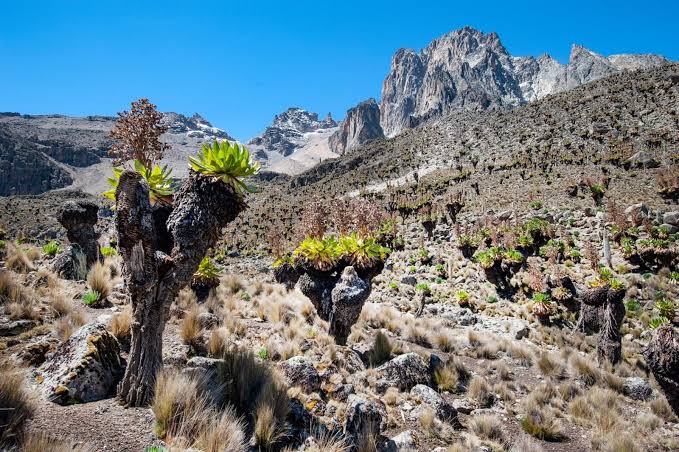
The lower section passes through montane forest, where visitors may encounter birds, monkeys and other forest wildlife. As the trail climbs, the vegetation changes and the landscape becomes more open. Giant heathers, lobelias and groundsels are among the distinctive plants found in Mount Kenya’s alpine environment.
The route commonly uses Old Moses Camp and Shipton’s Camp as overnight stops on the approach to Point Lenana. These camps provide places to rest and adjust to the altitude before the final summit attempt.
Shipton’s Camp is particularly important because it sits in a dramatic mountain setting beneath the main peaks. From here, trekkers can prepare for the early morning climb towards Point Lenana.
The final ascent is steep and demanding, especially in darkness and cold conditions. Climbers usually begin before sunrise to reach the summit around dawn, when weather and visibility are often more favourable.
Sirimon is a good choice for trekkers who want a balanced combination of scenery, manageable stages and opportunities for acclimatisation. It is also a popular option for first-time high-altitude hikers, provided they have suitable fitness and allow enough days for the climb.



No comment