
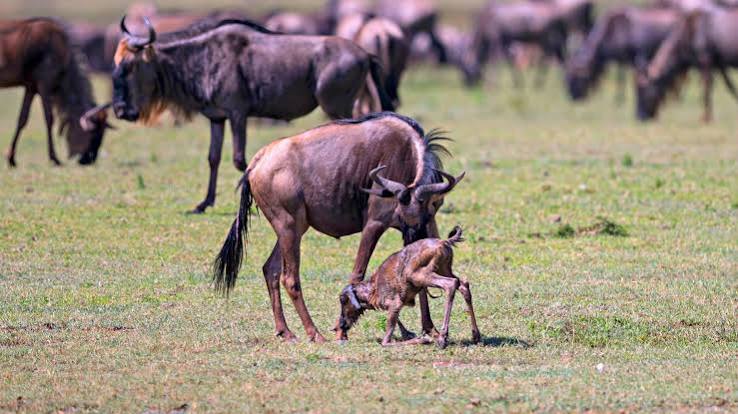
The short grass plains of Ndutu are among the most important breeding grounds for migrating wildebeest in Tanzania. Every year, enormous herds gather across the southern Serengeti and Ndutu region, where hundreds of thousands of calves are born during a relatively short period. The combination of nutritious grasses, seasonal rainfall, mineral-rich soils and extensive open landscapes makes this region particularly suitable for pregnant wildebeest and nursing mothers.
Located near the boundary between Serengeti National Park and the Ngorongoro Conservation Area, Ndutu becomes a major wildlife destination between December and March. During the height of the calving season, visitors may observe newborn wildebeest standing beside their mothers, large grazing herds moving across green grasslands and predators searching for opportunities to hunt.
However, the attraction of Ndutu is not simply its open landscape. The relationship between volcanic soils, short grasses and seasonal rainfall creates feeding conditions that are especially valuable during reproduction. Understanding these environmental factors explains why wildebeest repeatedly return to southern Serengeti and why the calving season is one of the most remarkable stages of Africa’s Great Migration.
Where Are the Short Grass Plains of Ndutu?
Ndutu lies in northern Tanzania, within the wider Serengeti–Mara ecosystem.
The region surrounds Lake Ndutu and Lake Masek and includes open grasslands, seasonal wetlands and areas of acacia woodland.
It is closely associated with the southern Serengeti plains and the Ngorongoro Conservation Area.
The surrounding grasslands are important seasonal habitats for wildebeest, plains zebras, Thomson’s gazelles and numerous predators.
During the wet season, rainfall encourages fresh grass growth, attracting large concentrations of migrating herbivores.
Quick Facts About Ndutu’s Calving Plains
Feature | Description |
|---|---|
Country | Tanzania |
Main location | Ndutu and southern Serengeti |
Protected areas | Serengeti National Park and Ngorongoro Conservation Area |
Main calving period | January to March |
Typical peak | February |
Main animal | Blue Wildebeest |
Scientific name | Connochaetes taurinus |
Important vegetation | Short, nutritious grasses |
Soil characteristics | Volcanic-influenced, mineral-rich soils |
Major predators | Lions, cheetahs and spotted hyenas |
Recommended visit | February for concentrated calving activity |
1. Volcanic Soils Help Produce Nutritious Grass
One of the main reasons wildebeest gather around Ndutu is the quality of its grasslands.
The southern Serengeti plains contain soils influenced by volcanic materials originating from the Ngorongoro Highlands.
Over long periods, volcanic ash and other geological processes contributed to the development of the region’s distinctive soils.
These soils contain minerals that support nutritious grass growth when sufficient rainfall is available.
The grasslands are particularly important for animals with high nutritional requirements.
Why Soil Minerals Matter to Wildebeest
Pregnant wildebeest require adequate nutrients to support foetal development.
After giving birth, females need sufficient energy and nutrients to produce milk.
The grass growing on Ndutu’s plains can provide valuable nutrition during these demanding stages.
Important nutrients include protein, calcium, phosphorus and other minerals required for normal growth and reproduction.
However, soil fertility varies between locations, and not every grass patch provides identical nutritional value.
The combination of suitable soils and seasonal grass growth is more important than any single mineral.
2. Short Grass Is Easier for Wildebeest to Graze
Wildebeest are grazing mammals that generally benefit from nutritious, relatively short grasses.
Their broad mouths allow them to crop grass close to the ground.
During the wet season, the Ndutu plains produce fresh growth that can be easier to digest than older, fibrous vegetation.
Young grasses often contain higher concentrations of digestible nutrients.
These characteristics make the plains attractive to pregnant females and mothers nursing young calves.
Does Short Grass Always Mean Better Food?
Not necessarily.
Grass height is only one factor influencing feeding quality.
A short grassland affected by prolonged drought may provide insufficient food.
By contrast, fresh grass growing after suitable rainfall can provide valuable nutrition.
Wildebeest respond to a combination of grass abundance, growth stage, nutritional quality and access to water.
This explains why they may move between different areas of the southern Serengeti as conditions change.
3. Seasonal Rainfall Creates Fresh Grazing
Rainfall is another major reason wildebeest return to Ndutu.
The Serengeti ecosystem experiences seasonal rainfall patterns that influence where grass grows.
During the wetter months, rain supports new vegetation across the southern plains.
This creates favourable feeding conditions for large herbivore populations.
Many wildebeest arrive in southern Serengeti during November and December as suitable grazing becomes available.
By January and February, substantial herds may be concentrated around Ndutu and neighbouring short-grass plains.
Why the Timing Changes Between Years
Rainfall does not follow an identical pattern every season.
Some years experience early rains, while others receive delayed or uneven rainfall.
When grass develops earlier than usual, herds may move towards the southern plains sooner.
If rainfall is delayed, the animals may remain elsewhere until suitable feeding conditions improve.
The calving season is biologically concentrated, but the distribution of herds across Ndutu and neighbouring areas can vary.
This makes recent migration reports useful when planning a safari.
4. Nutritious Grazing Supports Pregnant Wildebeest
Pregnancy places substantial nutritional demands on female wildebeest.
As birth approaches, the developing calf requires energy and nutrients from its mother.
Female wildebeest must maintain their body condition while continuing to graze and move with the herd.
The short-grass plains provide an important seasonal source of nutritious vegetation.
This helps mothers meet the demands of late pregnancy.
Why Feeding Conditions Matter Before Birth
Poor nutrition can affect the condition of pregnant animals.
Adequate grazing supports normal body functions and helps females prepare for lactation.
The availability of nutritious grasses around Ndutu therefore contributes to favourable reproductive conditions.
However, calving locations are influenced by the wider migration cycle, not simply individual females selecting a particular patch of grass immediately before giving birth.
5. Grass Quality Helps Mothers Produce Milk
After birth, wildebeest calves depend on their mothers for milk.
Lactation requires substantial energy, protein and other nutrients.
Mothers need access to suitable grazing to maintain milk production.
The fresh grasses of the southern Serengeti provide valuable feeding opportunities during this period.
Why Milk Is Important for Calves
Milk provides the energy and nutrients needed for early growth.
Newborn wildebeest must develop strength rapidly because migrating herds remain mobile.
A calf that feeds successfully and remains close to its mother has a better opportunity to develop during its earliest days.
However, food availability alone cannot guarantee survival.
Predators, disease, weather and separation from the mother can also affect young calves.
6. Open Plains Help Wildebeest Detect Predators
Ndutu’s extensive grasslands provide relatively open views across the landscape.
This allows wildebeest to detect movement over considerable distances.
Lions, cheetahs, spotted hyenas and jackals inhabit the wider ecosystem and may hunt during the calving season.
Open terrain can reduce some opportunities for predators to approach without being seen.
However, visibility does not eliminate predation.
How Different Predators Hunt Around Ndutu
Lions may use shallow depressions, vegetation and changes in terrain to approach wildebeest.
Cheetahs rely on speed and careful positioning to capture suitable prey across open grasslands.
Spotted hyenas are capable hunters that may pursue vulnerable calves or larger animals.
Black-backed jackals may take advantage of small prey, carrion and occasionally vulnerable newborn animals.
The calving season provides opportunities to observe these predators, but their presence is not the primary reason wildebeest select Ndutu’s grazing areas.
7. Synchronised Calving Helps More Wildebeest Survive
Wildebeest reproduction is highly seasonal within the Serengeti migration.
Large numbers of females give birth during a concentrated period, generally between January and March.
February is often the busiest month.
Estimates commonly suggest that approximately 400,000–500,000 calves may be born during a major calving season, although the number varies.
Why Do So Many Calves Arrive Together?
Synchronous births may help reduce the proportion of newborns captured by predators.
When thousands of calves are born within a short period, local predators cannot consume all of them.
This effect is known as predator saturation.
Although lions, hyenas and other carnivores capture some calves, many survive because of the enormous number of births.
The timing also coincides with a season when nutritious grazing is generally available for nursing mothers.
8. Newborn Calves Can Stand Soon After Birth
One of the most remarkable features of wildebeest calving is how quickly newborn animals become mobile.
A healthy calf may begin attempting to stand within minutes of birth.
Many are able to walk and follow their mothers shortly afterwards.
This ability is essential because wildebeest do not remain in sheltered breeding areas for extended periods.
Why Early Movement Matters
The open grasslands provide limited concealment for newborn calves.
Young animals must remain close to their mothers and respond to herd movements.
Rapid mobility helps calves avoid becoming separated and improves their ability to respond to approaching predators.
However, newborn calves remain vulnerable during their earliest days, particularly when exhausted or separated from the herd.
9. Why Wildebeest Do Not Give Birth in Forests
Wildebeest are adapted primarily to open grassland and savannah environments.
Their feeding habits depend on access to extensive grazing areas.
Dense forests generally do not provide the same abundance of accessible grass required by large migrating wildebeest herds.
Forest environments can also restrict visibility and movement.
The open plains of Ndutu offer suitable grazing and space for large numbers of animals.
However, wildebeest do not require completely treeless habitats.
They may use grasslands interspersed with woodland and other vegetation types throughout the migration.
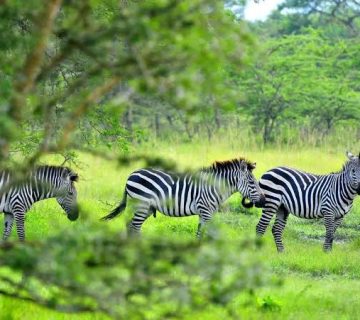
10. Why Zebras and Gazelles Also Gather Around Ndutu
Wildebeest are not the only herbivores attracted to the southern Serengeti grasslands.
Plains zebras and Thomson’s gazelles also use these habitats during suitable seasonal conditions.
These animals share some feeding areas but have different dietary requirements.
Zebras can consume relatively fibrous grasses because of their hindgut digestive systems.
Wildebeest generally benefit from shorter, nutritious grazing.
Thomson’s gazelles often select highly nutritious plant material.
How Their Feeding Habits Compare
Animal | Main feeding characteristic | Importance of Ndutu |
|---|---|---|
Wildebeest | Prefer nutritious grass | Calving and seasonal grazing |
Plains zebra | Can use coarser grasses | Seasonal feeding and movement |
Thomson’s gazelle | Select nutritious grasses and other plant material | Feeding and breeding habitats |
Topi | Graze on suitable grasslands | Resident and seasonal feeding opportunities |
These differences allow several herbivore species to use overlapping habitats, although competition for food can occur.
11. Why Wildebeest Return to Ndutu Every Year
The annual return of migrating wildebeest to Ndutu is closely associated with the seasonal distribution of grazing.
During the wet season, southern Serengeti usually offers nutritious grass that supports pregnant females and nursing mothers.
As these grasslands begin drying, herds gradually move towards other parts of the ecosystem.
This creates a repeating seasonal pattern across southern, central, western and northern Serengeti.
However, wildebeest do not necessarily return to exactly the same location every year.
Their movements respond to actual rainfall and vegetation conditions.
Are Wildebeest Returning to Their Birthplace?
It is tempting to imagine that wildebeest return to Ndutu because they remember where they were born.
Although animals can learn routes and recognise familiar landscapes, the annual concentration around Ndutu is more directly explained by seasonal habitat suitability.
The southern plains offer nutritious grazing at a time when many females are preparing to give birth.
Individual wildebeest may use slightly different locations from one year to another.
12. Why Ndutu Becomes Less Suitable During the Dry Season
Despite its valuable wet-season grazing, Ndutu cannot support the main migration herds at the same concentration throughout the year.
Parts of the southern Serengeti contain relatively shallow soils that dry quickly once seasonal rainfall declines.
As soil moisture decreases, fresh grass growth slows.
The available grass may become shorter, drier and less nutritious.
This encourages many wildebeest to begin moving towards central and western Serengeti.
Where Do the Herds Travel Next?
During April and May, many migrating wildebeest move towards central and western Serengeti.
Some reach the Western Corridor and Grumeti River region during late May and June.
As the dry season progresses, substantial herds may continue towards northern Serengeti and the Maasai Mara.
Later in the year, renewed rainfall can encourage a gradual return towards the southern plains.
This movement forms the wider annual Great Migration cycle.
13. What Scientific Research Reveals About Ndutu Grass Quality
Research into the Serengeti ecosystem has demonstrated that soil nutrients and vegetation quality vary considerably across the landscape.
A 2025 study examining differences in forage quality across Serengeti National Park highlighted the influence of volcanic ash and the distribution of important nutrients, particularly phosphorus.
Volcanic-derived soils are especially prominent in the southern plains, while other Serengeti regions contain different geological materials.
These differences influence the nutritional characteristics of grasslands and help explain the seasonal distribution of grazing animals.
Research on ungulate breeding has also shown that food availability influences the timing of births, while synchronised calving can provide protection through predator saturation.
These findings reinforce the importance of understanding Ndutu as part of a wider ecological system rather than simply a location where wildebeest happen to give birth.
Best Time to Visit Ndutu for Wildebeest Calving
The best-known Ndutu calving season generally takes place between January and March.
February is usually the strongest month for travellers hoping to observe concentrated births.
However, herd locations change according to rainfall and grazing conditions.
Ndutu Calving Season Calendar
Month | Typical wildlife activity |
|---|---|
December | Large herds may begin returning to southern Serengeti |
January | Increasing concentrations of pregnant wildebeest and early births |
February | Usually the busiest calving period |
March | Calving may continue as grazing conditions change |
April | Many migrating herds begin moving towards central Serengeti |
These dates are approximate and should not be treated as guarantees.
Where to See Calving Wildebeest Around Ndutu
Several habitats around Ndutu provide opportunities for observing wildebeest and their newborn calves.
Lake Ndutu Plains
The open grasslands around Lake Ndutu attract grazing wildebeest when seasonal conditions are suitable.
Visitors may observe large herds, newborn calves, zebras and nearby predators.
The surrounding woodland can also provide opportunities for birdwatching and other wildlife encounters.
Lake Masek Area
Lake Masek is another important feature of the Ndutu landscape.
Its surrounding habitats contain grasslands and woodland used by different wildlife species.
Lions, hyenas and other predators may be encountered in this area.
Southern Serengeti Plains
The wider southern Serengeti plains support some of the largest seasonal concentrations of migrating wildebeest.
During the peak calving period, extensive grassland areas may contain thousands of animals.
Visitors can observe newborn calves, maternal behaviour and predator activity during guided game drives.
Matiti Plains
The Matiti Plains are another important calving landscape within the southern Serengeti ecosystem.
Their open grasslands and nutritious seasonal vegetation can support large wildebeest concentrations.
Wildlife activity varies according to recent rainfall and herd movements.
Photography Tips for the Ndutu Calving Season
Ndutu offers excellent opportunities for photographing wildebeest mothers and newborn calves.
The open landscapes often provide clear views, while fresh green grass creates attractive backgrounds.
A telephoto zoom lens of approximately 100–400 mm is useful for photographing animals from a safari vehicle.
For moving calves or running herds, use a shutter speed around 1/1000–1/2000 second when sufficient light is available.
Early morning and late afternoon generally provide softer natural light.
Recommended Photography Subjects
Newborn wildebeest standing beside their mothers.
Large herds grazing across the green plains.
Mothers nursing young calves.
Cheetahs searching for prey across open grassland.
Zebras feeding near wildebeest herds.
Lions and spotted hyenas around seasonal herbivore concentrations.
Visitors should maintain suitable distances from animals giving birth and avoid interfering with natural behaviour.
How Many Days Should You Spend in Ndutu?
Travellers primarily interested in wildebeest calving should consider spending three or four nights in Ndutu.
This allows several game drives across different habitats.
A longer stay also provides flexibility if rainfall or herd movements affect wildlife viewing.
Suggested Three-Day Calving Safari
Day 1: Arrival and Afternoon Game Drive
Arrive in Ndutu and explore nearby grasslands.
Search for wildebeest herds, zebras, gazelles and predators.
Day 2: Full-Day Wildlife Viewing
Spend the day exploring suitable calving areas.
Observe mothers and calves while looking for lions, cheetahs and spotted hyenas.
Day 3: Morning Game Drive and Departure
Enjoy an early morning wildlife excursion before continuing towards another Serengeti destination.
This itinerary can be extended to provide more opportunities for wildlife observation.
Responsible Wildlife Viewing During Calving
The calving season is a sensitive period for wildebeest.
Newborn calves require close contact with their mothers, particularly during their earliest hours.
Safari vehicles should never separate mothers from calves or block animals attempting to move through the grasslands.
Visitors should avoid excessive noise around birthing animals.
Do not ask guides to chase predators or approach newborn calves too closely for photographs.
Protected-area rules differ according to location, and visitors should follow the instructions of authorised guides and conservation staff.
Responsible wildlife viewing helps protect animals while maintaining a rewarding safari experience.
Why the Short Grass Plains of Ndutu Are Essential
The short grass plains of Ndutu attract calving wildebeest because they provide a valuable combination of nutritious vegetation, mineral-rich soils and favourable seasonal grazing conditions.
Volcanic influences have contributed to the soil characteristics that support these grasslands.
Rainfall encourages fresh grass growth at a time when pregnant wildebeest and nursing mothers have high nutritional requirements.
The open landscape also allows large herds to gather, while synchronised calving helps many newborns survive despite the presence of predators.
However, the importance of Ndutu extends beyond a single calving season.
The region forms part of the larger Serengeti–Mara migration system, where wildebeest move between different habitats according to changing environmental conditions.
For travellers visiting Tanzania, the Ndutu calving season provides an opportunity to observe how grassland ecology, reproduction and predator behaviour are connected.
Understanding why wildebeest choose these plains adds another dimension to one of Africa’s most remarkable wildlife experiences.


No comment