
What Becomes of the Wildebeest That Do Not Survive a Crossing
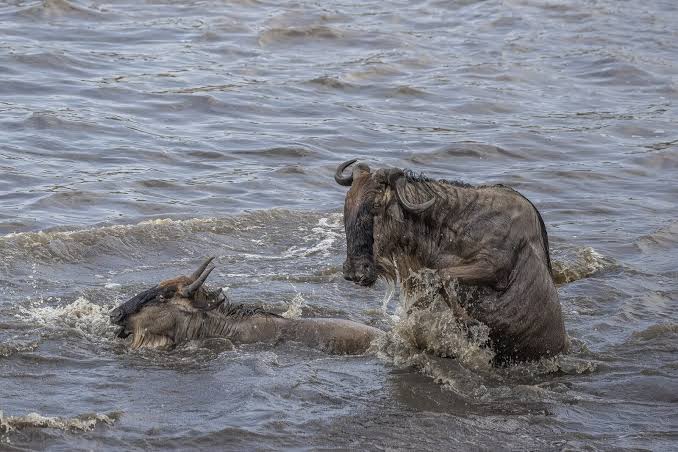
Every year, thousands of wildebeest attempt to cross the Mara River during the Great Migration between Kenya’s Maasai Mara National Reserve and Tanzania’s Serengeti National Park. While most animals successfully reach the opposite bank, others die because of powerful currents, steep riverbanks, exhaustion, overcrowding and attacks by Nile crocodiles. What happens to wildebeest that die during river crossings reveals an important part of the migration that many safari visitors rarely consider.
When wildebeest die in the Mara River, their remains become food for crocodiles, vultures, Marabou Storks, fish and numerous smaller organisms. As their bodies decompose, they release nutrients into the water, supporting aquatic life long after the migration herds have moved elsewhere.
For travellers exploring the Serengeti–Mara ecosystem, understanding this natural process provides a broader appreciation of the Great Migration. The river crossings influence the survival of individual animals, the feeding behaviour of predators and the ecological health of the surrounding environment.
Why Do Wildebeest Die During Mara River Crossings?
The Mara River is one of the most challenging obstacles encountered by migrating wildebeest.
During the crossing season, large herds gather along its banks before entering the water. Some crossings involve relatively calm sections, while others take place where strong currents, deep channels and steep banks make swimming difficult.
Although wildebeest are capable swimmers, not every animal survives.
Strong River Currents
Heavy rainfall can increase the flow of the Mara River, creating difficult swimming conditions.
Wildebeest entering strong currents may be carried downstream or become exhausted before reaching the opposite shore.
Young calves and injured animals can face additional challenges.
Steep and Slippery Riverbanks
Some crossing locations contain steep muddy slopes and rocky sections.
Wildebeest may successfully swim across the river but struggle to climb out.
When many animals arrive simultaneously, crowded conditions can make the situation more difficult.
Nile Crocodile Attacks
The Mara River supports Nile crocodiles that may attack wildebeest entering the water.
These powerful predators use concealment and sudden movements to capture prey.
However, crocodiles are not responsible for every wildebeest death. Many animals drown without being attacked.
How Many Wildebeest Die During River Crossings?
Scientific research has shown that mass drowning events can introduce substantial quantities of animal remains into the Mara River.
A study published in 2017 examined mass wildebeest drownings along the Kenyan section of the river.
Researchers estimated that approximately 6,250 wildebeest drowned annually on average during the period examined.
These deaths represented roughly 1,100 tonnes of animal biomass entering the river each year.
The figures are historical scientific estimates rather than confirmed totals for every migration season.
Actual mortality varies according to water levels, herd sizes, crossing locations and weather conditions.
Mara River Crossing Facts
| Feature | Description |
|---|---|
| Main location | Mara River, Kenya and Tanzania |
| Main migration period | July to October |
| Migrating animal | Blue Wildebeest |
| Scientific name | Connochaetes taurinus |
| Main mortality risks | Drowning, injuries and crocodile attacks |
| Major scavengers | Crocodiles, vultures and Marabou Storks |
| Aquatic consumers | Fish, invertebrates and microorganisms |
| Ecological contribution | Nutrient recycling and aquatic food resources |
What Happens Immediately After a Wildebeest Dies?
The fate of a dead wildebeest depends on where its body comes to rest.
Some carcasses remain submerged beneath the water.
Others float downstream until they become trapped among rocks, branches or river bends.
Carcasses that reach shallow areas may become accessible to crocodiles and scavenging birds.
Those remaining underwater provide food for fish and smaller aquatic organisms.
The decomposition process begins as microorganisms break down tissues.
Over time, different animals and organisms consume or process the remains.
1. Nile Crocodiles Feed on Wildebeest Carcasses
Nile crocodiles are among the most recognisable predators associated with the Great Migration.
They may capture live wildebeest during crossings or feed on animals that have already drowned.
Their powerful jaws allow them to grip large prey, while twisting movements help separate pieces of flesh.
Because adult wildebeest are too large to swallow whole, crocodiles must consume manageable portions.
Do Crocodiles Eat Every Dead Wildebeest?
No. Crocodiles consume only part of the animal material entering the river.
Their relatively low metabolic requirements mean they can survive for extended periods between substantial meals.
Research examining Mara River carcasses estimated that crocodiles consumed a relatively small proportion of the wildebeest biomass entering the studied river section.
Much of the remaining material became available to fish, scavenging birds and other organisms.
Crocodiles therefore play an important role, but they are only one part of the river’s natural food web.
2. Vultures and Marabou Storks Consume Exposed Remains
When wildebeest carcasses become stranded along riverbanks, scavenging birds may gather.
Vultures can detect carrion while searching extensive areas.
Their strong bills allow them to tear flesh from accessible carcasses.
Marabou Storks also consume animal remains, particularly where food is exposed along shallow river margins.
These large birds are opportunistic scavengers that may feed alongside vultures and other animals.
Why Scavenging Birds Are Important
Scavengers help remove exposed animal remains from the environment.
By consuming carrion, they transfer nutrients into their bodies and eventually back into the wider ecosystem.
Their feeding activities also influence how quickly accessible carcasses disappear.
However, many drowned wildebeest remain underwater, where birds cannot reach them.
3. Fish Feed on Wildebeest Remains
Fish are among the less visible beneficiaries of wildebeest deaths in the Mara River.
When carcasses enter the water, small pieces of animal tissue become available to aquatic consumers.
Some fish consume carcass material directly.
Others benefit indirectly from nutrients and smaller organisms associated with decomposition.
Scientific research has shown that wildebeest carcasses can contribute substantially to the diets of certain fish in the Mara River during periods when animal remains are available.
This demonstrates how the Great Migration influences aquatic animals that never leave the river.
4. Aquatic Invertebrates Help Break Down Carcasses
Aquatic invertebrates are small animals without backbones that live within freshwater environments.
Some feed on decomposing organic material, while others consume microorganisms growing on submerged surfaces.
When wildebeest carcasses enter the river, these organisms can benefit from the additional food resources.
Different invertebrates may become involved at different stages of decomposition.
Their feeding activities help transfer nutrients through the aquatic food web.
How Decomposition Takes Place
The breakdown of a wildebeest carcass generally involves several overlapping processes:
Crocodiles and other scavengers consume accessible flesh.
Fish feed on suitable pieces of animal tissue.
Microorganisms begin breaking down remaining material.
Aquatic invertebrates consume organic particles and microbial growth.
Nutrients enter the surrounding water and sediments.
Bones gradually break down over a much longer period.
The speed of decomposition depends on water temperature, oxygen levels, river flow and scavenger activity.
5. Wildebeest Bones Can Remain in the River for Years
One of the most remarkable findings from Mara River research concerns wildebeest bones.
Soft tissues generally decompose relatively quickly, often within several weeks.
Bones are much more resistant.
Research has shown that some bone material may remain in aquatic environments for years or even decades.
As bones slowly break down, they release nutrients such as phosphorus.
These nutrients can support microorganisms and other aquatic organisms.
Why Bones Matter
Phosphorus is an important nutrient for biological growth.
When bones release phosphorus into the river, some of it becomes available to organisms within the aquatic food web.
Microbial communities can also develop on submerged bones, providing additional feeding surfaces for small aquatic animals.
The remains of a single wildebeest may therefore continue influencing the river long after the visible carcass has disappeared.
6. Wildebeest Carcasses Transfer Nutrients Into the River
Wildebeest spend much of their lives grazing across the Serengeti–Mara grasslands.
The nutrients contained in the grasses they eat become incorporated into their bodies.
When an animal dies during a crossing, some of those nutrients enter the river.
Carbon, nitrogen and phosphorus are among the important materials released during decomposition.
These nutrients can be used by microorganisms and other aquatic life.
Some are transported downstream, while others become temporarily stored in sediments and remaining bones.
This creates an ecological connection between the savannah grasslands and the Mara River.
What Happens During Large Wildebeest Drowning Events?
Occasionally, hundreds or thousands of wildebeest may die during a particularly difficult crossing.
These mass drowning events introduce large quantities of organic material into a relatively small section of the river.
As carcasses decompose, microorganisms consume oxygen.
Where large amounts of organic material accumulate, dissolved oxygen levels may decline temporarily.
This can create difficult conditions for some aquatic organisms.
However, the additional food and nutrients also support scavengers and other consumers.
The overall ecological effect depends on river flow, the number of carcasses and environmental conditions.
Do Wildebeest Carcasses Attract Other Predators?
Dead wildebeest can attract terrestrial predators and scavengers when their bodies become accessible along riverbanks.
Spotted hyenas may feed on carcasses stranded near the shore.
Vultures and Marabou Storks may gather around exposed remains.
Crocodiles can also return to carcasses that remain partly submerged.
However, not every carcass attracts a large group of scavengers.
Some are carried downstream, trapped underwater or consumed by aquatic organisms before terrestrial animals can reach them.
When Do Most Wildebeest Cross the Mara River?
The main Mara River crossing season usually occurs between July and October.
August and September are often particularly favourable months for visitors hoping to observe large migrating herds.
However, rainfall patterns and grazing conditions influence the timing.
Crossings can occur at different locations throughout the season.
Some days produce several major crossings, while others pass without significant activity.
Where to See Wildebeest River Crossings
Maasai Mara National Reserve, Kenya
The Maasai Mara is one of Africa’s most famous destinations for observing wildebeest crossing the Mara River.
Visitors may encounter large herds, Nile crocodiles and scavenging birds around suitable crossing locations.
Mara Triangle, Kenya
The Mara Triangle provides access to important migration habitats and several sections of the Mara River.
Its open grasslands also support numerous predators and grazing animals.
Northern Serengeti National Park, Tanzania
Northern Serengeti offers opportunities to observe river crossings around areas such as Kogatende and Lamai.
Wildlife viewing depends on the location of migrating herds and seasonal conditions.
How Long Should Travellers Stay to See a Crossing?
Mara River crossings are unpredictable.
Wildebeest may gather near the river for several hours before entering the water.
Sometimes the animals approach the riverbank and then move away without crossing.
Travellers primarily interested in migration activity should consider spending three or four nights in a suitably located safari camp.
This provides several opportunities to search for active herds.
However, no safari duration guarantees a river crossing.
An experienced guide can help interpret recent animal movements and select appropriate viewing locations.
Photography Tips for Mara River Wildlife
Photographing the Great Migration provides opportunities to capture herd movements, predator behaviour and the surrounding landscape.
A zoom lens of approximately 100–400 mm offers flexibility for photographing animals at different distances.
For running or swimming wildebeest, use a shutter speed around 1/1000–1/2000 second when lighting conditions permit.
Wider photographs can show the scale of the crossing and surrounding savannah.
Visitors interested in ecological behaviour may also photograph crocodiles and scavenging birds feeding naturally.
Avoid disturbing carcasses or approaching animals unnecessarily.
Responsible Wildlife Viewing During Crossings
The Mara River is a sensitive wildlife environment where animals should be allowed to move naturally.
Safari vehicles should remain in authorised viewing areas.
Drivers must avoid blocking wildebeest approaching the river.
Visitors should never attempt to influence the direction or timing of a crossing.
Carcasses should remain undisturbed because they provide important food for wildlife.
Responsible observation helps protect migrating animals, predators and scavengers while allowing visitors to experience natural behaviour.
Why Wildebeest Deaths Are Important to the Mara River Ecosystem
The wildebeest that do not survive river crossings become part of a complex natural process.
Their remains feed crocodiles, vultures, Marabou Storks, fish and aquatic invertebrates.
As tissues decompose, nutrients enter the river and support different organisms.
Bones may remain for years, gradually releasing additional nutrients.
Scientific research demonstrates that these annual inputs can influence the Mara River’s aquatic food web long after the migration has passed.
For travellers exploring the Serengeti–Mara ecosystem, understanding this process provides a more complete appreciation of the Great Migration.
The event involves much more than large herds travelling between grazing areas. It also influences predators, scavengers, freshwater organisms and the surrounding environment.
What becomes of the wildebeest that do not survive a crossing reveals an important ecological relationship between Africa’s savannah grasslands and freshwater ecosystems.
Some animals are consumed by crocodiles, while others provide food for scavenging birds and aquatic organisms.
Their remains gradually decompose, releasing nutrients that contribute to the river’s natural processes.
Although these deaths are an unavoidable part of the migration, they demonstrate how wildlife and ecosystems remain connected.
For safari visitors, observing the Great Migration with an understanding of these relationships adds valuable context to one of Africa’s most remarkable natural events.



No comment