
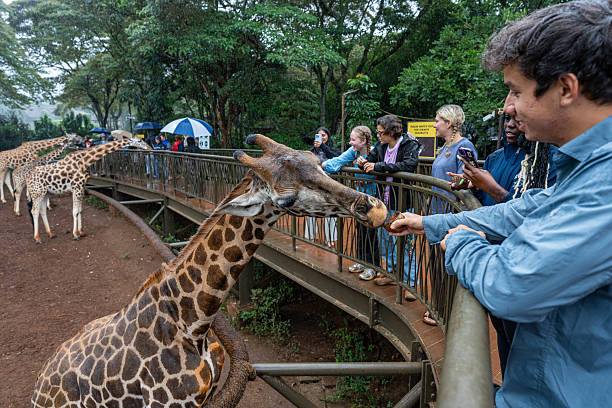
Giraffe Centre in Nairobi: Feeding Rothschild’s Giraffes at Eye Level
The Giraffe Centre in Nairobi is one of Kenya’s most memorable wildlife attractions, offering visitors the opportunity to feed endangered Rothschild’s giraffes from an elevated viewing platform. Located in the leafy Lang’ata area, near Karen, the centre combines close wildlife encounters with conservation education and beautiful natural surroundings.
Unlike a traditional safari, where giraffes are usually observed from a vehicle, the Giraffe Centre allows visitors to stand almost face-to-face with these magnificent animals. Their long necks, gentle movements and remarkable tongues make the experience particularly enjoyable for families, photographers and wildlife enthusiasts.
The centre also plays an important role in protecting endangered giraffes through breeding, conservation education and wildlife translocation programmes.
For travellers spending a day in Nairobi, the Giraffe Centre provides an accessible introduction to Kenya’s wildlife conservation efforts.
Where Is the Giraffe Centre Located?
The Giraffe Centre is situated on Nyumbi Road, off Duma Road, in Nairobi’s Lang’ata suburb.
It lies approximately 15 kilometres from Nairobi’s city centre.
The surrounding area contains residential neighbourhoods, restaurants and several popular tourist attractions.
Quick Facts About the Giraffe Centre
| Feature | Description |
|---|---|
| Country | Kenya |
| City | Nairobi |
| Area | Lang’ata, near Karen |
| Established | 1979 |
| Opened to visitors | 1983 |
| Main attraction | Rothschild’s giraffes |
| Opening hours | 9:00 am–5:00 pm |
| Adult non-resident entry | KES 1,500 |
| Child non-resident entry | KES 750 |
| Recommended visit | 1½–2 hours |
The History of the Giraffe Centre
The Giraffe Centre was established by the African Fund for Endangered Wildlife, commonly called AFEW Kenya.
The organisation was founded in 1979 by Jock Leslie-Melville and his wife, Betty Leslie-Melville.
Their conservation work began after they recognised the serious decline of Rothschild’s giraffes in Kenya.
At the time, habitat loss threatened the remaining populations.
The First Rescued Giraffes
The founders brought two young giraffes, Daisy and Marlon, to their property in Lang’ata.
These animals became the foundation of a breeding programme designed to support the survival of the subspecies.
In 1983, the centre opened to the public and began welcoming schoolchildren for conservation education.
Over time, it developed into one of Nairobi’s best-known wildlife attractions.
What Are Rothschild’s Giraffes?
Rothschild’s giraffes are a distinctive population of northern giraffes, often associated with the Nubian giraffe subspecies.
They are historically found in parts of Kenya and Uganda.
Their striking coat patterns and impressive height make them easily recognisable.
How to Identify a Rothschild’s Giraffe
Rothschild’s giraffes have irregular brown patches separated by lighter lines.
Their lower legs are often largely white, creating an appearance sometimes described as wearing white stockings.
They also possess the familiar horn-like structures called ossicones.
Like other giraffes, they use their long tongues to reach leaves and other vegetation.
Why Are Rothschild’s Giraffes Endangered?
Historically, Rothschild’s giraffes occupied a wider range across East Africa.
Agricultural expansion, settlement and habitat fragmentation reduced suitable grazing and browsing areas.
Small isolated populations became particularly vulnerable.
Conservation Challenges
Limited habitat restricts animal movement.
Small populations can experience reduced genetic diversity.
Human development may also interrupt natural migration routes.
Protecting suitable habitats and maintaining healthy breeding populations are therefore important conservation priorities.
Feeding Giraffes at Eye Level
The centre’s most famous attraction is its elevated wooden feeding platform.
The structure allows visitors to stand at approximately the height of a giraffe’s head.
Instead of looking upwards from the ground, visitors can observe the giraffe’s face closely.
What Happens During Feeding?
Staff provide specially prepared food pellets.
Visitors hold individual pellets between their fingers while the giraffes approach.
The animals extend their long tongues to collect the food.
Guides explain how to offer pellets safely.
The encounter is supervised to protect both visitors and animals.
What Do the Giraffes Eat?
The centre provides specially formulated food pellets containing ingredients such as corn, wheat, grass and molasses.
These supplements are offered alongside the giraffes’ normal feeding arrangements.
Why Visitors Cannot Bring Food
Giraffes require suitable nutrition.
Human snacks and unsuitable plants can cause health problems.
Visitors must therefore feed only the pellets or foliage supplied by authorised staff.
Never offer bread, biscuits, fruit or other food without permission.
How to Feed a Giraffe Safely
The centre has specific rules for feeding.
Visitors should listen carefully to the conservation educators before approaching the animals.
Important Feeding Rules
Hold one pellet between your thumb and index finger.
Offer the pellet towards the giraffe’s tongue.
Do not place several pellets on an open palm.
Never tease or pull food away.
Avoid loud noises and sudden movements.
Follow the educator’s instructions.
Remain within permitted visitor areas.
Giraffes are powerful wild animals despite their generally calm appearance.
Can a Giraffe Kiss You?
The Giraffe Centre is famous for photographs showing giraffes taking pellets from visitors’ lips.
However, close contact with wild animals carries hygiene and safety considerations.
Visitors should follow current staff instructions rather than assume such contact is appropriate.
A Better Wildlife Experience
Feeding the giraffes by hand provides excellent opportunities for close observation.
Visitors can appreciate their enormous eyes, long eyelashes and unusual tongues.
There is no need to encourage unnecessary physical contact to enjoy the experience.
The Giraffe Centre’s Conservation Programme
The centre operates a breeding programme supporting Rothschild’s giraffe conservation.
Young giraffes born through the programme may eventually be transferred to suitable protected habitats.
Returning Giraffes to Protected Areas
The organisation works with conservation authorities to identify appropriate release locations.
Animals are monitored and managed according to conservation requirements.
The programme has released more than 40 giraffes into protected areas across Kenya.
These efforts help support surviving populations.
Conservation Education for Children
Education is central to the Giraffe Centre’s mission.
The organisation welcomes thousands of Kenyan schoolchildren every year.
Students learn about wildlife, ecosystems and environmental protection.
Why Education Matters
Children who understand wildlife conservation may become more interested in protecting natural habitats.
The centre introduces topics including sustainable development, waste management and forest conservation.
Educational visits help connect classroom learning with living animals.
Exploring the Nature Trail
The Giraffe Centre offers more than feeding opportunities.
Visitors can explore an approximately 1.5-kilometre nature trail through the adjoining sanctuary.
The trail passes woodland habitats and viewpoints.
Wildlife Along the Trail
Visitors may encounter birds, squirrels and small antelopes such as dik-diks.
The route also leads towards the Gogo River.
A viewpoint provides attractive scenery towards the Ngong Hills.
Walking conditions vary, so comfortable shoes are recommended.
Birdwatching at the Giraffe Centre
The sanctuary supports numerous bird species associated with Nairobi’s woodland habitats.
Birdwatchers can explore the trail while listening for calls and observing birds among the trees.
What to Bring
Binoculars are useful for identifying smaller birds.
A camera with a zoom lens can capture distant wildlife.
Early visits may provide comfortable walking conditions.
Remain on designated paths to avoid disturbing vegetation and nesting birds.
Giraffe Centre Entrance Fees
The centre publishes separate admission rates for residents and non-residents.
Published Entry Fees
| Visitor category | Entrance fee |
|---|---|
| Non-resident adult | KES 1,500 |
| Non-resident child, 3–12 years | KES 750 |
| Resident adult | KES 400 |
| Resident child, 3–12 years | KES 200 |
| Children under 3 | Free |
Eligible students below 23 years may qualify for child rates with valid student identification.
Visitors should confirm current admission arrangements before travelling.
How to Pay for Admission
The Giraffe Centre accepts electronic payments.
Visitors can pay using M-Pesa, Visa or Mastercard.
Cash is not accepted under the centre’s published payment policy.
Do You Need Advance Booking?
Ordinary individual visits are generally accommodated during opening hours, subject to capacity and admission arrangements.
The centre also provides an online pre-booking service.
School groups must book at least one week in advance.
Visitors travelling with large groups should confirm arrangements beforehand.
Opening Hours and Best Visiting Time
The Giraffe Centre opens daily from 9:00 am to 5:00 pm, including weekends and public holidays.
Weekdays between 11:00 am and 1:00 pm can be particularly busy.
Weekends often attract large crowds throughout the day.
When Should You Arrive?
An early morning visit can provide a quieter experience.
Allow approximately one and a half to two hours for feeding, educational activities and exploring the nature trail.
Visitors who dislike crowds should avoid the busiest periods.
How to Reach the Giraffe Centre
The centre is accessible by private taxi, ride-hailing vehicle or organised sightseeing transport.
Travellers commonly visit from Nairobi’s city centre, Karen or nearby hotels.
Driving times vary considerably with traffic.
A private transfer can simplify transport arrangements for families.
Visiting With Children
The Giraffe Centre is popular with families because children can observe giraffes at close range.
The elevated platform provides an unusual educational experience.
Parents should supervise younger visitors carefully.
Children must follow feeding instructions and avoid reaching towards animals without guidance.
Photography Tips
The giraffe feeding platform creates excellent photography opportunities.
Portrait photographs can capture giraffes at eye level.
Visitors can also photograph the animals against the surrounding greenery.
Getting Better Photographs
Use natural light where possible.
Avoid unnecessary flash.
Keep your camera secure.
Do not interrupt other visitors.
Follow instructions when photographing animals near the platform.
Combining the Visit With Other Attractions
The Giraffe Centre can be included in a wider Nairobi wildlife itinerary.
Nearby attractions include the Sheldrick Wildlife Trust Nairobi Nursery, Karen Blixen Museum and Nairobi National Park.
Suggested Nairobi Day Trip
Morning: Visit the Giraffe Centre and enjoy the feeding experience.
Late Morning: Continue towards Karen Blixen Museum or another nearby attraction.
Afternoon: Enjoy lunch and explore suitable cultural or wildlife attractions.
Sheldrick Wildlife Trust visits require separate advance booking for the 11:00 am session.
Responsible Wildlife Tourism
The Giraffe Centre’s animals are part of a managed conservation programme.
Visitors should respect their welfare and follow all instructions.
Avoid feeding unauthorised food.
Do not attempt to touch or disturb the giraffes unnecessarily.
Supporting established conservation programmes helps protect threatened wildlife populations.
Why the Giraffe Centre Is Worth Visiting
The Giraffe Centre offers one of Nairobi’s most memorable wildlife experiences.
Feeding Rothschild’s giraffes from an elevated platform allows visitors to appreciate these magnificent animals from an unusual perspective.
The visit also provides valuable information about endangered wildlife, habitat protection and conservation education.
For families, photographers and safari travellers, the centre combines enjoyable wildlife observation with an important environmental message.



No comment