
The African Fish Eagle’s Cry
The African Fish Eagle’s Cry: Why It Became the Sound of Africa
The African Fish Eagle (Icthyophaga vocifer) is one of Africa’s most recognisable birds of prey, famous for its powerful, ringing cry that echoes across lakes, rivers and wetlands. Its distinctive call has become widely associated with African wildlife documentaries, nature programmes and safari experiences. For many travellers, hearing an African Fish Eagle calling from a tall tree beside the water is among the most memorable moments of an African safari.
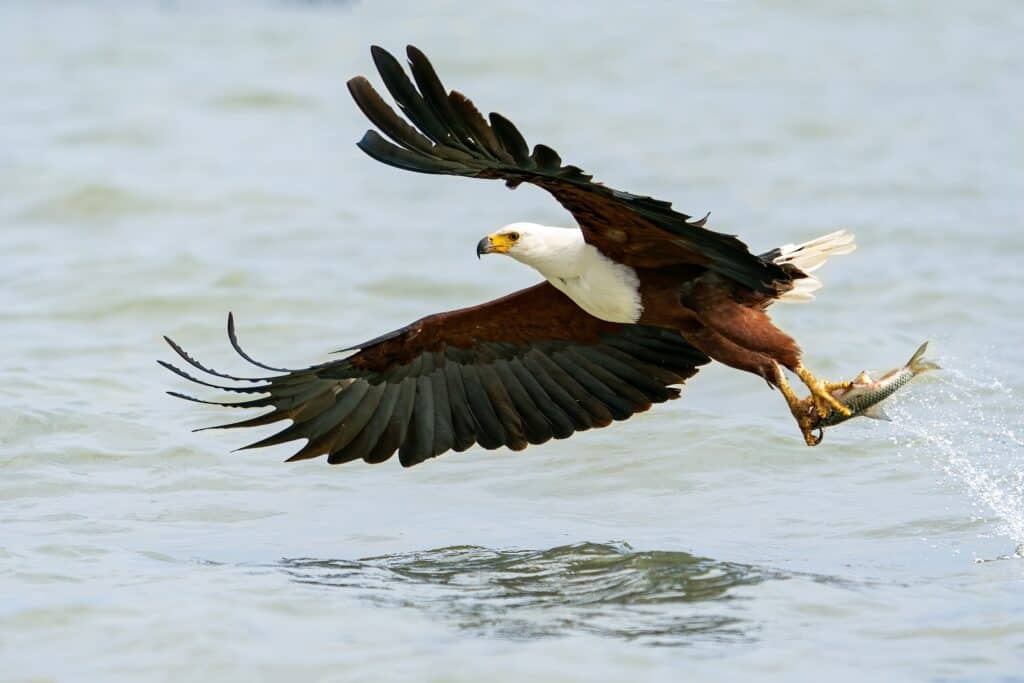
With its bright white head, chestnut-brown body, dark wings and piercing yellow eyes, the African Fish Eagle is unmistakable. However, its voice is even more famous than its appearance. The bird produces a loud, musical call that can travel considerable distances across open water. Often described as the “Voice of Africa”, its cry is associated with the continent’s freshwater landscapes and wildlife.
In Uganda, visitors can hear African Fish Eagles around Lake Victoria, the Nile River, Lake Mburo and the Kazinga Channel in Queen Elizabeth National Park. Understanding why these birds call, how they communicate and where to observe them adds an interesting dimension to a birdwatching safari.
What Is the African Fish Eagle?
The African Fish Eagle is a large bird of prey belonging to the family Accipitridae, which includes eagles, hawks and other raptors. Its scientific name is Icthyophaga vocifer, although it remains widely known by its former scientific name, Haliaeetus vocifer.
The species occurs throughout much of sub-Saharan Africa, particularly around freshwater lakes, major rivers, reservoirs and coastal lagoons.
Fish eagles depend on aquatic habitats because fish make up most of their diet. They generally occupy areas with suitable hunting perches, nesting trees and reliable food supplies.
Unlike many smaller birds, African Fish Eagles are relatively easy to observe because they often perch openly on tall trees overlooking the water.
Quick Facts About the African Fish Eagle
| Feature | Description |
|---|---|
| Common name | African Fish Eagle |
| Scientific name | Icthyophaga vocifer |
| Former scientific name | Haliaeetus vocifer |
| Family | Accipitridae |
| Body length | Approximately 63–75 cm |
| Wingspan | Approximately 2–2.4 metres |
| Main colours | White, chestnut-brown and black |
| Main food | Fish |
| Habitat | Lakes, rivers, wetlands and coastal lagoons |
| Famous feature | Loud, ringing territorial call |
| Behaviour | Territorial, often seen alone or in pairs |
| Conservation status | Least Concern |
| Distribution | Much of sub-Saharan Africa |
Why Is the African Fish Eagle’s Cry Called the Sound of Africa?
The African Fish Eagle’s call is among the most distinctive natural sounds associated with African freshwater environments.
Its powerful, clear notes can be heard from considerable distances, especially across open lakes where fewer physical obstacles interrupt the sound.
The call is frequently used in wildlife documentaries and films to represent African landscapes. As a result, many people recognise the sound before they have ever seen the bird.
Unlike the deep roar of a lion or the trumpeting of an elephant, the African Fish Eagle’s cry is commonly associated with rivers, lakes and peaceful morning wildlife scenes.
However, the bird’s call has an important biological purpose. African Fish Eagles use vocalisations to communicate with their mates, advertise territories and respond to other birds.
What Does an African Fish Eagle Sound Like?
The African Fish Eagle produces a loud, ringing series of notes commonly written as:
“Weee-ah, hyo-hyo-hyo!”
The opening note is usually high and clear, followed by several shorter, descending calls.
When calling, the eagle often throws its head backwards, opens its bill and projects the sound across the surrounding landscape.
Both males and females call, although their voices differ slightly in pitch.
Pairs may also call together, creating a distinctive duet that can be heard around their territories.
Why Do African Fish Eagles Cry So Loudly?
The African Fish Eagle uses its voice for several important reasons.
1. Defending Its Territory
African Fish Eagles are territorial birds, particularly around established feeding and nesting areas.
A breeding pair may occupy a section of shoreline containing suitable fishing locations and tall nesting trees.
Their calls warn neighbouring eagles that the area is occupied.
These vocal displays can help birds maintain territorial boundaries without constantly engaging in physical confrontations.
2. Communicating With Their Partners
African Fish Eagles often form long-term breeding pairs.
The male and female regularly communicate through calls, particularly around nesting sites.
Pairs sometimes perform coordinated vocal duets, with one bird calling and the other responding.
These exchanges help maintain communication between partners and reinforce their pair relationship.
3. Responding to Other Eagles
When one African Fish Eagle begins calling, another may respond from a nearby tree or an adjoining territory.
During a boat safari, visitors may hear several birds calling from different parts of a lake or river.
This creates an impressive wildlife experience, particularly during quiet mornings when sound travels clearly across the water.
4. Communicating During Breeding
Calling activity can increase during territorial displays and the breeding season.
Adults may call near their nests or while interacting with their partners.
However, fish eagles also vocalise outside the breeding season, so hearing a call does not necessarily indicate that nesting is taking place.
How to Identify an African Fish Eagle
The African Fish Eagle has a distinctive appearance that makes adult birds relatively easy to identify.
Its head, chest and tail are bright white, while its body contains rich chestnut-brown feathers. Dark wings provide a strong contrast during flight.
The bird has a large, hooked bill, yellow facial skin and powerful feet equipped with sharp talons.
Female African Fish Eagles are generally larger than males, although both sexes have similar colouring.
Main Identification Features
White head, chest and tail.
Chestnut-brown body and shoulders.
Broad, dark wings.
Large hooked bill with yellow facial skin.
Strong yellow feet and sharp talons.
Broad wings used for soaring and fishing.
Loud, distinctive calls around waterways.
Young African Fish Eagles look different from adults. Their feathers are generally mottled brown and white, and they gradually develop the characteristic adult plumage over several years.
How African Fish Eagles Catch Fish
The African Fish Eagle is a skilled hunter that relies heavily on its eyesight, powerful feet and sharp talons.
It commonly hunts from a tree overlooking a lake or river, carefully watching for fish approaching the water’s surface.
When suitable prey appears, the eagle launches from its perch and flies towards the target.
It extends its feet forward and grasps the fish with its talons, often taking the prey without fully entering the water.
Main Hunting Techniques
| Hunting method | Description |
|---|---|
| Perch hunting | Watching fish from a waterside tree |
| Surface fishing | Grabbing fish close to the water’s surface |
| Low flight | Searching for prey while flying over water |
| Scavenging | Feeding on available dead animals |
| Stealing food | Taking prey from other birds |
African Fish Eagles sometimes steal fish captured by other birds, including herons and other fish-eating species.
They may also feed on waterbirds and other small animals when opportunities arise.
What Fish Do African Fish Eagles Eat?
Their diet varies according to the species available in different lakes and rivers.
Common prey includes tilapia, catfish and other freshwater fish.
Smaller fish are usually carried to a nearby perch, where the eagle uses its hooked bill to tear the prey into manageable pieces.
Larger fish may be dragged towards the shoreline when they are too heavy to lift directly from the water.
Best Places to Hear African Fish Eagles in Uganda
Uganda offers excellent opportunities to observe African Fish Eagles because the country contains numerous lakes, rivers and freshwater wetlands.
Several major national parks also provide boat safari experiences where visitors can watch these birds hunting, calling and resting along the shoreline.
Top African Fish Eagle Birdwatching Destinations
| Destination | Location | Birdwatching opportunity |
|---|---|---|
| Lake Victoria | Central and southern Uganda | Fish eagles around wooded shorelines and islands |
| Murchison Falls National Park | Northwestern Uganda | Eagles along the Nile River |
| Queen Elizabeth National Park | Western Uganda | Boat safaris along the Kazinga Channel |
| Lake Mburo National Park | Western Uganda | Lakeshore birdwatching and boat trips |
| Lake Albert | Western Uganda | Fish eagles near suitable fishing areas |
| Lake Bunyonyi | Southwestern Uganda | Birdwatching around wooded lakeshores |
| Lake Edward | Western Uganda | Waterbirds and fish eagles near the shoreline |
African Fish Eagles Along the Kazinga Channel
The Kazinga Channel connects Lake Edward and Lake George within Queen Elizabeth National Park.
The channel supports numerous waterbirds, including pelicans, cormorants, herons and African Fish Eagles.
During a boat safari, visitors may observe fish eagles perched on shoreline trees, searching for fish or calling to their partners.
The open water provides favourable opportunities for photographing birds without approaching their nesting sites.
African Fish Eagles in Murchison Falls National Park
The Nile River is another rewarding location for observing African Fish Eagles.
Visitors exploring the river by boat may encounter birds resting in tall trees, flying over the water or hunting near quieter river sections.
Morning and afternoon boat excursions offer opportunities to hear their calls and watch their movements.
African Fish Eagles Around Lake Victoria
Lake Victoria is one of Africa’s largest freshwater lakes and supports numerous fish-eating bird species.
African Fish Eagles occur along suitable sections of its extensive shoreline.
Travellers visiting Entebbe and nearby lakeside areas may hear their distinctive calls while exploring beaches, gardens and wetland environments.
Best Time to Hear the African Fish Eagle’s Cry
African Fish Eagles can be observed throughout the year in Uganda and other parts of East Africa.
However, certain times of day offer better opportunities to hear their calls and observe their behaviour.
Early morning is particularly rewarding because the birds may be calling, communicating with their partners or preparing to hunt.
Late afternoon can also be productive, especially around quiet lakes and rivers.
Best Birdwatching Conditions
| Time or season | What visitors may experience |
|---|---|
| Early morning | Territorial calls and hunting activity |
| Mid-morning | Birds perched or soaring above water |
| Afternoon | Fishing and resting along shorelines |
| Late afternoon | Calling and movement between perches |
| Wet season | Birdwatching around lakes and flooded habitats |
| Dry season | Opportunities near permanent water sources |
For the best experience, choose a quiet boat excursion with a knowledgeable wildlife guide who can identify calls and explain bird behaviour.
African Fish Eagle Breeding and Nesting Behaviour
African Fish Eagles generally form breeding pairs and construct large nests in tall trees near water.
Their nests are made from sticks and branches, with softer materials sometimes used to line the interior.
Pairs may reuse the same nest over several breeding seasons, gradually adding more materials.
The female usually lays one to three eggs, although two is common.
Incubation lasts approximately 42–45 days, and both parents contribute to raising the young.
Young birds remain dependent on their parents for some time after leaving the nest.
During breeding periods, adult eagles may become particularly vocal around their territories.
How to Photograph African Fish Eagles on Safari
African Fish Eagles are popular wildlife photography subjects because of their striking appearance and impressive hunting behaviour.
A telephoto lens of approximately 300–500 mm is suitable for many boat safari situations.
For an eagle diving towards the water, a shutter speed of around 1/1600–1/2500 second can help freeze the action when lighting conditions permit.
When photographing a perched bird, focus carefully on its eyes and include enough surrounding habitat to provide context.
Avoid approaching active nests or disturbing birds while they are feeding.
Conservation of African Fish Eagles
The African Fish Eagle is currently classified as Least Concern on the IUCN Red List.
Although the species remains widespread, some populations face pressure from pollution, habitat loss and changes in fish availability.
Wetland destruction and the removal of large waterside trees can reduce suitable nesting and hunting locations.
Pollutants entering freshwater systems may also affect fish and the birds that consume them.
Protecting lakes, rivers and wetlands helps maintain healthy habitats for African Fish Eagles and many other aquatic species.
Why the African Fish Eagle Remains a Symbol of Africa’s Wildlife
The African Fish Eagle has earned its reputation as one of the continent’s most recognisable birds.
Its powerful voice, distinctive white head and remarkable fishing abilities make it a memorable species for wildlife enthusiasts.
For travellers exploring Uganda’s waterways, hearing an African Fish Eagle call from a tall tree can be as rewarding as watching it catch a fish.
Its cry is widely associated with Africa because it is distinctive, frequently heard around major waterways and familiar through decades of wildlife films and nature programmes.
Whether you encounter the bird along the Nile River, beside Lake Victoria or during a Kazinga Channel boat safari, its unmistakable call is an unforgettable part of East Africa’s natural environment.







No comment