
Shimba Hills National Park: Sable Antelope and Waterfall Walks Near Mombasa
Shimba Hills National Park, officially known as Shimba Hills National Reserve, is one of Kenya’s most beautiful coastal wildlife destinations. Located in Kwale County, near Mombasa and Diani Beach, the reserve offers visitors a refreshing combination of rare sable antelopes, forest elephants, tropical vegetation and scenic waterfall walks.
Unlike the open grasslands of the Maasai Mara, Shimba Hills features rolling green hills, coastal rainforest, woodland and scattered grassland clearings. These habitats support an interesting variety of wildlife and provide opportunities for peaceful game drives, birdwatching and guided hiking.
For travellers spending time along Kenya’s southern coastline, Shimba Hills offers an enjoyable escape from the beach and an opportunity to discover the country’s lesser-known wildlife.
Where Is Shimba Hills National Reserve Located?
Shimba Hills National Reserve lies approximately 30 kilometres southwest of Mombasa, within Kwale County.
The reserve covers around 192.5 square kilometres and forms part of an important coastal forest ecosystem.
Visitors commonly reach it from Diani Beach, Ukunda, Kwale or Mombasa.
Quick Facts About Shimba Hills
| Feature | Description |
|---|---|
| Country | Kenya |
| County | Kwale |
| Official name | Shimba Hills National Reserve |
| Reserve size | Approximately 192.5 km² |
| Established as a national reserve | 1968 |
| Famous wildlife | Sable antelope and elephants |
| Main waterfall | Sheldrick Falls |
| Main activities | Game drives and guided walking |
| Opening hours | 6:00 am–6:00 pm |
| Recommended visit | One full day |
| Management | Kenya Wildlife Service and Kenya Forest Service |
Why Is Shimba Hills Special?
Shimba Hills protects one of Kenya’s most important remaining coastal forest landscapes.
Its vegetation differs considerably from the dry savannah found in many other national parks.
The reserve contains forested valleys, grassland openings and viewpoints overlooking the coastal region.
These varied habitats support rare plants, birds, butterflies and large mammals.
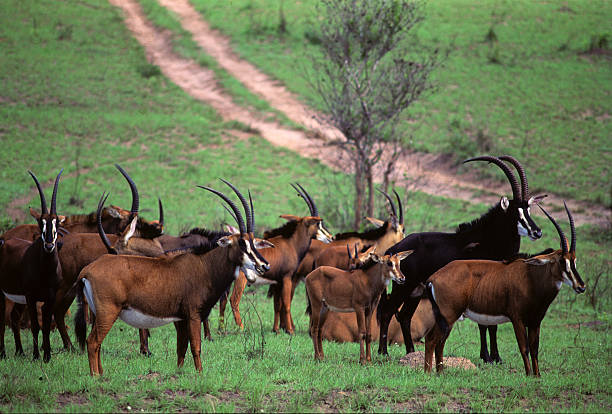
The reserve is especially important because it protects Kenya’s remaining breeding population of sable antelopes.
Sable Antelope: The Star of Shimba Hills
Sable antelopes are among Africa’s most impressive antelope species.
They are recognised by their strong bodies, striking facial markings and long backward-curving horns.
Adult males generally develop very dark coats, while females and younger animals are more reddish-brown.
Why Are Sable Antelopes Rare in Kenya?
Sable antelopes historically occupied suitable woodland and grassland habitats across parts of eastern and southern Africa.
In Kenya, habitat changes and population declines reduced their distribution.
Today, Shimba Hills supports the country’s last recognised breeding population.
Protecting this population remains a major conservation priority.
Where Can You See Sable Antelopes?
Sable antelopes generally favour grassland clearings near woodland.
They may move between open feeding areas and sheltered vegetation.
Tips for Finding Sable Antelopes
Begin game drives early in the morning.
Explore appropriate grassland habitats with an experienced guide.
Use binoculars to scan distant vegetation.
Remain patient because the animals may be difficult to locate.
Sable sightings are never guaranteed, particularly when animals remain hidden within dense vegetation.
Elephants in Shimba Hills
African elephants are another important attraction.
The reserve supports elephants that move through forest, woodland and grassland habitats.
Visitors may encounter individuals or family groups during game drives.
Understanding Elephant Behaviour
Elephants browse leaves, branches and other vegetation.
Their movements depend on food availability, water and seasonal conditions.
They also influence vegetation through feeding and movement.
Elephant Safety
Never approach elephants on foot without authorised ranger arrangements.
Remain inside your safari vehicle during ordinary game drives.
Avoid blocking elephant movement routes.
Maintain safe viewing distances, particularly around mothers with calves.
Other Wildlife in Shimba Hills
Although sable antelopes and elephants receive the most attention, the reserve supports many other animals.
Wildlife Viewing Guide
| Animal | Typical habitat |
|---|---|
| Sable antelope | Grassland clearings |
| African elephant | Forest and woodland |
| African buffalo | Grassland and forest edges |
| Bushbuck | Dense woodland |
| Waterbuck | Suitable grassland areas |
| Sykes’ monkey | Coastal forest |
| Black-and-white colobus | Forest canopy |
| Leopard | Secretive forest habitats |
| Duiker | Dense undergrowth |
Wildlife viewing can be challenging because vegetation is often thick.
Sheldrick Falls: The Famous Waterfall
Sheldrick Falls is among the most popular attractions within Shimba Hills National Reserve.
The waterfall drops approximately 21 metres into a pool surrounded by green vegetation.
Reaching the falls involves a guided walk through beautiful forest scenery.
What Makes the Waterfall Special?
The walking route introduces visitors to a quieter part of the reserve.
Along the trail, travellers may observe birds, butterflies, forest plants and interesting vegetation.
The sound of flowing water becomes more noticeable as visitors approach the waterfall.
The setting is particularly attractive for landscape photography.
Hiking to Sheldrick Falls
The waterfall walk is moderately challenging because of uneven terrain and the uphill return journey.
Visitors should arrange a guide or ranger escort and confirm current access conditions.
Walking Information
| Feature | Description |
|---|---|
| Attraction | Sheldrick Falls |
| Waterfall height | Approximately 21 metres |
| Walking difficulty | Moderate |
| Trail | Forest path with downhill and uphill sections |
| Recommended footwear | Closed walking shoes |
| Guide | Ranger or authorised guide recommended |
| Main challenge | Uphill return walk |
Allow approximately two hours or more for the complete experience, depending on walking speed and trail conditions.
Is Swimming Allowed at Sheldrick Falls?
The waterfall has a natural pool, and some guided excursions include swimming when conditions permit.
However, water depth, currents and slippery rocks create potential hazards.
Important Swimming Precautions
Ask your ranger whether swimming is currently permitted.
Avoid entering the water after heavy rainfall.
Never dive into unfamiliar pools.
Do not swim alone.
Keep children supervised.
Visitors who prefer not to swim can enjoy photography and the surrounding scenery.
Exploring Shimba Hills’ Coastal Rainforest
The reserve’s forest contains an impressive variety of indigenous plants.
Its vegetation benefits from relatively high rainfall compared with nearby coastal lowlands.
Large trees provide habitats for birds, monkeys and smaller forest animals.
Why the Forest Matters
Coastal forests support species that may struggle to survive in open savannah habitats.
They also protect water catchment areas and reduce soil erosion.
Conservation helps preserve rare plants and important ecological relationships.
Birdwatching in Shimba Hills
Shimba Hills is a rewarding birdwatching destination because of its forest and grassland habitats.
The reserve supports birds associated with Kenya’s coastal forests.
Birds to Look For
| Bird | Main attraction |
|---|---|
| Crowned hornbill | Forest and woodland bird |
| Uluguru violet-backed sunbird | Colourful forest species |
| Greater honeyguide | Woodland bird |
| African hawk-eagle | Bird of prey |
| Kenya crested guineafowl | Distinctive forest bird |
| Trumpeter hornbill | Large forest hornbill |
Birdwatchers should bring binoculars and allow time for slow observation.
Ocean View Point
Ocean View Point is one of Shimba Hills’ most attractive scenic stops.
On clear days, visitors can enjoy expansive views towards Kenya’s coastline.
The surrounding hills, valleys and forests create beautiful photographic backgrounds.
Photography Opportunities
Wide-angle photographs capture the rolling landscape.
Morning light can be particularly attractive.
Clouds and mist may occasionally reduce visibility, but they can also create dramatic scenery.
Pengo Hill and Scenic Landscapes
Pengo is associated with the highest area of the Shimba Hills landscape.
The surrounding elevated terrain offers impressive views across forest and grassland habitats.
Visitors should confirm accessible viewpoints and approved routes with park staff.
Not every hillside is open for independent exploration.
Best Time to Visit Shimba Hills
The reserve can be visited throughout the year.
However, relatively dry conditions generally make game drives and waterfall walking more comfortable.
January to March and June to October are often convenient visiting periods.
Seasonal Visiting Guide
| Period | General conditions |
|---|---|
| January–March | Warm and often relatively dry |
| April–May | Increased rainfall |
| June–October | Generally comfortable conditions |
| November–December | Variable rainfall |
Rain may make forest trails slippery and affect road conditions.
Shimba Hills Entrance Fees
Kenya Wildlife Service publishes different conservation fees according to visitor category.
Published 2026 Entry Fees
| Visitor category | Adult fee | Child fee |
|---|---|---|
| East African citizen | KES 500 | KES 250 |
| Kenya resident | KES 675 | KES 350 |
| African citizen outside East Africa | USD 20 | USD 10 |
| International non-resident | USD 50 | USD 25 |
Guiding and vehicle charges may apply separately.
Confirm the current tariff before travelling.
How to Reach Shimba Hills From Mombasa
Travellers commonly reach the reserve through the southern coastal road network towards Kwale.
Visitors departing from Mombasa Island may use the Likoni crossing before continuing inland.
Travel time depends on traffic, ferry queues and road conditions.
A private safari vehicle offers convenient access to the reserve.
Visiting Shimba Hills From Diani Beach
Diani Beach is a practical starting point for a Shimba Hills day trip.
The journey usually takes approximately one hour, depending on the accommodation location and road conditions.
Visitors can combine a morning game drive with an afternoon waterfall excursion.
An early departure provides more time for exploring.
Suggested Full-Day Shimba Hills Itinerary
Early Morning: Wildlife Game Drive
Leave Diani or Mombasa early.
Enter the reserve and begin exploring suitable grassland habitats.
Search for sable antelopes, elephants and other wildlife.
Late Morning: Scenic Viewpoints
Stop at approved viewpoints.
Enjoy photography and birdwatching.
Prepare for the waterfall excursion.
Afternoon: Sheldrick Falls
Meet your ranger for the guided walk.
Explore the forest trail and enjoy the waterfall scenery.
Return carefully along the uphill route.
Leave the reserve before closing time.
Accommodation Near Shimba Hills
Visitors can stay in Diani, Kwale or selected accommodation near the reserve.
Kenya Wildlife Service lists Sable Bandas and camping facilities.
Other properties in the surrounding area provide different comfort levels.
Confirm availability before travelling.
What to Pack for a Shimba Hills Visit
Visitors should carry appropriate equipment for both driving and walking.
Recommended items include:
Comfortable walking shoes.
Drinking water.
Sun hat and sunscreen.
Lightweight rain jacket.
Binoculars.
Camera.
Insect repellent.
Small backpack.
Long trousers may help protect legs during guided forest walks.
Conservation Challenges
Shimba Hills faces conservation pressures associated with habitat fragmentation, human settlement and wildlife movement.
Elephants may sometimes move towards surrounding farmland, creating human-wildlife conflicts.
Protecting suitable movement corridors and supporting neighbouring communities remains important.
Conservation also helps safeguard the reserve’s remaining sable antelope population.
Responsible Tourism in Shimba Hills
Visitors should follow reserve regulations.
Remain on established roads and approved walking trails.
Avoid feeding animals.
Maintain safe distances from elephants and buffaloes.
Do not remove plants or disturb nesting birds.
Carry away rubbish and respect ranger instructions.
Why Shimba Hills Is Worth Visiting
Shimba Hills National Reserve provides an exceptional combination of rare wildlife, coastal rainforest and scenic outdoor adventure.
Its sable antelopes are among Kenya’s most distinctive conservation attractions, while elephants, birds and monkeys add interest to game drives.
The guided walk to Sheldrick Falls introduces visitors to beautiful forest scenery and offers a refreshing change from beach activities.
For travellers staying around Mombasa or Diani Beach, Shimba Hills is one of the most rewarding nearby wildlife destinations.



No comment