
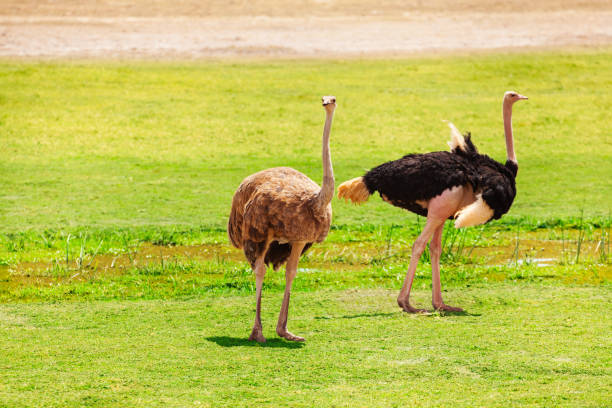
Maasai and Somali Ostriches
Maasai and Somali Ostriches: Two Species, One Bird to Spot
The morning sun rises over Kenya’s Samburu National Reserve as a tall bird walks between scattered acacia bushes. Its enormous body, long legs and black-and-white feathers make it unmistakably an ostrich.
However, something about this bird looks unusual. Instead of the pinkish neck commonly seen on ostriches in the Maasai Mara, this male has blue-grey skin.
Your safari guide explains that it is a Somali ostrich, one of the special birds of northern Kenya.
Maasai and Somali ostrich identification is an interesting part of East African birdwatching. Although both birds share the familiar ostrich appearance, they differ in skin colour, geographical distribution and habitat preferences.
There is also an important scientific distinction: the Maasai ostrich is a form of the common ostrich, while the Somali ostrich is widely recognised as a separate species.
This guide explains how to distinguish them, where to find them and why protecting both forms matters.
1. Are Maasai and Somali Ostriches Different Species?
The answer requires a little explanation.
The Maasai ostrich, also written Masai ostrich, is classified as Struthio camelus massaicus.
It is a subspecies of the common ostrich, Struthio camelus.
The Somali ostrich has the scientific name Struthio molybdophanes and is recognised as a separate species by major modern bird checklists.
Historically, scientists classified the Somali ostrich as another subspecies of the common ostrich.
Genetic and ecological research helped support its recognition as a distinct species.
Therefore, East Africa supports two recognised ostrich species: the common ostrich, represented locally by the Maasai form and others in certain regions, and the Somali ostrich.
2. Maasai vs Somali Ostrich: Quick Comparison
| Feature | Maasai Ostrich | Somali Ostrich |
|---|---|---|
| Scientific name | Struthio camelus massaicus | Struthio molybdophanes |
| Classification | Common ostrich subspecies | Separate species |
| Adult male neck | Pinkish | Blue-grey |
| Adult male legs | Pinkish | Blue-grey, with pink breeding features |
| Breeding appearance | Pink or reddish tones become stronger | Blue skin becomes brighter |
| Male body feathers | Mainly black with white wings | Mainly black with white wings |
| Female feathers | Greyish or brown | Often darker brown |
| Preferred habitat | Open grassland and savannah | Dry bushland and semi-arid country |
| Main East African range | Kenya and Tanzania | Northern Kenya and the Horn of Africa |
| Conservation status | Included in common ostrich assessment | Vulnerable |
The neck colour and geographical location are usually the most useful identification clues.
3. How to Identify a Maasai Ostrich
The Maasai ostrich is the familiar ostrich seen in many southern Kenyan and Tanzanian savannah landscapes.
Adult males are large, with predominantly black body feathers and contrasting white wing and tail feathers.
Their necks and legs are usually pinkish-grey.
During breeding, the exposed skin may become a stronger pink or reddish colour.
Females are generally brownish-grey and less brightly coloured.
Main Identification Features
- Pinkish neck and legs in adult males.
- Black body feathers with white wing feathers in males.
- Brownish-grey females.
- Very long legs and an upright posture.
- Preference for open savannah and grassland.
Skin colour can vary with breeding condition, age and lighting, so avoid relying on one photograph alone.
4. How to Identify a Somali Ostrich
The Somali ostrich is often called the blue-necked ostrich.
Adult males have distinctive blue-grey skin on their necks and much of their legs.
During breeding, the blue colour can become more intense, while the bill and parts of the legs may appear pink.
Males also have black bodies and white wing feathers.
Females are brown, with features that can be difficult to distinguish from female common ostriches without a good view.
Somali ostriches often occur alone, in pairs or in relatively small groups.
Their preference for drier and bushier habitats is another useful field clue.
5. Why Do Their Necks Have Different Colours?
The difference results from inherited characteristics affecting the appearance of their exposed skin.
Male neck and leg colours can become more pronounced during breeding.
These changes form part of their reproductive appearance.
However, scientists have not established that neck colour evolved solely for one purpose.
The contrasting colours also provide a convenient field identification feature.
For visitors, the simplest distinction is pinkish Maasai males versus blue-grey Somali males.
Remember that Somali males may show pink areas during breeding, so the whole bird should be considered.
6. Where Do Maasai Ostriches Live?
Maasai ostriches are associated mainly with eastern African savannah landscapes, especially Kenya and Tanzania.
They favour open grasslands, wooded grasslands and other areas where visibility is relatively good.
Popular Maasai Ostrich Safari Areas
| Destination | Country | Habitat |
|---|---|---|
| Maasai Mara National Reserve | Kenya | Open grassland and savannah |
| Amboseli National Park | Kenya | Plains and dry grassland |
| Serengeti National Park | Tanzania | Extensive savannah |
| Ngorongoro Conservation Area | Tanzania | Grassland and open country |
| Tarangire National Park | Tanzania | Savannah and woodland |
Ostrich sightings are possible throughout the year, although their exact locations change with local conditions.
7. Where Do Somali Ostriches Live?
Somali ostriches inhabit parts of northern and northeastern Kenya, Ethiopia, Somalia and neighbouring Horn of Africa landscapes.
They are particularly associated with semi-arid country containing scattered bushes and dry grassland.
Northern Kenya offers some of the most accessible safari opportunities.
Somali Ostrich Safari Areas
| Destination | Country | Viewing Potential |
|---|---|---|
| Samburu National Reserve | Kenya | Well-known Somali ostrich habitat |
| Buffalo Springs National Reserve | Kenya | Dry savannah and bushland |
| Shaba National Reserve | Kenya | Semi-arid habitat |
| Lewa Wildlife Conservancy | Kenya | Somali ostrich sightings |
| Suitable areas of northern Kenya | Kenya | Distribution varies locally |
In the Samburu ecosystem, the Somali ostrich is recognised as one of the region’s Special Five wildlife attractions, alongside the reticulated giraffe, Grevy’s zebra, gerenuk and Beisa oryx.
8. Why Do They Prefer Different Habitats?
The two forms differ partly in their feeding ecology.
Maasai ostriches are commonly associated with open habitats where they can graze and select low-growing vegetation.
Somali ostriches often use bushier environments and may browse vegetation above ground level.
These preferences can reduce competition where their distributions approach one another.
However, habitat separation is not absolute.
Both can use grasslands and scrub, and local habitat conditions influence where individual birds are found.
9. What Do Maasai and Somali Ostriches Eat?
Both are omnivorous birds that consume substantial quantities of plant material.
Their diets may include leaves, grass, seeds, shoots and flowers.
They can also eat insects and other small animals.
Their long legs allow them to walk considerable distances while searching for food.
Ostriches swallow small stones and grit that help their muscular digestive system process food.
Although they can obtain moisture from vegetation, access to water remains useful.
10. How Fast Can Ostriches Run?
Ostriches are the world’s largest living birds and among the fastest running birds.
Their powerful legs are adapted for moving quickly across open ground.
They can reach speeds of around 70 kilometres per hour for short periods under suitable conditions.
Their wings cannot support flight, but they can help with balance and manoeuvring.
Both Maasai and Somali ostriches share these impressive adaptations.
Their strong legs can also deliver dangerous defensive kicks.
Visitors should never approach or corner a wild ostrich.
11. How Do Ostriches Attract Mates?
During breeding, males perform striking courtship displays.
A male may lower his body, spread his wings and move them rhythmically.
He may also swing his head and neck while displaying towards a female.
Male ostriches produce deep booming calls that can sound surprisingly powerful.
These displays can be fascinating to observe from a safari vehicle.
However, courtship activity depends on breeding condition and local circumstances.
Not every ostrich encounter includes a dramatic display.
12. Do Ostriches Lay Their Eggs in Nests?
Yes. Ostriches lay their eggs in shallow ground nests.
A male may prepare a simple depression in the soil.
Females lay eggs there, and several females may contribute to a communal nest.
In common ostriches, the major female often incubates during daylight while the male takes over at night.
Their contrasting plumage can help them blend into different lighting conditions.
Somali ostriches also nest on the ground, although detailed breeding information is less extensive.
Ostrich eggs are the largest produced by any living bird.
13. Why Are Ostrich Chicks Striped?
Young ostriches look quite different from adults.
Their bodies are covered in patterned down that helps them blend into vegetation and sandy ground.
Chicks can walk soon after hatching.
Adults protect and guide the youngsters as they begin feeding.
Ostrich families may sometimes form larger gatherings with numerous chicks.
Young birds gradually develop their adult plumage as they mature.
For safari visitors, a group of small striped chicks following an adult is a memorable sight.
14. Are Somali Ostriches Endangered?
The Somali ostrich is classified as Vulnerable on the IUCN Red List.
The species faces pressures including hunting, egg collection, habitat degradation and livestock-related changes in its environment.
Its range is also less extensive than that of the common ostrich.
The common ostrich is assessed as Least Concern globally, although individual populations and subspecies can face local threats.
Main Conservation Concerns
| Threat | Possible Impact |
|---|---|
| Habitat conversion | Reduces suitable habitat |
| Hunting | Removes breeding birds |
| Egg collection | Reduces reproductive success |
| Livestock pressure | Alters vegetation and habitat |
| Human disturbance | May disrupt nesting |
| Habitat fragmentation | Restricts movement between populations |
Protecting breeding habitats and reducing direct persecution are important conservation priorities.
15. How to Tell Female Ostriches Apart
Female ostriches are considerably more difficult to identify than adult males.
Both types generally have brownish body feathers.
The Somali female may have a darker brown body and pale grey-blue eyes.
However, lighting and individual variation make these features less dependable than the male’s neck colour.
A female seen in Samburu may be more likely to be Somali, while one seen in the Serengeti is more likely to be a Maasai ostrich.
Location is helpful, but it should not replace careful identification.
If the bird cannot be identified confidently, recording it simply as an ostrich is better than guessing.
16. Can Maasai and Somali Ostriches Interbreed?
The two forms are closely related.
Their natural ranges approach one another in parts of Kenya, but ecological and behavioural differences have helped maintain their distinct identities.
Historical records describe hybridisation involving introduced Somali ostriches and local common ostriches in Nairobi National Park.
This demonstrates that reproductive separation is not necessarily absolute.
However, natural hybridisation should not be assumed to be common.
The evolutionary relationship between the two forms has been studied using genetic evidence.
17. Photographing Ostriches on Safari
Ostriches are excellent subjects for wildlife photography because of their height, unusual appearance and movement.
For identification, capture the entire body, including the neck and legs.
A side profile helps show plumage, while a close-up can reveal facial details.
Photography Tips
| Technique | Benefit |
|---|---|
| Full-body photograph | Shows neck and leg colour |
| Side profile | Reveals body shape and feathers |
| Telephoto lens | Maintains a safe distance |
| Early morning light | Improves colour and detail |
| Wider landscape image | Shows habitat differences |
Do not try to provoke an ostrich into running, displaying or defending a nest.
Natural behaviour produces the most valuable photographs.
18. Frequently Asked Questions
Are Maasai and Somali Ostriches the Same Species?
No. The Maasai ostrich is a subspecies of the common ostrich, while the Somali ostrich is recognised as a separate species by major modern bird authorities.
Which Ostrich Has a Blue Neck?
The adult male Somali ostrich typically has a blue-grey neck and legs.
Which Ostrich Has a Pink Neck?
The adult male Maasai ostrich normally has pinkish skin that becomes brighter during breeding.
Where Can I See Somali Ostriches in Kenya?
Samburu, Buffalo Springs and Shaba are well-known destinations for Somali ostrich sightings.
Can You Find Both Types in One Park?
Their distributions approach one another in parts of Kenya, but seeing both during one ordinary game drive is not something visitors should expect.
Two Ostriches Worth Learning to Recognise
Maasai and Somali ostriches are among East Africa’s most interesting large birds.
Their enormous size, powerful legs and black-and-white male feathers make them unmistakably ostriches.
Yet their neck colours, habitat preferences and scientific classification reveal important differences.
The Maasai ostrich is most familiar in Kenya’s and Tanzania’s open savannahs, while the Somali ostrich is especially associated with the dry landscapes of northern Kenya and the Horn of Africa.
Learning to distinguish them adds another enjoyable challenge to an East African safari.






No comment