
Lalibela Rock-Hewn Churches: Planning a Visit to Ethiopia’s Medieval Sites
Lalibela rock-hewn churches in Ethiopia are among Africa’s most extraordinary historical and religious monuments. Carved directly into volcanic rock, these remarkable medieval churches demonstrate centuries of architectural knowledge, Christian devotion and Ethiopian cultural identity.
Located in the northern Ethiopian Highlands, Lalibela is famous for its eleven rock-hewn churches, connected through narrow passages, trenches and underground corridors. Unlike ordinary buildings constructed with separate stones, many of these churches were excavated from solid rock, creating elaborate structures beneath the surrounding ground level.
Recognised as a UNESCO World Heritage Site in 1978, Lalibela remains an important pilgrimage destination for Ethiopian Orthodox Christians.
For travellers interested in archaeology, architecture and African history, the churches offer a fascinating introduction to Ethiopia’s medieval civilisation.
Important travel advisory — October 2026: Lalibela is in Ethiopia’s Amhara Region, where the United States, United Kingdom and several other governments advise against all travel because of armed conflict and insecurity. This article describes the heritage site and its established visiting arrangements, not a currently safe or available itinerary.
Where Is Lalibela Located?
Lalibela lies in the mountainous Lasta area of Ethiopia’s Amhara Region, approximately 645 kilometres from Addis Ababa.
The town stands at an elevation of around 2,500 metres, surrounded by highland scenery and rural communities.
Quick Facts About Lalibela
| Feature | Description |
|---|---|
| Country | Ethiopia |
| Region | Amhara |
| Main attraction | Eleven rock-hewn churches |
| UNESCO designation | 1978 |
| Historical period | Primarily medieval |
| Traditional association | King Lalibela |
| Religion | Ethiopian Orthodox Christianity |
| Popular activities | Heritage walks and photography |
| Ideal heritage visit | Two days |
| Current travel status | Do not travel — Amhara Region |
Why Are Lalibela’s Churches Special?
Lalibela’s churches represent an extraordinary achievement of medieval engineering.
Builders removed enormous quantities of volcanic rock to create freestanding structures, courtyards, doors, windows and interior chambers.
Many churches remain connected through narrow passages and underground corridors.
A City Carved From Stone
Instead of building upwards, craftspeople excavated downwards into the landscape.
They carefully shaped roofs, pillars and walls from the surrounding rock.
The result is an architectural complex unlike almost any other religious settlement in Africa.
The History of King Lalibela
The construction of the churches is traditionally associated with King Gebre Mesqel Lalibela, who ruled during the Zagwe dynasty around the late twelfth and early thirteenth centuries.
According to Ethiopian Christian tradition, the king envisioned creating a sacred centre resembling Jerusalem.
Why Was Lalibela Called New Jerusalem?
Religious traditions link the settlement to the difficulty of travelling to the Holy Land.
Several features received names associated with biblical locations.
These include the River Jordan, Golgotha and the Church of Bethlehem.
Although construction dates remain subjects of scholarly research, the churches reflect important developments in medieval Ethiopian Christianity.
Understanding the Eleven Churches
The eleven principal churches are traditionally organised into two main groups, with the famous Church of Saint George standing separately.
Main Church Groups
| Group | Important monuments |
|---|---|
| Northern group | Biete Medhane Alem, Biete Mariam |
| Northern group | Biete Maskal, Biete Denagel |
| Northern group | Biete Golgotha Mikael |
| Southern group | Biete Amanuel, Biete Mercoreos |
| Southern group | Biete Abba Libanos |
| Southern group | Biete Gabriel Raphael, Biete Lehem |
| Separate church | Biete Ghiorgis |
Spellings vary between English-language guides and Ethiopian transliterations.
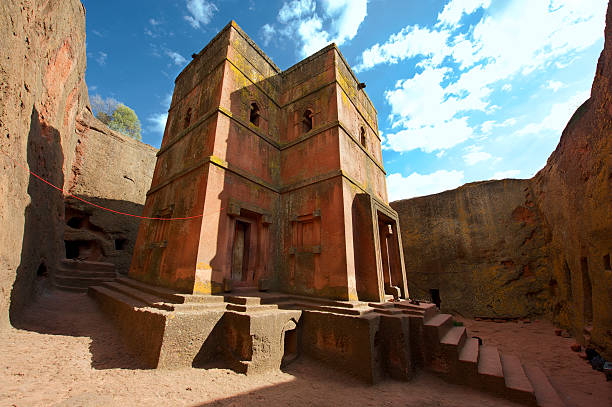
Biete Ghiorgis: The Church of Saint George
Biete Ghiorgis is Lalibela’s most recognisable monument.
Carved into the rock in the shape of a cross, the church stands inside a deep excavation.
Visitors traditionally approach it through carved pathways and trenches.
What Makes Saint George Special?
Its distinctive cruciform roof creates a remarkable view from above.
Carefully shaped walls demonstrate the precision of medieval stoneworkers.
The church remains an active religious site.
Its striking appearance makes it one of Ethiopia’s most photographed historical landmarks.
Biete Medhane Alem: A Monumental Church
Biete Medhane Alem, meaning House of the Saviour of the World, is among Lalibela’s largest religious buildings.
It is widely regarded as the world’s largest monolithic church.
Architectural Features
The church contains impressive columns and a broad interior.
Its exterior resembles a monumental stone structure despite being carved from the surrounding rock.
The building demonstrates the ambition and technical capabilities of Lalibela’s medieval craftspeople.
Biete Mariam: The Church of Mary
Biete Mariam is one of the most spiritually important churches in the complex.
Dedicated to the Virgin Mary, it contains decorative carvings and religious features.
What Can Visitors Discover?
The church is known for its interior details and traditional Christian symbolism.
Decorative windows and carved surfaces reflect medieval Ethiopian artistic traditions.
Visitors should remain quiet and respectful because religious activities continue inside.
Biete Amanuel: Remarkable Stone Architecture
Biete Amanuel is among the most impressive churches in Lalibela’s southern group.
Its carefully carved exterior demonstrates exceptional architectural precision.
Why Is It Interesting?
The church features decorative horizontal bands and striking architectural details.
Its design reflects influences associated with earlier Ethiopian building traditions.
The monument provides valuable insight into the development of medieval Christian architecture.
Biete Abba Libanos
Biete Abba Libanos is particularly interesting because of its unusual relationship with the surrounding rock.
Unlike some freestanding monolithic churches, parts of the structure remain connected to the rock above.
Understanding Its Design
The building demonstrates another technique used by Lalibela’s stoneworkers.
Its sheltered position creates a distinctive architectural appearance.
Different construction methods across the complex reveal the creativity involved in its development.
Underground Passages and Rock Trenches
One of Lalibela’s most memorable features is the network of passages connecting the churches.
Some corridors are narrow and dark.
Others pass between high rock walls.
Walking Through the Complex
Visitors may encounter uneven steps, low ceilings and exposed stone surfaces.
A torch can be useful in darker sections.
Good footwear is essential, and visitors should follow authorised routes.
Some passages may be unsuitable for people uncomfortable with confined spaces.
Lalibela as a Living Religious Site
The churches are not simply abandoned archaeological ruins.
They remain active places of Ethiopian Orthodox Christian worship.
Priests, monks and pilgrims continue to use the sacred spaces.
Religious Traditions
Visitors may witness prayers, chanting and religious processions.
White traditional garments are commonly worn by worshippers.
Ancient manuscripts, crosses and ceremonial objects remain important elements of church traditions.
Tourism must respect the continuing religious importance of the site.
Ethiopian Christmas in Lalibela
Ethiopian Christmas, known as Genna or Ganna, is traditionally celebrated on 7 January in the Gregorian calendar.
Lalibela becomes an important destination for pilgrims during this period.
What Happens During Christmas?
Religious ceremonies bring worshippers together for prayers and celebrations.
Traditional white clothing creates a distinctive atmosphere around the churches.
However, religious events are not performances arranged for tourists.
Visitors should respect worshippers and avoid interrupting ceremonies.
How to Visit the Churches
Historically, visitors have explored the churches through guided walking tours.
A local guide helps explain the buildings, religious traditions and architectural details.
Traditional Visiting Arrangements
| Activity | Suggested time |
|---|---|
| Northern churches | Half-day |
| Southern churches | Half-day |
| Church of Saint George | 45–60 minutes |
| Photography and interpretation | Additional time |
| Complete heritage experience | Two days |
These durations are planning estimates, not confirmation of present-day access.
Entrance Fees and Local Guides
Lalibela traditionally uses a church-complex admission system.
Entrance charges, guide fees and photography rules may change.
Visitors should obtain current information from the appropriate church administration when travel becomes safe.
Booking Considerations
Confirm whether admission covers all eleven churches.
Ask whether guiding is included.
Understand photography restrictions.
Check whether religious ceremonies affect access.
Avoid relying on outdated online prices.
What to Wear When Visiting Churches
Modest clothing is essential because the monuments remain active religious spaces.
Visitors should cover shoulders and knees.
Shoes are normally removed before entering church interiors.
Recommended Items
Comfortable walking shoes.
Modest clothing.
Clean socks.
Small torch.
Drinking water.
Sun protection.
Camera, where permitted.
Follow instructions from religious custodians and guides.
Best Time of Year to Visit Lalibela
Lalibela’s highland climate differs from Ethiopia’s warmer lowland regions.
The drier months, generally October to March, traditionally provide more comfortable conditions for exploring outdoor heritage sites.
Seasonal Visiting Guide
| Period | Typical conditions |
|---|---|
| October–November | Landscapes become greener after rains |
| December–February | Generally dry with cooler nights |
| March–May | Variable rainfall |
| June–September | Main rainy season |
Weather conditions alone should never determine travel plans while serious security risks remain.
Getting to Lalibela
Before the current security concerns, travellers commonly reached Lalibela by domestic flight or road.
Flights traditionally connected the town with Addis Ababa and other Ethiopian destinations.
Road journeys passed through mountainous landscapes and rural settlements.
Flight operations, road access and visitor services cannot be assumed available in October 2026. Travellers should postpone visits until official security advice improves and reliable arrangements can be confirmed.
Preserving Lalibela’s Historic Churches
The churches face conservation challenges from water erosion, weathering and deterioration of their rock surfaces.
Protective shelters have been installed over some monuments.
International conservation organisations have supported preservation initiatives.
Responsible Heritage Tourism
Visitors should avoid touching fragile carvings, damaging walls or entering restricted areas.
Photography must follow religious and conservation rules.
Supporting authorised local guides and heritage programmes helps maintain the site’s cultural importance.
Why Lalibela Is Worth Discovering
Lalibela represents an extraordinary achievement in African architectural and religious history.
Its eleven rock-hewn churches demonstrate the creativity of medieval Ethiopian craftspeople and the enduring importance of Orthodox Christianity.
From the cross-shaped Church of Saint George to the impressive Biete Medhane Alem, each monument contributes to the story of Ethiopia’s remarkable cultural heritage.
For travellers interested in archaeology, historic architecture and religious traditions, Lalibela remains one of Africa’s most important heritage destinations—one to consider visiting when conditions permit safe travel.







No comment