
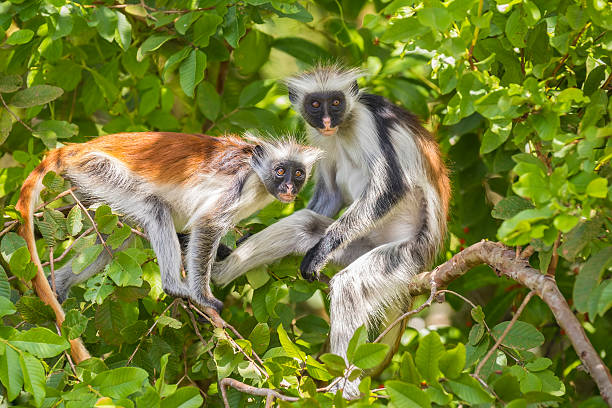
Jozani Forest: Zanzibar Red Colobus Monkeys Up Close
Jozani Forest in Zanzibar is one of Tanzania’s most fascinating wildlife destinations, offering visitors the opportunity to observe endangered Zanzibar red colobus monkeys in their natural habitat. Located in the heart of Unguja Island, Jozani combines tropical forest, mangrove boardwalks, rare wildlife and peaceful nature trails.
Unlike mainland Tanzania’s famous national parks, where visitors search for elephants and lions, Jozani focuses on smaller forest animals and the conservation of Zanzibar’s unique biodiversity.
The Zanzibar red colobus monkey is the forest’s greatest attraction. These distinctive primates are known for their reddish backs, black-and-white markings, long tails and lively social behaviour.
For travellers exploring Zanzibar beyond its white sandy beaches, a guided visit to Jozani provides a rewarding opportunity to discover the island’s natural heritage.
Where Is Jozani Forest Located?
Jozani Forest lies within Jozani–Chwaka Bay National Park, approximately 35 kilometres southeast of Stone Town.
The protected landscape contains groundwater forest, coral-rag woodland, mangrove habitats and surrounding wetlands.
Its central location makes it accessible from many popular Zanzibar beach destinations.
Quick Facts About Jozani Forest
| Feature | Description |
|---|---|
| Country | Tanzania |
| Island | Unguja, Zanzibar |
| Protected area | Jozani–Chwaka Bay National Park |
| Main attraction | Zanzibar red colobus monkeys |
| Scientific name | Piliocolobus kirkii |
| Conservation status | Endangered |
| Main activities | Guided walks and mangrove exploration |
| Famous boardwalk | Pete–Jozani Mangrove Boardwalk |
| Recommended visit | 1½–2 hours |
| Best for | Wildlife, forests and photography |
Why Is Jozani Forest Special?
Jozani protects one of Zanzibar’s most important remaining natural forest landscapes.
Its habitats support plants and animals found in relatively few other locations.
The forest is particularly significant because it protects a major population of the endangered Zanzibar red colobus.
Visitors can observe these monkeys at relatively close distances without visiting a zoo or captive wildlife facility.
However, the animals remain wild and should never be touched or fed.
The Zanzibar Red Colobus Monkey
The Zanzibar red colobus is a species of monkey native to Zanzibar.
It is also called Kirk’s red colobus, reflecting its historical association with British naturalist Sir John Kirk.
These monkeys are particularly recognisable because of their unusual colouring and expressive faces.
How to Identify a Red Colobus
Zanzibar red colobus monkeys have reddish-brown fur across their backs.
Their bodies also display black and pale markings, while their faces are mostly dark.
They possess long tails that help with balance when moving through trees.
Unlike many other monkeys, they have a distinctive four-fingered hand structure with a reduced thumb.
Why Are Zanzibar Red Colobus Monkeys Endangered?
The species has a naturally restricted geographic range.
Most populations live in forest habitats across Unguja Island.
Habitat destruction and fragmentation remain major conservation challenges.
Main Threats
Agricultural expansion has reduced some natural forest areas.
Roads can separate monkey populations and increase vehicle collisions.
Settlement development also affects movement between woodland patches.
Conservation programmes therefore focus on protecting forests, maintaining habitat connections and improving public awareness.
How Many Red Colobus Monkeys Remain?
An island-wide scientific survey published in 2019 estimated approximately 5,862 Zanzibar red colobus monkeys.
The research recorded hundreds of groups across Unguja.
Jozani and its surrounding protected habitats supported an important proportion of the population.
Although this estimate was higher than earlier figures, the species remains Endangered.
Current population numbers may differ, and continued monitoring is essential.
Watching Red Colobus Monkeys Up Close
Observing the monkeys is the highlight of a Jozani Forest visit.
Some groups are accustomed to people passing through established visitor routes.
They may feed, rest or move through branches while visitors watch quietly.
What Can You Expect?
Visitors may encounter monkeys sitting on low branches.
Young animals sometimes play together while adults feed.
Others travel through the forest canopy using branches as natural pathways.
Their activities provide excellent opportunities for wildlife observation.
However, encounters depend on animal movements.
Understanding Red Colobus Behaviour
Zanzibar red colobus monkeys are social animals.
They generally live in groups containing adult males, females and young monkeys.
Group members communicate through calls, body movements and social interactions.
Common Behaviours
| Behaviour | What visitors may observe |
|---|---|
| Feeding | Monkeys eating leaves |
| Grooming | Individuals cleaning one another |
| Playing | Young monkeys chasing each other |
| Resting | Animals sitting on branches |
| Calling | Vocal communication |
| Travelling | Groups moving through trees |
Observing these behaviours helps visitors understand their natural social lives.
What Do Red Colobus Monkeys Eat?
Zanzibar red colobus monkeys feed mainly on leaves and other plant materials.
They possess specialised digestive systems that help process fibrous vegetation.
Young leaves and leaf buds form an important part of their diet.
Feeding Adaptations
The monkeys spend considerable time selecting suitable plant material.
Their stomachs contain microorganisms that help break down difficult plant fibres.
This adaptation allows them to survive on food that many other primates cannot digest efficiently.
Visitors must never offer food because human feeding can disrupt their natural behaviour.
Guided Forest Walks
Guided walks provide the best way to explore Jozani.
Local guides introduce visitors to the forest’s plants, animals and conservation history.
Most ordinary walks follow relatively manageable paths.
What Happens During the Walk?
The experience begins with a briefing about forest rules.
Visitors then follow their guide through designated areas.
Guides explain tree species, vegetation and wildlife habitats.
When monkeys are encountered, the group stops at an appropriate distance for observation.
The walk provides opportunities for photography and learning.
Exploring the Mangrove Boardwalk
The mangrove boardwalk is another major attraction.
Located within the wider Jozani–Chwaka Bay ecosystem, it allows visitors to explore a fascinating coastal wetland environment.
Why Are Mangroves Important?
Mangrove trees survive in salty, waterlogged conditions.
Their specialised roots help stabilise coastal sediments.
They provide nursery habitats for fish, crabs and other marine organisms.
Mangrove forests also support coastal protection and carbon storage.
What Can You See Along the Boardwalk?
Visitors can observe mangrove roots extending through muddy ground.
Small crabs may move around the exposed sediment.
Birds sometimes feed along the tidal channels.
Mangrove Wildlife
| Wildlife | Possible sighting |
|---|---|
| Fiddler crabs | Muddy surfaces |
| Mudskippers | Exposed tidal mud |
| Kingfishers | Mangrove channels |
| Herons | Shallow water |
| Small fish | Tidal pools |
| Insects | Forest vegetation |
Sightings change according to tides and weather.
Other Wildlife in Jozani Forest
Although red colobus monkeys receive the most attention, Jozani supports other animals.
Visitors may encounter Sykes’ monkeys, bushbabies, birds and reptiles.
Forest Wildlife
Small mammals often remain hidden in dense vegetation.
Bushbabies are mainly nocturnal and are unlikely to be seen during ordinary daytime tours.
Butterflies and insects are more easily observed.
Chameleons may occasionally be discovered by experienced guides.
Birdwatching in Jozani
The forest offers rewarding birdwatching opportunities.
Its combination of woodland, wetland and mangrove habitats attracts different species.
Visitors may encounter kingfishers, sunbirds, greenbuls and other forest birds.
Birdwatching Tips
Carry binoculars.
Walk quietly.
Avoid disturbing nesting sites.
Listen carefully for calls.
Early morning can be particularly rewarding when birds are active.
Best Time to Visit Jozani Forest
Jozani can be visited throughout the year.
However, relatively dry periods generally provide comfortable walking conditions.
June to October and December to February are often convenient.
Seasonal Visiting Guide
| Period | General conditions |
|---|---|
| January–February | Warm, often relatively dry |
| March–May | Increased rainfall |
| June–October | Generally comfortable |
| November–December | Variable rainfall |
Rain can make forest paths slippery.
The forest remains attractive during wetter months because of its lush vegetation.
Entrance Fees and Opening Hours
Jozani–Chwaka Bay National Park charges admission fees for visitors.
Fees may vary according to age, residency and current regulations.
Visitor Planning Information
| Item | Details |
|---|---|
| Opening time | Generally 7:30 am |
| Closing time | Generally 5:00 pm |
| Entrance fee | Confirm current official tariff |
| Guide | Included or arranged through park services |
| Visit duration | 1½–2 hours |
| Main experiences | Forest and mangrove walks |
Confirm operating arrangements before travelling.
How to Reach Jozani Forest
Jozani is accessible by road from Stone Town and Zanzibar’s beach areas.
Private taxis and organised excursions provide convenient transport.
Approximate Travel Times
| Starting location | Journey time |
|---|---|
| Stone Town | 45–60 minutes |
| Paje | 20–30 minutes |
| Jambiani | 25–40 minutes |
| Bwejuu | 20–30 minutes |
| Nungwi | 1½–2 hours |
Actual times depend on traffic and road conditions.
What to Wear for a Forest Walk
Lightweight clothing is suitable for Zanzibar’s warm climate.
Comfortable closed shoes help on uneven forest paths.
Recommended Items
Walking shoes.
Drinking water.
Insect repellent.
Sun protection.
Camera.
Binoculars.
Lightweight rain jacket.
Avoid carrying unnecessary luggage during the walk.
Photography Tips for Red Colobus Monkeys
Jozani provides excellent opportunities for primate photography.
The monkeys’ reddish coats create attractive contrasts against green vegetation.
How to Take Better Photographs
Use natural light when possible.
Avoid flash photography.
Keep a respectful distance.
Photograph monkeys displaying natural behaviour.
Never touch branches or disturb animals to improve a photograph.
A zoom lens can capture detailed portraits without approaching too closely.
Can Visitors Touch the Monkeys?
No. Visitors should not touch, hold or feed Zanzibar red colobus monkeys.
Close physical contact can create stress and increase disease-transmission risks.
Even monkeys accustomed to visitors remain wild animals.
Responsible Monkey Watching
Follow your guide’s instructions.
Never chase animals.
Avoid blocking their movement.
Keep food secured.
Do not encourage monkeys to approach for photographs.
Respecting these rules protects both visitors and wildlife.
Combining Jozani With Other Zanzibar Attractions
Jozani can easily be combined with experiences along Zanzibar’s southeastern coastline.
Visitors may explore Paje Beach, Jambiani or suitable cultural attractions.
Suggested Half-Day Itinerary
Begin with a morning visit to Jozani.
Enjoy a guided forest walk and observe the monkeys.
Continue towards the mangrove boardwalk.
Afterwards, travel to a nearby coastal village for lunch.
Spend the afternoon relaxing beside the Indian Ocean.
Conservation and Local Communities
Protecting Jozani requires cooperation between conservation authorities and surrounding communities.
Forest conservation supports wildlife habitats while helping preserve important environmental resources.
Community tourism also creates opportunities for local employment.
Visitors contribute by paying official entrance fees, following regulations and supporting responsible guides.
Why Jozani Forest Is Worth Visiting
Jozani Forest offers one of Zanzibar’s most memorable wildlife experiences.
Its endangered red colobus monkeys, beautiful tropical vegetation and fascinating mangrove ecosystems reveal a different side of the island.
The experience combines conservation education with peaceful nature exploration.
For travellers seeking wildlife encounters beyond Zanzibar’s famous beaches, Jozani provides an enjoyable opportunity to appreciate the island’s remarkable biodiversity and understand why protecting its remaining forests matters.


No comment