
How Wildebeest Calves Stand Within Minutes of Birth
The morning sun rises over the short-grass plains of Tanzania’s southern Serengeti. Thousands of wildebeest graze across the green landscape, while pregnant females move slowly among the herds.
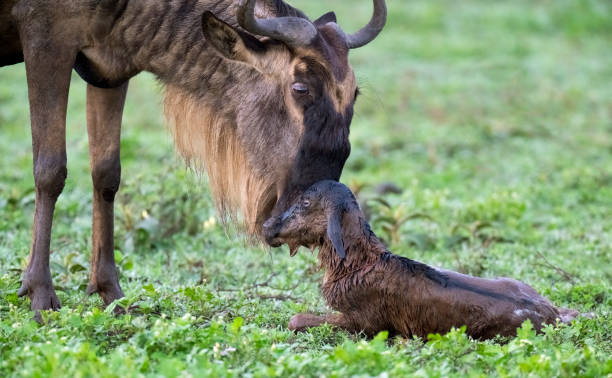
Suddenly, one female stops walking. Within a short time, she gives birth to a small, wet calf lying on the grass.
The mother turns towards her newborn, sniffing and licking its body. The calf lifts its head, stretches its slender front legs and struggles to stand. It falls, tries again and eventually balances on four unsteady legs.
Only minutes have passed since its birth.
How wildebeest calves stand within minutes of birth is one of the most remarkable examples of early development in African wildlife.
Unlike many mammals whose newborns remain helpless for extended periods, wildebeest calves enter the world with a strong ability to move almost immediately.
This rapid development helps them survive in open savannahs, where lions, hyenas, cheetahs and other predators search for vulnerable prey.
1. Why Must Wildebeest Calves Stand So Quickly?
Wildebeest are highly mobile grazing mammals.
Their survival depends partly on moving across large landscapes in search of suitable grass and water.
During calving season, females give birth in open grasslands rather than hiding their young in dense vegetation.
A newborn that remains on the ground for too long may be vulnerable to approaching predators.
Standing quickly allows the calf to reach its mother, begin nursing and follow the herd.
Why Early Movement Matters
| Advantage | Importance |
|---|---|
| Escaping predators | Reduces time spent helpless on the ground |
| Following the mother | Helps prevent separation |
| Nursing | Allows the calf to reach its mother’s udder |
| Herd movement | Supports early participation in group movements |
| Social bonding | Helps maintain contact between mother and calf |
Early mobility improves survival opportunities but does not guarantee safety.
2. How Soon Can a Wildebeest Calf Stand?
Wildebeest calves are among the fastest-developing newborn hoofed mammals.
A healthy calf may begin attempting to stand only a few minutes after delivery.
Tanzania National Parks has described wildebeest calves becoming mobile within approximately three to seven minutes.
However, this should not be treated as an exact deadline for every individual.
Some calves take longer, particularly after difficult births or when environmental conditions are challenging.
First Hour of a Wildebeest Calf’s Life
| Approximate Time | Possible Development |
|---|---|
| Immediately after birth | Calf lies on the ground and begins moving |
| First few minutes | Raises its head and attempts to position its legs |
| Around 3–7 minutes | Some healthy calves become mobile |
| Following minutes | Improves balance and begins walking |
| Within the first hour | May nurse and follow its mother |
These stages are illustrative. The timing differs between individual calves.
3. How Can a Newborn Stand So Quickly?
Wildebeest calves are born at a relatively advanced stage of physical development.
Scientists describe such young animals as precocial.
Their muscles, skeletons and nervous systems have developed sufficiently during pregnancy to support early movement.
Although a newborn still needs practice to balance properly, it already possesses much of the physical equipment required for walking.
Precocial vs Helpless Newborns
| Characteristic | Wildebeest Calf | More Helpless Newborn Mammal |
|---|---|---|
| Eyes | Open and functional | May remain closed |
| Legs | Capable of early weight-bearing | May be unable to support body |
| Movement | Begins within minutes | May take much longer |
| Maternal dependence | High, despite mobility | High |
| Early protection | Following and remaining with mother | Often shelter or concealment |
Early mobility is an adaptation associated with life in open, predator-rich habitats.
4. What Happens During the First Attempt to Stand?
A newborn wildebeest does not usually rise smoothly like an adult.
Its first movements can appear awkward.
The calf may stretch its front legs, push its chest upwards and attempt to bring its hind legs underneath its body.
Sometimes its legs spread too far apart, causing it to collapse.
After several attempts, it may manage to stand briefly.
Each successful movement helps the calf develop better balance and coordination.
The process can be fascinating to watch, especially when the mother remains close and attentive.
5. How Does the Mother Help Her Calf?
The mother plays an important role during the first moments after birth.
She often turns towards the calf, licks it and remains nearby while it attempts to stand.
Licking helps remove birth fluids and provides close sensory contact.
The mother may also investigate the calf through smelling and vocal communication.
These interactions are important because wildebeest live in large herds where many mothers and newborns may be close together.
The calf must learn to remain associated with its own mother.
6. How Do Wildebeest Mothers Recognise Their Calves?
Wildebeest use several senses during mother-calf recognition.
Vocal communication is particularly important.
Mothers and calves produce contact calls that help maintain their relationship.
Smell and visual information may also contribute.
In a large calving herd, these signals help reduce confusion when thousands of young animals are moving among adults.
However, recognition does not mean that separation never happens.
Young calves can still become lost, especially during disturbance or rapid herd movements.
7. When Does a Wildebeest Calf First Drink Milk?
Once a calf can stand and move towards its mother, it can begin nursing.
Milk provides essential nutrition during early life.
The first milk, known as colostrum, contains important immune-supporting components.
Receiving colostrum is especially valuable because newborn mammals are still developing their immune protection.
As the calf grows, it begins sampling grass while continuing to depend on its mother’s milk.
The transition from nursing to grazing takes place gradually.
8. Can Wildebeest Calves Run Immediately?
Standing, walking and running are different abilities.
A calf may stand within minutes but still move awkwardly.
Its balance, leg coordination and stamina improve rapidly.
Some calves can move surprisingly quickly soon after birth, while others need more time before keeping pace confidently.
Early running ability is important because wildebeest families must remain mobile.
However, a newborn does not possess the strength or endurance of a mature animal.
9. Why Are Wildebeest Born in Open Grasslands?
Wildebeest in the Serengeti–Mara ecosystem give birth mainly on the southern short-grass plains of Tanzania.
These grasslands provide nutritious vegetation during the rainy season.
Fresh grazing helps nursing females meet their nutritional needs.
The open environment also allows animals to detect predators at considerable distances.
However, open terrain provides relatively little concealment for newborn calves.
Wildebeest compensate through rapid early movement, maternal care and the protection offered by large herds.
10. Why Are So Many Wildebeest Calves Born Together?
One of the most remarkable features of the Great Migration is the concentration of births.
Hundreds of thousands of wildebeest calves are born during a relatively short period.
Scientific research describes this as highly synchronised calving.
The strategy is associated with predator swamping.
What Is Predator Swamping?
When enormous numbers of calves appear within a short period, predators cannot capture every newborn.
Although many calves are still killed, the proportion surviving may be higher than if the same number of births occurred gradually over many months.
Benefits of Synchronised Calving
| Factor | Survival Advantage |
|---|---|
| Many births together | Predators cannot consume every calf |
| Large herds | More animals can detect threats |
| Fresh seasonal grass | Supports nursing females |
| Similar-aged calves | Young animals develop during the same season |
| Rapid calf mobility | Reduces exposure while helpless |
This combination helps explain the extraordinary success of migratory wildebeest populations.
11. How Many Wildebeest Calves Are Born in the Serengeti?
Estimates vary according to the population size, study period and counting method.
Scientific literature has described close to 500,000 births concentrated within approximately three weeks during major calving seasons.
Such figures illustrate the enormous scale of the event rather than a fixed number repeated every year.
The exact total depends on the breeding population and environmental conditions.
Even when births are highly synchronised, some occur before or after the main peak.
12. When Is Wildebeest Calving Season?
In the Serengeti–Mara ecosystem, the main calving period generally occurs between late January and March.
February is often the peak month.
The southern Serengeti and Ndutu region are particularly well known for this activity.
Serengeti Calving Season Guide
| Period | General Situation |
|---|---|
| December | Herds may begin gathering in southern grazing areas |
| January | Increasing numbers of pregnant females and early births |
| February | Often the main calving peak |
| March | Remaining births and growing calves |
| April onwards | Herd movements increasingly influenced by rainfall and grazing |
Rainfall can shift the timing and distribution of herds, so no particular week guarantees the peak.
13. Which Predators Hunt Wildebeest Calves?
Newborn calves are vulnerable to several African carnivores.
Spotted hyenas are particularly effective hunters and scavengers in the Serengeti.
Lions may also target wildebeest calves and adults.
Cheetahs, leopards and African wild dogs can take young wildebeest when circumstances allow.
Predators and Calf Survival
| Predator | Possible Threat |
|---|---|
| Spotted hyena | Hunts vulnerable calves and other wildebeest |
| Lion | Hunts calves and mature animals |
| Cheetah | May pursue young wildebeest |
| Leopard | Opportunistic attacks |
| African wild dog | Coordinated hunting where present |
| Jackals | May threaten very young or weakened calves |
Many calves survive through vigilance, maternal association and remaining with the herd.
14. Do Wildebeest Mothers Hide Their Newborns?
Unlike some antelopes that conceal their young in vegetation, wildebeest calves normally follow their mothers soon after birth.
Scientists describe these young animals as followers rather than hiders.
The distinction is important.
A bushbuck calf may remain concealed while its mother feeds elsewhere.
A wildebeest calf usually relies on early mobility and remaining close to its mother.
Hider vs Follower Antelope Strategy
| Feature | Wildebeest | Bushbuck |
|---|---|---|
| Early survival approach | Follows mother | Often remains concealed |
| Typical birthplace | Open grassland | Sheltered vegetation |
| Early movement | Rapid | Develops while using cover |
| Main protection | Mobility and maternal association | Concealment and maternal care |
Both strategies help young animals survive in different habitats.
15. What Happens if a Wildebeest Calf Is Separated?
Separation can be dangerous.
A young calf depends on its mother for milk and protection.
Without her, it may struggle to feed and become more vulnerable to predators.
The mother and calf may use vocal calls to locate each other.
However, successful reunification is not guaranteed.
A calf that is very young or weakened faces particularly serious risks.
Safari visitors should never interfere with a separated calf unless authorised conservation personnel direct an intervention.
16. How Quickly Do Wildebeest Calves Grow?
Calves grow rapidly during their early months.
They continue nursing while gradually consuming increasing amounts of grass.
Their legs become stronger, and their coordination improves.
As they develop, they can keep pace more confidently with the moving herd.
However, calf growth varies according to nutrition, health and environmental conditions.
A calf born during a period of abundant fresh grazing may have advantages over one experiencing drought or nutritional stress.
17. Why Is the Southern Serengeti Important for Calving?
The southern Serengeti contains extensive short-grass plains influenced by volcanic soils.
Seasonal rainfall supports nutritious grazing.
These conditions make the area important for pregnant and nursing wildebeest.
The Ndutu region, near the boundary between Serengeti National Park and Ngorongoro Conservation Area, is particularly associated with calving.
The landscape also supports numerous predators.
This creates remarkable opportunities to observe both new life and the challenges faced by young animals.
18. Can Tourists Watch Wildebeest Calves Being Born?
Yes, but witnessing an actual birth requires patience and favourable circumstances.
During the calving season, safari visitors may encounter females giving birth or newborn calves attempting their first steps.
However, births happen across a vast landscape.
No guide can guarantee that a particular visitor will see the entire process.
Responsible Calving Safari Tips
- Use an experienced local safari guide.
- Visit during the main seasonal calving period.
- Carry binoculars and a suitable camera lens.
- Maintain a safe distance from mothers and newborns.
- Remain inside the vehicle where required.
- Never approach a calf to encourage it to stand.
- Allow natural wildlife interactions to continue undisturbed.
Respectful viewing is especially important when animals are vulnerable.
19. How to Photograph a Calf’s First Steps
A newborn wildebeest standing for the first time is an unforgettable photography subject.
Look for calves with damp coats and mothers showing close attention.
Use a telephoto lens to capture the behaviour without disturbance.
Continuous shooting can help document the sequence from lying down to standing and walking.
Photography Guide
| Technique | Benefit |
|---|---|
| Telephoto lens | Maintains distance |
| Continuous shooting | Captures rapid changes |
| Fast shutter speed | Freezes the calf’s movement |
| Wider framing | Includes mother and calf |
| Natural lighting | Shows coat and body detail |
| Patience | Allows natural behaviour to unfold |
Avoid repositioning a vehicle repeatedly around a mother that is giving birth.
20. Frequently Asked Questions
How Many Minutes Does a Wildebeest Calf Take to Stand?
Some healthy calves become mobile within approximately three to seven minutes, although individual timings vary.
Can a Wildebeest Calf Run on the Day It Is Born?
Yes. Many calves develop the ability to move quickly during their first day, although they are not immediately as strong as adults.
Why Are Wildebeest Calves Born So Developed?
Wildebeest are precocial mammals whose young develop the physical ability to move before birth.
Why Do So Many Wildebeest Give Birth Together?
Highly synchronised births can reduce the proportion of calves taken by predators through predator swamping.
Where Is the Best Place to See Wildebeest Calving?
The southern Serengeti and Ndutu region in Tanzania are especially well known for the annual calving season.
Born Ready for Life on the Move
Wildebeest calves possess one of the most impressive early survival abilities in the African savannah.
Within minutes of birth, many begin standing, walking and developing the coordination needed to follow their mothers.
This rapid mobility is especially important in the open grasslands of the Serengeti, where predators are constantly searching for vulnerable prey.
The calves also benefit from maternal care, large herds and highly synchronised breeding.
Together, these adaptations help thousands of young wildebeest survive their first challenging days.
For safari travellers, witnessing a newborn calf struggling to stand provides a powerful reminder of how quickly life begins on Africa’s open plains.







No comment