
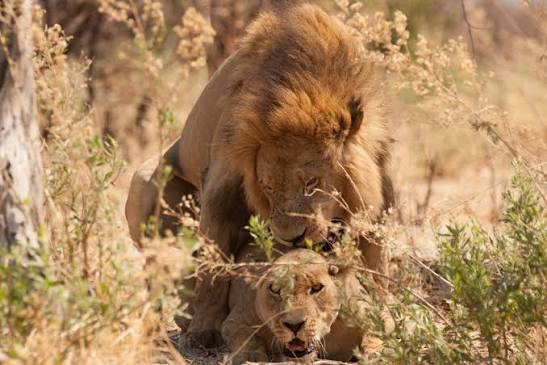
How Lion Prides Work
How Lion Prides Work: Who Hunts, Who Guards and Who Eats First
Imagine watching a pride of lions resting beneath an acacia tree in Uganda’s Queen Elizabeth National Park. Several lionesses lie together, young cubs play nearby, and a large male surveys the surrounding grassland. Everything appears peaceful until a herd of buffalo approaches. Suddenly, the lionesses become alert, and the pride’s behaviour changes.
Understanding how lion prides work makes an African safari much more interesting. Lions are unusual among big cats because they live in social groups, cooperate during hunting, protect shared territories and raise their young together.
However, their responsibilities are not as simple as saying females hunt while males guard. Both sexes contribute to survival, and competition can become particularly intense when food is available.
This guide explains who hunts, who protects the pride, how cubs are raised and who usually eats first.
1. What Is a Lion Pride?
A lion pride is a social group generally consisting of related adult females, their offspring and one or more resident adult males.
The females often form the permanent foundation of the pride. Mothers, daughters and sisters may remain together for many years.
Adult males usually join from outside after leaving their birth prides.
Pride size varies depending on habitat, prey availability and competition.
Some prides contain fewer than ten lions, while larger groups may include more than twenty individuals.
| Pride Member | Main Responsibilities |
|---|---|
| Adult lionesses | Hunting, raising cubs and defending territory |
| Resident males | Defending against rival males, mating and sometimes hunting |
| Subadult lions | Learning to hunt and developing social skills |
| Cubs | Growing, playing and learning from adults |
Not every pride member stays together throughout the day. Lions frequently separate into smaller groups before reuniting.
2. Who Does Most of the Hunting?
Lionesses perform much of the hunting in many African lion prides.
Their relatively lighter bodies and cooperative hunting behaviour help them pursue animals such as antelopes, zebras, wildebeest and buffaloes.
However, not every hunt involves several lionesses.
A female may hunt alone when suitable prey becomes available, while larger prey sometimes requires cooperation.
How Lionesses Hunt Together
When hunting cooperatively, lionesses may approach prey from different directions.
Some individuals move towards the sides of a herd while others position themselves where fleeing animals may pass.
This strategy can increase their chances of catching prey.
However, lions do not follow a fixed hunting plan every time.
Hunting success depends on vegetation, wind direction, prey behaviour and the number of participating lions.
3. Do Male Lions Hunt?
Yes. Male lions are capable hunters.
The popular belief that males never hunt is incorrect.
Adult males may capture prey independently, cooperate with other males or participate in hunts involving lionesses.
Males can be particularly effective when hunting large animals or using dense vegetation for ambushes.
They may also scavenge or take food from other predators.
Male lions living outside established prides must obtain food without relying on resident lionesses.
Their hunting behaviour varies considerably between habitats.
4. Who Guards the Pride?
Resident male lions play an important role in defending the pride against rival males.
They patrol their territory, roar and leave scent markings that communicate their presence.
Male lions may fight intruders attempting to take control of the pride.
However, lionesses also defend their territory, particularly against neighbouring females.
Why Territory Matters
A suitable territory provides access to:
- Prey animals.
- Water sources.
- Shaded resting areas.
- Places for hiding cubs.
- Space for hunting and raising young.
Research in Tanzania’s Serengeti has demonstrated that larger prides can be more successful at defending valuable territories.
Territorial protection is therefore important for the survival of adults and cubs.
5. Why Do Male Lions Form Coalitions?
Young male lions generally leave their birth prides as they mature.
They may travel alone or form partnerships with other males, often brothers or relatives.
These partnerships are called coalitions.
Coalition members cooperate when challenging resident males and defending territory.
A coalition of two or three males may have an advantage over a single competitor.
However, coalitions vary in size, and membership does not always depend on close family relationships.
Successful males may gain access to one or more prides.
Their position is temporary because other coalitions may eventually challenge them.
6. Who Eats First After a Successful Hunt?
Feeding is one of the most competitive moments in a lion pride.
Adult males commonly dominate access to a carcass when they are present.
They may push lionesses or younger animals aside to reach desirable portions.
However, feeding does not follow an unchanging order.
If a male is absent, lionesses may begin eating immediately. Cubs sometimes feed alongside adults, particularly when there is enough meat.
Typical Feeding Patterns
| Pride Member | Feeding Behaviour |
|---|---|
| Adult males | Often dominate access when present |
| Adult lionesses | Feed after hunting and compete for available space |
| Subadult lions | Feed when opportunities arise |
| Cubs | May feed alongside adults but can lose access during competition |
The size of the prey matters greatly.
A large buffalo provides more feeding opportunities than a small antelope.
7. Why Do Lionesses Sometimes Wait to Eat?
A lioness that has successfully captured prey may be displaced by a larger male arriving at the carcass.
This can appear unfair to safari visitors, particularly when the female performed much of the hunting.
However, lions do not distribute food according to effort.
Feeding access depends on strength, competition, carcass size and which individuals arrive first.
Research also shows that lionesses do not maintain a rigid feeding hierarchy among themselves.
Individuals often compete over particular positions at a carcass rather than following a fixed ranking.
8. Do Lion Cubs Eat Last?
Cubs are vulnerable during feeding because they are smaller and less powerful than adults.
They may struggle to reach meat when several hungry lions gather around a small carcass.
However, cubs do not always eat last.
They may feed while their mothers eat, particularly when food is abundant.
Lionesses also provide milk during the early months of their cubs’ lives.
Food shortages are especially dangerous for young lions because growing cubs need adequate nutrition.
Watching how adults and cubs behave around a carcass can reveal the pride’s current feeding conditions.
9. How Do Lionesses Raise Cubs Together?
Lionesses often give birth away from the main pride, hiding newborn cubs in sheltered places.
After several weeks, mothers may introduce their offspring to other pride members.
When multiple females have young cubs, they may form communal nursery groups called crèches.
Benefits of Communal Care
Crèches can help lionesses:
- Protect cubs against threats.
- Keep young animals together.
- Cooperate against intruding lions.
- Maintain social relationships.
- Supervise cubs while resting.
Some females may nurse another lioness’s cubs, although mothers generally invest most heavily in their own offspring.
Communal care is an important part of lion social behaviour.
10. What Happens When New Males Take Over?
Male takeovers are among the most dramatic events in lion society.
When a new coalition defeats or drives away resident males, it may gain control of the pride.
Incoming males sometimes kill young cubs fathered by previous residents.
This behaviour is known as infanticide.
It is associated with reproductive competition because females without dependent cubs may become ready to mate sooner.
Lionesses sometimes attempt to defend their offspring, particularly when several females cooperate.
However, not every takeover results in cub deaths.
These interactions demonstrate why territorial defence can be important for offspring survival.
11. How Do Lions Communicate Within a Pride?
Lions communicate through roaring, scent marking, body movements and physical contact.
Roaring helps individuals announce their presence and communicate across considerable distances.
Head rubbing and licking can strengthen social relationships.
Cubs communicate with their mothers through sounds and physical contact.
During a safari, you may notice lions rubbing their heads together after reuniting.
This friendly behaviour contrasts with the competition sometimes observed during feeding.
12. Why Do Lions Spend So Much Time Resting?
Lions conserve energy by spending much of their day resting or sleeping.
Hunting requires intense physical effort, particularly when pursuing large prey.
Resting helps lions recover between activities.
They often become more active during cooler periods, including early morning, evening and night.
However, hunting can occur at any time when suitable opportunities arise.
A sleeping pride may suddenly become active when prey approaches.
13. Where Can You Observe Lion Pride Behaviour in East Africa?
East Africa offers several destinations where travellers can observe lions.
| Destination | Country | Main Lion Experience |
|---|---|---|
| Queen Elizabeth National Park | Uganda | Savannah lions and Ishasha tree-climbing lions |
| Murchison Falls National Park | Uganda | Lions in open savannah and woodland |
| Kidepo Valley National Park | Uganda | Lion encounters in remote grassland |
| Serengeti National Park | Tanzania | Large prides and predator-prey interactions |
| Maasai Mara National Reserve | Kenya | Pride hunting and family behaviour |
| Ngorongoro Crater | Tanzania | Lion prides within a concentrated wildlife ecosystem |
Every sighting is different, and hunting behaviour cannot be guaranteed.
14. How to Watch Lion Prides Responsibly
Observing lion behaviour requires patience and respect.
Remain inside your safari vehicle unless your guide confirms that leaving is permitted and safe.
Avoid shouting, feeding wildlife or attempting to attract lions towards the vehicle.
Give animals enough room to move naturally.
If lions are hunting, do not position the vehicle where it could block their approach or interfere with fleeing prey.
Use optical zoom for photographs rather than moving unnecessarily close.
Experienced guides can help interpret behaviour while keeping visitors at a safe distance.
Understanding Lion Pride Life
Learning how lion prides work reveals a fascinating system of cooperation, competition and family relationships.
Lionesses perform much of the hunting and cub care, while resident males play important roles in territorial defence.
Both sexes can hunt and protect their territory.
At feeding time, adult males often dominate access to meat, but there is no fixed order that applies to every meal.
Lion cubs depend on the adults for food and protection while gradually developing the skills needed for independence.
The next time you encounter a pride on safari, watch how its members interact. Every hunt, greeting and feeding session reveals something about the complex social lives of Africa’s lions.







No comment