
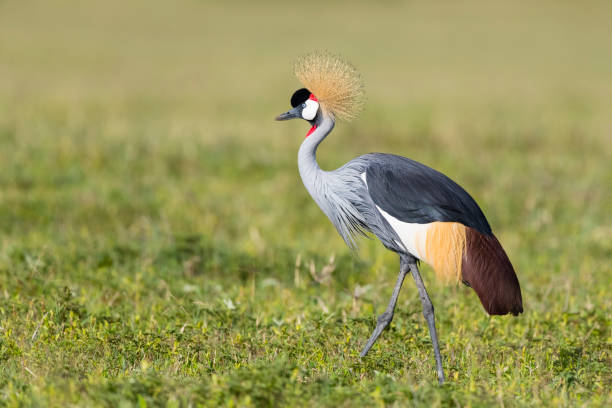
Grey Crowned Cranes
Grey Crowned Cranes: Uganda’s National Bird and Where to Find It
The morning sun rises over the rolling grasslands of Lake Mburo National Park in southwestern Uganda. Two elegant birds walk slowly through the green vegetation, occasionally lowering their heads to search for insects and seeds.
Their long grey necks, black-and-white faces and magnificent golden crowns make them immediately recognisable. One bird suddenly spreads its wings, revealing beautiful white, black and chestnut feathers. Its partner responds with a graceful jump before both return to feeding.
These are grey crowned cranes, among Africa’s most beautiful birds and one of Uganda’s most treasured wildlife symbols.
The grey crowned crane, Uganda’s national bird, appears on the country’s national flag and coat of arms. Its distinctive appearance has made it familiar to generations of Ugandans, even those who have never seen one in the wild.
However, this celebrated bird faces serious conservation challenges. Wetland drainage, habitat loss, accidental poisoning and illegal capture have contributed to its decline.
For travellers exploring Uganda, seeing a pair of crowned cranes in their natural habitat is a rewarding wildlife experience. These birds can be found in several national parks, wetlands, grasslands and agricultural landscapes.
This guide explores their identification, behaviour, breeding habits, conservation status and the best places to find them during a Ugandan safari.
1. What Is a Grey Crowned Crane?
The grey crowned crane is a large African bird belonging to the crane family, Gruidae.
Its scientific name is Balearica regulorum.
It is one of two living crowned crane species, the other being the black crowned crane (Balearica pavonina).
Grey crowned cranes occur in eastern and southern Africa, including Uganda, Kenya, Tanzania, Rwanda and several countries farther south.
They are closely associated with wetlands, grasslands and agricultural areas.
Unlike many familiar savannah birds, grey crowned cranes have long legs, an upright posture and an elaborate crown of stiff golden feathers.
Grey Crowned Crane Quick Facts
| Feature | Description |
|---|---|
| Common name | Grey crowned crane |
| Scientific name | Balearica regulorum |
| Bird family | Gruidae |
| Conservation status | Endangered |
| Height | Approximately 1 metre |
| Wingspan | Around 2 metres |
| Main habitat | Wetlands, grasslands and farmland |
| Diet | Seeds, insects and small animals |
| Breeding | Ground nests in wetland vegetation |
| Social behaviour | Pairs, families and flocks |
| National significance | Uganda’s national bird |
Its beauty makes it one of the most photographed birds on Ugandan wildlife safaris.
2. Why Is the Grey Crowned Crane Uganda’s National Bird?
The grey crowned crane occupies a special place in Uganda’s national identity.
It appears in the centre of the country’s national flag, surrounded by the familiar black, yellow and red horizontal stripes.
The bird also appears on Uganda’s coat of arms alongside the Uganda kob.
These symbols reflect the country’s identity, natural heritage and wildlife diversity.
The crested crane was used as a symbol in Uganda before independence and remained an important national emblem after the country became independent in 1962.
Its graceful appearance has helped make it a symbol of dignity and national pride.
Although cranes are sometimes associated with peace and harmony, visitors should distinguish cultural symbolism from scientific facts about the birds’ behaviour.
3. How Can You Identify a Grey Crowned Crane?
The most distinctive feature is the golden crown on top of the bird’s head.
This crown consists of stiff, straw-coloured feathers arranged in a circular shape.
The bird also has a slate-grey body, long neck, black forehead and striking white cheek patches.
Red facial markings and a red throat pouch provide additional identification clues.
Its wings contain white, black and chestnut feathers, which become especially noticeable during flight or display.
Main Identification Features
| Body Feature | Appearance |
|---|---|
| Crown | Golden, stiff feathers |
| Body | Predominantly grey |
| Cheeks | White with red markings |
| Throat | Red inflatable pouch |
| Wings | White, black and chestnut |
| Legs | Long and dark |
| Bill | Relatively short and dark |
| Posture | Tall and upright |
Both sexes look similar, making males and females difficult to distinguish by appearance alone.
4. Grey Crowned Crane vs Black Crowned Crane
Africa has two crowned crane species that can appear similar to inexperienced birdwatchers.
The grey crowned crane is commoner in suitable habitats across eastern and southern Africa.
The black crowned crane is associated mainly with parts of western and central Africa.
Identification Comparison
| Feature | Grey Crowned Crane | Black Crowned Crane |
|---|---|---|
| Scientific name | Balearica regulorum | Balearica pavonina |
| Body colour | Mainly grey | Generally darker |
| Cheek markings | Large white patch with red | Different red-and-white cheek pattern |
| Golden crown | Present | Present |
| Main distribution | Eastern and southern Africa | Western and central Africa |
| Uganda’s national bird | Yes | No |
For ordinary Uganda safari itineraries, the grey crowned crane is the species visitors should expect.
5. Where Do Grey Crowned Cranes Live?
Grey crowned cranes use a combination of wetland and grassland habitats.
Wetlands are especially important for breeding, while nearby grasslands provide feeding opportunities.
The birds may also forage in agricultural fields and livestock grazing areas.
This ability to use different habitats explains why crowned cranes are sometimes seen far outside national parks.
Important Crane Habitats
| Habitat | Importance |
|---|---|
| Freshwater marshes | Nesting and shelter |
| Wet grasslands | Feeding and breeding |
| Open savannah | Foraging |
| Agricultural fields | Seeds and insects |
| Pastures | Invertebrates and other food |
| Shallow lake margins | Feeding opportunities |
| Trees near wetlands | Roosting sites |
Their survival often depends on having several suitable habitats within the same landscape.
6. Where Can You See Grey Crowned Cranes in Uganda?
Grey crowned cranes occur in several parts of Uganda.
Some of the most accessible viewing areas include Lake Mburo National Park, Queen Elizabeth National Park and wetlands in southwestern Uganda.
Travellers may also encounter them around farming landscapes, lakeshores and seasonal wetlands.
Best Places to Look for Grey Crowned Cranes
| Destination | Region | Where to Look |
|---|---|---|
| Lake Mburo National Park | Western Uganda | Grasslands, wetland margins and grazing areas |
| Queen Elizabeth National Park | Western Uganda | Kasenyi plains and suitable wetland habitats |
| Murchison Falls National Park | Northwestern Uganda | Wet grasslands and open savannah |
| Mabamba Wetland | Central Uganda | Suitable wetland margins and nearby open habitats |
| Lake Bunyonyi surroundings | Southwestern Uganda | Farmland and wetland margins |
| Mbarara and Isingiro | Southwestern Uganda | Pastures, farms and wetlands |
| Rukiga and Kabale | Southwestern Uganda | Wetland valleys and agricultural landscapes |
| Lake Victoria basin | Central Uganda | Suitable marshes and grasslands |
These are potential viewing areas rather than guaranteed sighting locations.
7. Lake Mburo National Park: A Good Place to Start
Lake Mburo National Park is particularly attractive for travellers interested in photographing grey crowned cranes.
The park contains open grasslands, woodland and wetland habitats.
These environments support a variety of birds, including crowned cranes.
During a morning game drive, visitors may find pairs walking through the grass or feeding near suitable wetland areas.
The relatively open landscape can provide clear photographic opportunities.
Lake Mburo is also conveniently positioned along the main route between Kampala and southwestern Uganda.
This makes it a useful addition to gorilla trekking itineraries visiting Bwindi Impenetrable National Park or Mgahinga Gorilla National Park.
8. Queen Elizabeth National Park: Cranes Among Savannah Wildlife
Queen Elizabeth National Park is another rewarding destination for birdwatchers.
Its varied habitats include grasslands, wetlands, lakes and woodland.
Grey crowned cranes may be encountered in suitable open areas, particularly around the Kasenyi plains.
Visitors can sometimes see them feeding near grazing antelopes or other savannah wildlife.
Their bright golden crowns and graceful movement contrast beautifully with the surrounding landscape.
However, their movements vary, and visitors should ask guides about recent sightings.
9. Can You See Grey Crowned Cranes Near Entebbe?
Yes, crowned cranes can occur in suitable wetland and grassland habitats around the Lake Victoria basin.
The Mabamba Wetland area is particularly well known for birdwatching.
Although visitors usually travel there hoping to see the shoebill, the wider wetland environment supports many other birds.
Grey crowned cranes may occasionally be encountered around suitable wetland margins and nearby open country.
However, a crowned crane sighting should not be promised as a standard part of every Mabamba excursion.
Visitors with a particular interest in cranes may have better opportunities in the grasslands and wetlands farther southwest.
10. What Do Grey Crowned Cranes Eat?
Grey crowned cranes are omnivorous.
Their diet includes both plant and animal material.
They eat grass seeds, grains, insects, worms and other small animals.
In agricultural areas, they may feed on seeds and invertebrates found in cultivated fields.
Grey Crowned Crane Diet
| Food | Feeding Importance |
|---|---|
| Grass seeds | Plant-based food |
| Grain | Available in agricultural landscapes |
| Insects | Important animal food |
| Earthworms | Found in moist soil |
| Small frogs | Occasional prey |
| Other small invertebrates | Supplementary nutrition |
| Plant material | Part of a varied diet |
Their flexible feeding habits allow them to use different landscapes.
However, feeding in agricultural areas can expose cranes to pesticides and other human-related risks.
11. Why Do Grey Crowned Cranes Dance?
One of the most fascinating crowned crane behaviours is dancing.
The birds may bow, jump, spread their wings and move around one another.
These elaborate displays are often associated with courtship and pair bonding.
However, dancing is not limited to mating.
Young birds may display, and cranes sometimes dance during other social interactions.
Common Display Behaviours
| Behaviour | Possible Function |
|---|---|
| Bowing | Social display |
| Jumping | Courtship or excitement |
| Wing spreading | Visual communication |
| Head movements | Social signalling |
| Calling | Maintaining communication |
| Mutual dancing | Pair interaction |
Watching a pair perform these movements is one of the most memorable birdwatching experiences in Uganda.
12. Do Grey Crowned Cranes Mate for Life?
Grey crowned cranes are generally described as monogamous birds that form long-term pair bonds.
A breeding pair may remain together across successive seasons.
Partners communicate through calls and displays.
However, the phrase mate for life should not be interpreted as an absolute rule.
Pairs can separate, and individuals may find new partners after the loss of a mate.
Their social relationships are more complex than the romantic symbolism sometimes associated with crowned cranes.
13. Where Do Grey Crowned Cranes Build Their Nests?
Grey crowned cranes usually nest in wetlands or marshy vegetation.
They build nests from grasses, sedges and other plant material.
The nest is often a platform positioned among vegetation in shallow water or waterlogged ground.
This helps conceal the eggs and provide some protection against disturbance.
A female commonly lays two or three eggs, although clutch sizes vary.
Both parents participate in incubation and care of the young.
Crane Breeding Stages
| Stage | Description |
|---|---|
| Pair formation | Courtship and social displays |
| Nest construction | Building a platform in wet vegetation |
| Egg laying | Usually two or three eggs |
| Incubation | Approximately one month |
| Hatching | Chicks emerge and begin moving |
| Parental care | Adults protect and guide chicks |
Wetland disturbance during breeding can cause serious problems for nesting pairs.
14. Can Grey Crowned Cranes Perch in Trees?
Yes.
This is one of the most unusual characteristics of crowned cranes.
Unlike most other crane species, grey crowned cranes have a long hind toe that allows them to grasp branches.
They may roost in trees at night.
This provides a different form of shelter from the ground-level roosting behaviour associated with many other cranes.
For birdwatchers, seeing crowned cranes perched in a tree can be especially surprising.
Their long legs and elaborate crowns create an unusual silhouette among the branches.
15. Are Grey Crowned Cranes Endangered?
Yes.
The grey crowned crane is classified as Endangered on the IUCN Red List.
Its numbers have declined considerably across parts of its range.
Wetland destruction and degradation are among the most important threats.
Other problems include illegal capture, egg collection, poisoning, disturbance and collisions with electricity infrastructure.
Main Conservation Threats
| Threat | Possible Impact |
|---|---|
| Wetland drainage | Removes breeding habitat |
| Agricultural expansion | Reduces suitable wet grasslands |
| Pesticides | Can poison birds and reduce food resources |
| Illegal capture | Removes wild adults and chicks |
| Egg collection | Reduces breeding success |
| Power-line collisions | Causes injury and death |
| Human disturbance | Disrupts nesting |
| Habitat fragmentation | Separates suitable feeding and nesting areas |
Protecting wetlands is essential for the bird’s long-term survival.
16. How Many Grey Crowned Cranes Are Left in Uganda?
Uganda carried out its first countrywide grey crowned crane census between 9 August and 9 September 2023.
The survey covered 1,305 locations across 131 districts.
It recorded 10,077 grey crowned cranes.
Uganda Wildlife Authority published these findings in its State of Wildlife Resources in Uganda 2026 report.
Key Findings From Uganda’s Crane Census
| Census Finding | Result |
|---|---|
| Survey period | August–September 2023 |
| Survey locations | 1,305 |
| Districts covered | 131 |
| Cranes recorded | 10,077 |
| Western region | 46% of recorded birds |
| Central region | 36% of recorded birds |
| Important southwest districts | Lwengo, Isingiro and Mbarara |
The count provides a valuable national baseline.
It should not be interpreted as an exact live population total for every year, because surveys can miss birds and populations change over time.
17. Why Are Wetlands So Important for Crowned Crane Conservation?
Wetlands provide essential breeding habitat.
Crowned cranes need suitable vegetation and water conditions for nesting.
When marshes are drained for agriculture or other development, birds may lose nesting areas.
Wetland degradation also affects insects, amphibians and other organisms that form part of the cranes’ diet.
Protecting wetlands therefore supports cranes and many other species.
Healthy wetlands also benefit nearby communities by helping regulate water, reduce flooding and support livelihoods.
18. How Are Conservation Organisations Helping?
Organisations including the International Crane Foundation, Endangered Wildlife Trust and local conservation partners work to protect grey crowned cranes.
Their programmes involve research, community engagement, wetland restoration and education.
In Uganda, conservation efforts have also focused on reducing pressure on wetlands while supporting local livelihoods.
Important Conservation Actions
- Protecting and restoring wetland habitats.
- Monitoring crane populations and breeding sites.
- Educating communities about nesting areas.
- Reducing illegal capture and trade.
- Encouraging safer agricultural practices.
- Protecting important wetland corridors.
- Supporting community-led conservation initiatives.
Because many crowned cranes live outside national parks, cooperation with local communities is particularly important.
19. How to Photograph Grey Crowned Cranes in Uganda
Grey crowned cranes are excellent photography subjects because of their colours, graceful movements and social behaviour.
Early morning and late afternoon often provide attractive lighting.
A telephoto lens allows visitors to photograph the birds without approaching too closely.
Photography Tips
| Technique | Benefit |
|---|---|
| Photograph at eye level when safely possible | Creates natural portraits |
| Focus on the golden crown | Highlights identification features |
| Use fast shutter speeds | Captures dancing and wing movements |
| Include both birds | Shows pair behaviour |
| Use natural light | Reveals feather detail |
| Keep a respectful distance | Prevents unnecessary disturbance |
Never approach active nests or attempt to make birds fly for photographs.
20. Frequently Asked Questions
What Is Uganda’s National Bird?
The grey crowned crane is Uganda’s national bird. It appears on the country’s flag and coat of arms.
Where Is the Best Place to See Grey Crowned Cranes in Uganda?
Lake Mburo National Park and suitable wetlands and farmland in southwestern Uganda are good places to search.
Why Does the Grey Crowned Crane Have a Golden Crown?
The crown is a distinctive group of stiff feathers used in the bird’s visual appearance and social displays.
Do Grey Crowned Cranes Fly?
Yes. Despite their large size, grey crowned cranes are capable of flight and may travel between feeding and roosting sites.
Can Grey Crowned Cranes Sleep in Trees?
Yes. They are among the unusual crane species capable of perching in trees.
Are Grey Crowned Cranes Endangered?
Yes. They are classified as Endangered, mainly because of habitat loss and other human-related threats.
Final Thoughts: Protecting Uganda’s Beautiful National Bird
The grey crowned crane is more than an attractive bird seen in wetlands and grasslands.
It represents an important part of Uganda’s natural heritage and national identity.
Its golden crown, colourful wings and graceful dancing displays make it one of the country’s most memorable wildlife species.
Yet its survival increasingly depends on the protection of wetlands, grasslands and agricultural landscapes where breeding and feeding take place.
For travellers visiting Lake Mburo, Queen Elizabeth National Park or Uganda’s southwestern wetlands, observing crowned cranes provides an opportunity to appreciate wildlife beyond the famous Big Five and mountain gorillas.
Responsible tourism, habitat protection and community conservation can all contribute to their future.







No comment