
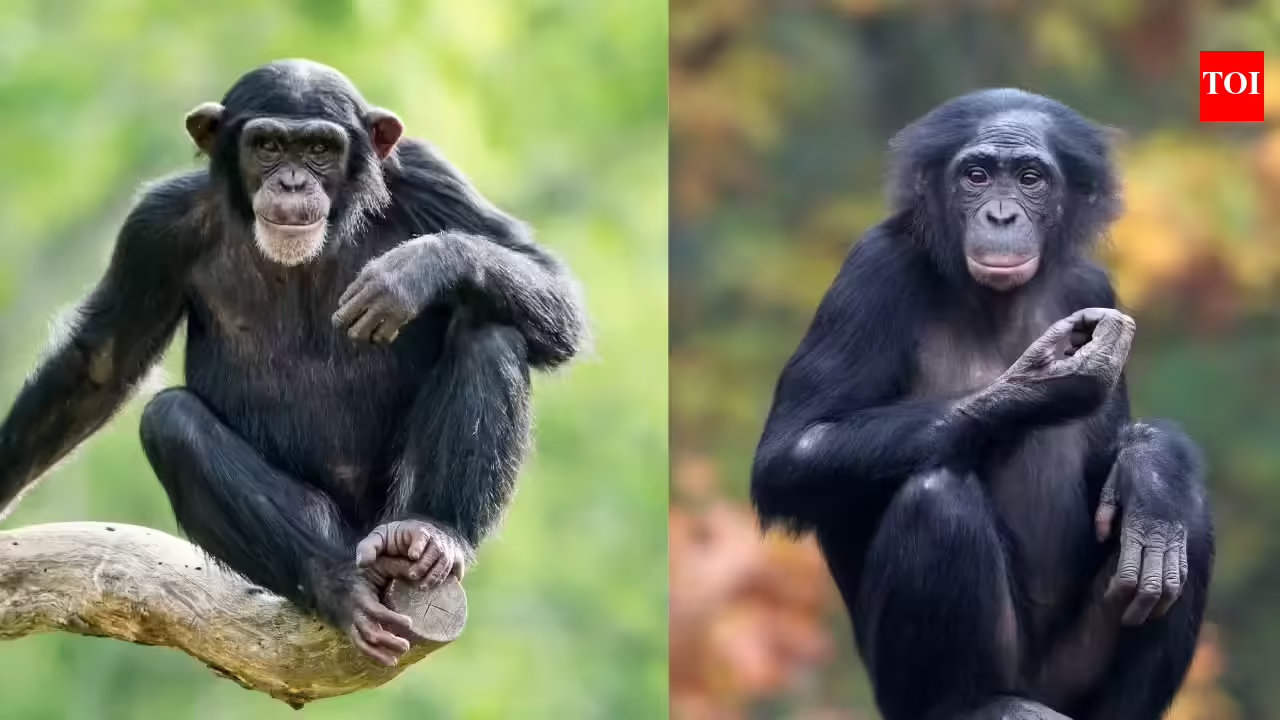
Chimpanzees vs Bonobos: Six Differences Primate Fans Should Know
At first glance, chimpanzees and bonobos look remarkably similar. Both have dark fur, expressive faces, powerful hands and complex social relationships. They are also our closest living relatives, sharing a common evolutionary history with humans. However, watching their behaviour reveals fascinating differences.
Understanding chimpanzees vs bonobos helps wildlife enthusiasts appreciate two of Africa’s most intelligent great apes. Chimpanzees inhabit forests and woodland habitats across several African countries, while wild bonobos live only in the Democratic Republic of Congo.
Although they belong to the same genus, Pan, these primates differ in physical appearance, social organisation, conflict behaviour, communication, tool use and natural distribution.
Here are six important differences every primate enthusiast should know before visiting Africa.
1. Physical Appearance: Bonobos Are Generally More Slender
Chimpanzees and bonobos are separate species with several visible physical differences.
The common chimpanzee is scientifically known as Pan troglodytes, while the bonobo is Pan paniscus.
Chimpanzees generally have robust bodies, muscular shoulders and relatively broad chests.
Bonobos tend to have slimmer builds, relatively longer legs and narrower shoulders.
How to Identify a Bonobo
Bonobos commonly have dark faces, pinkish lips and long black hair that forms a distinctive parting on the head.
Their faces generally remain dark throughout life.
Chimpanzees have more variable facial colouring, which can change as individuals mature.
Both species lack tails, distinguishing them from monkeys such as baboons and colobus monkeys.
| Physical Feature | Chimpanzees | Bonobos |
|---|---|---|
| Body build | Generally robust | More slender |
| Legs | Relatively shorter | Relatively longer |
| Head hair | Usually shorter or less distinctly parted | Often long with a central parting |
| Facial colour | Varies with age and individual | Usually dark |
| Tail | Absent | Absent |
These differences are useful, although age, sex and individual variation can affect appearance.
2. Social Structure: Males and Females Have Different Roles
One of the most interesting differences between chimpanzees and bonobos concerns their social relationships.
Chimpanzee communities usually have male-dominated dominance hierarchies.
Adult males compete for social rank and form alliances that influence their position within the community.
Females also maintain important relationships, particularly with offspring and other familiar individuals.
Female Relationships in Bonobo Societies
Bonobo communities are notable for strong relationships between adult females.
Females can form alliances that allow them to challenge males, influence group interactions and gain access to important resources.
Mothers can also play important roles in their adult sons’ social success.
However, describing every bonobo community as entirely female-controlled would oversimplify their behaviour.
Social relationships vary between individuals and populations.
Both species live in communities that regularly separate into smaller temporary groups.
3. Aggression and Conflict: Two Different Social Patterns
Chimpanzees are well known for territorial behaviour and competition between communities.
Researchers have documented aggressive encounters, coordinated patrols and occasional lethal attacks involving wild chimpanzees.
Such behaviours are not constant, however.
Chimpanzees also spend considerable time grooming, playing, cooperating and maintaining peaceful relationships.
Are Bonobos More Peaceful?
Bonobos are often described as more socially tolerant than chimpanzees.
They frequently use close social contact and affiliative behaviour to maintain relationships and reduce tension.
However, the popular description of bonobos as completely peaceful is misleading.
Bonobos can also behave aggressively, compete and injure one another.
The important difference lies in general social patterns rather than an absolute absence of aggression.
Both species demonstrate cooperation and conflict.
4. Communication: Different Ways of Maintaining Relationships
Chimpanzees and bonobos communicate through vocalisations, facial expressions, gestures and physical contact.
Chimpanzees are particularly known for pant-hoots, loud vocal sequences that can travel through forest habitats.
These calls help maintain communication between individuals separated by vegetation.
Chimpanzees also use grooming, gestures and other sounds during social interactions.
How Bonobos Communicate
Bonobos use a wide range of calls, gestures and facial expressions.
They are also well known for using sociosexual behaviour in several social situations, including greeting, bonding and tension reduction.
This behaviour occurs beyond reproduction and forms part of their wider social communication.
However, it is only one component of bonobo social life.
Grooming, play and vocal communication remain important for both species.
Researchers continue investigating how their communication systems compare and what they reveal about the evolution of human social behaviour.
5. Tool Use and Feeding: Chimpanzees Have More Documented Wild Tool Traditions
Chimpanzees are famous for their ability to make and use tools.
Wild chimpanzees have been observed using sticks to collect termites, leaves to absorb water and stones to crack nuts.
Some populations also use modified sticks when hunting small animals.
Jane Goodall’s observations at Gombe Stream in Tanzania helped establish that wild chimpanzees could manufacture and use tools.
Do Bonobos Use Tools?
Yes, bonobos are capable of using tools.
However, researchers have documented fewer tool-use traditions in wild bonobo populations than in wild chimpanzee populations.
Studies comparing chimpanzees in Uganda with bonobos in the Democratic Republic of Congo have investigated differences in object manipulation and opportunities to learn tool use.
Captive bonobos can demonstrate sophisticated tool-use abilities.
Therefore, the difference does not mean bonobos lack intelligence.
What About Their Diets?
Both species eat fruit, leaves, seeds and other plant materials.
They also consume animal foods.
Chimpanzees are known for hunting monkeys and sharing meat in certain social circumstances.
Wild bonobos have also been observed hunting and eating mammals, although their documented hunting patterns differ.
Both species are adaptable feeders whose diets depend on local habitats and food availability.
6. Natural Distribution: They Live in Different Parts of Africa
The geographical difference between chimpanzees and bonobos is particularly important for travellers.
Chimpanzees occur across several regions of tropical Africa.
Their distribution includes Uganda, Tanzania, Rwanda and parts of western and central Africa.
Wild bonobos, however, are found only in the Democratic Republic of Congo.
Their natural range lies south of the Congo River, mainly within the central Congo Basin.
The Congo River acts as a major geographical barrier separating bonobo populations from chimpanzees living farther north.
Where Can Tourists See Chimpanzees?
Popular chimpanzee destinations include:
- Kibale National Park, Uganda.
- Budongo Forest, Uganda.
- Kyambura Gorge, Uganda.
- Nyungwe National Park, Rwanda.
- Gombe Stream National Park, Tanzania.
- Mahale Mountains National Park, Tanzania.
These destinations offer different forms of guided chimpanzee observation.
Where Can Visitors See Bonobos?
Seeing wild bonobos is considerably more difficult because they inhabit remote forest regions of the Democratic Republic of Congo.
Most conventional travellers interested in observing bonobos can consider Lola ya Bonobo Sanctuary near Kinshasa.
The sanctuary provides a protected home for rescued bonobos and offers guided educational visits.
However, sanctuary viewing differs from observing wild animals in their original forest communities.
Quick Comparison: Chimpanzees vs Bonobos
| Feature | Chimpanzees | Bonobos |
|---|---|---|
| Scientific name | Pan troglodytes | Pan paniscus |
| Body type | More robust | More slender |
| Social hierarchy | Generally male-dominated | Strong female alliances |
| Conflict behaviour | Documented territorial aggression | Often greater social tolerance |
| Communication | Calls, grooming and gestures | Calls, grooming, gestures and extensive sociosexual contact |
| Tool use | Diverse traditions documented in the wild | Fewer documented wild traditions |
| Distribution | Several African countries | Only DR Congo |
| Conservation status | Endangered | Endangered |
Are Chimpanzees and Bonobos Equally Intelligent?
Both species demonstrate impressive cognitive abilities.
They can recognise social relationships, solve problems, learn from others and adapt their behaviour to changing situations.
Chimpanzees have been studied extensively for tool use, planning and cooperation.
Bonobos are particularly interesting to researchers investigating social tolerance, communication and cooperative behaviour.
However, intelligence cannot be reliably ranked using one activity.
A species that uses fewer feeding tools is not necessarily less intelligent.
Different ecological and social environments encourage different behavioural adaptations.
Why Are Both Species Endangered?
Chimpanzees and bonobos face serious conservation threats.
Habitat loss, hunting, illegal wildlife trade and diseases threaten populations across their ranges.
Forest fragmentation can isolate communities and reduce access to feeding areas.
Human illnesses also pose risks because great apes are biologically closely related to humans.
Protecting these species requires habitat conservation, law enforcement, scientific research and cooperation with local communities.
Responsible tourism can support conservation when activities are carefully managed.
Which Species Should You See on an African Primate Safari?
If you want to observe great apes living freely in natural forests, chimpanzee tracking in Uganda, Rwanda or Tanzania is usually the more accessible option.
Kibale National Park is particularly attractive for travellers combining chimpanzees with other Ugandan wildlife experiences.
Gombe Stream appeals to visitors interested in Jane Goodall’s research history.
For travellers fascinated by bonobos, Lola ya Bonobo Sanctuary provides an opportunity to learn about the species and the challenges of rescuing and rehabilitating endangered primates.
The two experiences should not be considered interchangeable.
Wildlife tracking focuses on animals in natural populations, while sanctuary visits emphasise welfare, education and conservation.
Two Remarkable Great Apes
Chimpanzees vs bonobos is more than a comparison of physical appearance.
Their different social structures, communication styles, tool-use traditions and geographical distributions reveal the remarkable diversity of African great apes.
Chimpanzees demonstrate complex alliances, territorial relationships and sophisticated tool use.
Bonobos are known for strong female relationships, social tolerance and equally fascinating communication.
Neither species should be reduced to simple descriptions such as aggressive chimpanzees or peaceful bonobos.
Both are intelligent, socially complex and endangered.
Understanding their differences helps travellers appreciate why protecting chimpanzees, bonobos and the forests they inhabit is essential for African wildlife conservation.







No comment