
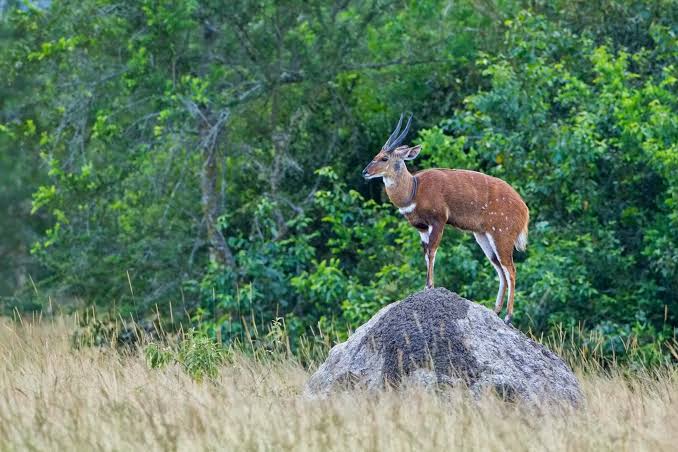
Bushbuck: Shy Antelope at the Forest Edge
A gentle movement catches your attention beside a forest trail in Uganda’s Queen Elizabeth National Park. Beneath the shade of thick vegetation, a reddish-brown antelope stands almost motionless. Its large ears point forward, and a few white spots shine through the leaves.
Before you can raise your camera, the animal turns and disappears into the undergrowth.
You have just encountered a bushbuck, one of Africa’s most attractive but easily overlooked antelopes.
The bushbuck antelope at the forest edge is a fascinating animal that prefers sheltered habitats rather than the wide-open grasslands favoured by many other antelopes. Its ability to remain hidden, feed quietly and move through thick vegetation makes it a rewarding discovery during a wildlife safari.
Bushbucks occur across much of sub-Saharan Africa, including Uganda, Rwanda, Kenya and Tanzania. Although they are widely distributed, their secretive behaviour means travellers can spend several days in suitable habitat without seeing one clearly.
This guide explains how to identify bushbucks, why they prefer forest edges, what they eat and where to look for them during an East African safari.
1. What Is a Bushbuck?
The bushbuck is a medium-sized African antelope belonging to the spiral-horned antelope group, which also includes nyalas, sitatungas and kudus.
Its coat varies from reddish-brown to dark brown, often decorated with white spots and short stripes. The pattern differs between individuals and geographical populations.
Adult males have short, spiralling horns, while females are naturally hornless.
Bushbuck Quick Facts
| Feature | Description |
|---|---|
| Common name | Bushbuck |
| Scientific classification | Tragelaphus scriptus species complex |
| Animal family | Bovidae |
| Habitat | Forest edges, thickets and wooded areas |
| Diet | Mainly leaves, shoots and other vegetation |
| Activity | Often dawn, dusk and night |
| Social structure | Mostly solitary or loosely associated |
| Male horns | Short, spiralled and pointed |
| Female horns | Absent |
| Conservation | Widespread, but local pressures exist |
Bushbucks are adaptable, but they depend heavily on vegetation that provides both food and concealment.
2. Why Do Bushbucks Prefer Forest Edges?
A forest edge provides an important combination of food and shelter.
Inside dense vegetation, a bushbuck can hide from predators and avoid unnecessary disturbance. Just outside the thickest cover, it can find fresh leaves, herbs, shoots and other plants.
This makes transitional areas between woodland and grassland particularly suitable.
Bushbucks also inhabit riverine forests, wooded valleys, thick scrub and patches of vegetation near water.
They are not restricted to the interior of tropical rainforests. In fact, extensive areas of very dense, closed-canopy forest may provide less suitable conditions than forest margins and clearings.
Common Bushbuck Habitats
| Habitat | Why Bushbucks Use It |
|---|---|
| Forest edges | Food and nearby hiding cover |
| Riverine woodland | Moist vegetation and shelter |
| Thick bushland | Concealment from predators |
| Forest clearings | Access to herbs and fresh growth |
| Wooded valleys | Protected movement routes |
| Regenerating vegetation | Leaves and young shoots |
The key requirement is suitable cover within reach of feeding opportunities.
3. How Can You Identify a Bushbuck?
Bushbucks have a compact body, slender legs, rounded ears and an alert expression.
Their coats are often marked with white spots, particularly around the flanks and hindquarters. Some also have pale stripes and a contrasting throat patch.
Male bushbucks are generally darker and more heavily built than females in many populations.
Their horns are an important identification feature, although a female or young male may be recognised by body shape and markings.
Male vs Female Bushbuck
| Feature | Male | Female |
|---|---|---|
| Horns | Present | Absent |
| Body build | Usually heavier | Generally smaller |
| Coat | May darken with age | Often reddish-brown |
| White markings | Variable | Variable |
| Behaviour | Often encountered alone | Alone or with offspring |
Markings and colours vary considerably, so avoid identifying an animal solely from the number of white spots.
4. Why Are Bushbucks So Difficult to See?
Bushbucks rely heavily on remaining concealed.
Unlike impalas or Uganda kobs, which often gather in visible herds, bushbucks commonly move individually through vegetation.
They may stand completely still when they detect unusual movement.
Their colouring helps them blend into the mixture of shade, leaves and stems.
If disturbed, a bushbuck may retreat quickly into nearby cover.
Researchers studying bushbucks in Queen Elizabeth National Park found that most sightings involved individual animals rather than groups.
This scattered social arrangement helps explain why bushbucks seem less common than they actually are.
5. Are Bushbucks Active During the Day or Night?
Bushbucks can be active during both daylight and darkness.
However, many populations show increased activity around dawn, dusk and night, especially where daytime disturbance is substantial.
They often remain concealed during the hottest or busiest parts of the day.
As conditions become quieter, they may emerge to feed.
Typical Bushbuck Activity
| Time | Possible Behaviour |
|---|---|
| Early morning | Feeding along clearings |
| Mid-morning | Browsing or moving into cover |
| Midday | Resting in sheltered vegetation |
| Late afternoon | Increased movement and feeding |
| Evening | Feeding near woodland edges |
| Night | Browsing in quieter areas |
This is a general pattern, not a fixed timetable for every bushbuck.
6. What Do Bushbucks Eat?
Bushbucks are primarily browsers, meaning they feed mainly on leaves and other vegetation rather than depending entirely on grass.
Their diet includes shoots, herbs, flowers, twigs and various plant species.
They may also consume fruits and fresh grasses when available.
Because they use different plant materials, bushbucks can occupy a wide range of wooded habitats.
Their feeding habits differ from those of grazing antelopes such as Uganda kobs.
Bushbuck Diet
| Food | Importance |
|---|---|
| Leaves | Major food source |
| Young shoots | Tender vegetation |
| Herbs | Ground-level feeding |
| Flowers | Seasonal food |
| Fruits | Available in some habitats |
| Fresh grass | Occasional supplementary food |
Their browsing also connects them to forest regeneration and the wider plant community.
7. Do Bushbucks Live Alone?
Bushbucks are among the more solitary African antelopes.
Adults are frequently seen alone, although this does not mean they never interact.
Mothers remain with their calves, and males and females associate during reproductive periods.
Several bushbucks may also occupy overlapping areas of suitable habitat.
A scientific study in Uganda’s Queen Elizabeth National Park found that 71% of recorded census sightings were of single animals.
Interestingly, the animals did not necessarily avoid one another or behave aggressively whenever they met.
This shows that being solitary does not mean being completely antisocial.
8. How Do Bushbucks Protect Themselves?
Their first defence is usually concealment.
Thick vegetation provides an opportunity to remain unnoticed or escape quickly.
Bushbucks can move through dense vegetation with surprising agility.
They may also produce barking alarm calls when disturbed.
Main Bushbuck Defences
- Remaining motionless in cover.
- Moving quietly through thick vegetation.
- Escaping into bushes when threatened.
- Using alert hearing and observation.
- Producing alarm sounds.
- Using horns defensively, particularly adult males.
A cornered bushbuck can be dangerous. Visitors should never approach or attempt to handle one.
9. What Animals Hunt Bushbucks?
Bushbucks are prey for several African carnivores.
Leopards are particularly well suited to hunting in wooded habitats where bushbucks live.
Lions, spotted hyenas and African wild dogs may also prey on them when opportunities arise.
Young calves can face additional threats from smaller predators.
Bushbucks rely on camouflage, alertness and nearby shelter rather than the safety of large open-country herds.
This relationship makes them an interesting example of how antelope behaviour adapts to different environments.
10. How Do Bushbucks Reproduce and Raise Their Calves?
Bushbucks can breed during different periods of the year, depending on local conditions.
After a pregnancy of approximately six months, a female normally gives birth to a single calf.
During early life, the youngster may remain concealed in thick vegetation while its mother feeds nearby.
The female returns to nurse and care for it.
As the calf becomes stronger, it begins accompanying its mother and feeding on vegetation.
This hidden early development provides protection, but visitors should never assume that a calf found alone has been abandoned.
11. Where Can You See Bushbucks in East Africa?
Bushbucks occur across suitable wooded and forest-edge habitats throughout East Africa.
In Uganda, they are sometimes encountered near forest trails, woodland margins and riverine vegetation.
Bushbuck Safari Destinations
| Country | Destination | Where to Look |
|---|---|---|
| Uganda | Queen Elizabeth National Park | Bushland and wooded areas |
| Uganda | Kibale National Park | Forest edges and clearings |
| Uganda | Bwindi Impenetrable National Park | Forest margins and suitable openings |
| Uganda | Lake Mburo National Park | Woodland and dense scrub |
| Kenya | Maasai Mara ecosystem | Thickets and riverine woodland |
| Tanzania | Serengeti ecosystem | Wooded areas and river margins |
| Rwanda | Volcanoes National Park | Montane forest-edge habitat |
| Rwanda | Nyungwe National Park | Suitable forest margins |
A sighting is never guaranteed. Bushbucks can remain hidden even where they are locally numerous.
12. Bushbuck vs Uganda Kob: What’s the Difference?
Bushbucks and Uganda kobs are both African antelopes, but they occupy different habitats and have different feeding habits.
| Feature | Bushbuck | Uganda Kob |
|---|---|---|
| Habitat | Forest edge and dense vegetation | Open grassland |
| Diet | Mainly browsing | Mainly grazing |
| Social behaviour | Mostly solitary | Often lives in herds |
| Male horns | Short, spiralling | Longer, curved and ridged |
| Coat markings | Often white spots and stripes | Generally more uniform |
| Visibility | Frequently concealed | More easily seen in open country |
If you spot a reddish-brown antelope alone beside dense bushes, consider a bushbuck. If it is grazing in an open herd, a kob may be more likely.
13. Are Bushbucks Endangered?
The bushbuck has traditionally been assessed as Least Concern on the IUCN Red List.
It is widely distributed across sub-Saharan Africa and can survive in some human-modified landscapes.
However, this does not mean that every local population is secure.
Habitat loss, illegal hunting and pressure from expanding agriculture can affect bushbucks.
They still require adequate vegetation and suitable habitat connections.
There is also ongoing scientific discussion about the classification of northern and southern bushbuck lineages.
For conservation and identification purposes, it is important to recognise that the traditional term bushbuck covers geographically varied populations.
14. How to Photograph Bushbucks on Safari
Photographing bushbucks requires patience.
Unlike large savannah animals that remain visible for several minutes, a bushbuck may disappear as soon as it detects disturbance.
A telephoto lens is useful for obtaining close photographs from a respectful distance.
Look towards quiet clearings, forest margins and sheltered paths.
Photography Tips
- Use soft morning or late-afternoon light.
- Keep movement and noise to a minimum.
- Focus on the eyes when vegetation partly hides the animal.
- Include the forest background to show its habitat.
- Avoid using flash in disturbing circumstances.
- Never chase a bushbuck out of cover for a photograph.
Sometimes the most interesting image is one that shows only part of the animal emerging from vegetation.
15. Frequently Asked Questions
Why Are Bushbucks Called Shy Antelopes?
They often remain concealed in dense vegetation and usually retreat when disturbed.
Do Female Bushbucks Have Horns?
No. Horns are normally present only in males.
Can Bushbucks Swim?
Yes. Bushbucks are capable swimmers, although they are not aquatic specialists like sitatungas.
Are Bushbucks Common in Uganda?
They occur in suitable forest-edge and woodland habitats, but their secretive behaviour makes sightings unpredictable.
Are Bushbucks Dangerous?
Bushbucks generally avoid humans, but a threatened or cornered animal, particularly a horned male, can cause injury.
The Hidden Beauty of Africa’s Forest Edges
Bushbucks may not attract as much attention as lions, elephants or mountain gorillas, but they are among Africa’s most interesting forest-edge mammals.
Their attractive coats, secretive movements and preference for dense vegetation make them very different from the antelopes commonly seen on open savannahs.
They are skilled browsers, frequently solitary and well adapted to living close to shelter.
For travellers exploring Uganda’s national parks or the wooded landscapes of Kenya, Tanzania and Rwanda, spotting a bushbuck rewards careful observation.




No comment