
Booking a Safari for a Large Family: Rooms, Vehicles and Costs
Booking a safari for a large family requires careful planning to ensure everyone enjoys a comfortable, affordable and memorable African wildlife holiday. Whether travelling with young children, teenagers, grandparents or several generations together, choosing suitable accommodation, transport and activities makes an enormous difference.
Uganda, Kenya, Tanzania and Rwanda offer excellent family safari opportunities, from game drives in Queen Elizabeth National Park to wildlife encounters in the Maasai Mara, Serengeti and Akagera National Park.
However, organising a safari for six, eight or twelve family members is different from booking a holiday for two. Large families need enough bedrooms, suitable safari vehicles, flexible meal arrangements and age-appropriate activities.
Understanding how group size affects prices can also help families reduce expenses without sacrificing comfort.
This guide explains how to organise a large family safari, compare accommodation arrangements, choose suitable vehicles and create a realistic travel budget.
What Counts as a Large Family Safari?
A large family safari generally involves six or more travellers sharing one holiday itinerary.
Groups may include parents, children, grandparents, cousins and other relatives.
Some families prefer travelling together throughout the journey, while others require separate accommodation or activities.
Large Family Safari Planning
| Family size | Main consideration |
|---|---|
| 4–5 travellers | Family rooms and suitable vehicle |
| 6–7 travellers | Multiple rooms or larger accommodation |
| 8–10 travellers | Two vehicles may be preferable |
| 11–15 travellers | Coordinated transport and room allocations |
| 16+ travellers | Group logistics and advance reservations |
The number of children and their ages can influence accommodation policies, wildlife activity restrictions and total costs.
Why Large Families Should Book Early
Popular safari lodges often have limited family rooms and interconnected accommodation.
Properties may offer several standard rooms but only one or two family suites.
During peak seasons, securing neighbouring rooms can become difficult.
Recommended Advance Booking
| Travel arrangement | Suggested booking period |
|---|---|
| Standard family safari | 6–9 months |
| School holiday safari | 9–12 months |
| Luxury family lodge | 9–15 months |
| Large multi-generational group | 9–12 months |
| Gorilla trekking with eligible adults | 6–12 months |
| Quieter-season safari | 3–6 months |
These are planning recommendations rather than official deadlines. Availability depends on the property and travel dates.
Choosing the Best Country for a Family Safari
Each East African country offers distinctive experiences.
Family Safari Destination Comparison
| Country | Popular destinations | Main attractions |
|---|---|---|
| Uganda | Queen Elizabeth, Murchison Falls, Lake Mburo | Game drives and boat trips |
| Kenya | Maasai Mara, Amboseli, Lake Nakuru | Big Five and open savannahs |
| Tanzania | Serengeti, Tarangire, Ngorongoro | Extensive wildlife viewing |
| Rwanda | Akagera, Lake Kivu, Volcanoes region | Wildlife and scenic relaxation |
For families with younger children, classic game drives are often easier to arrange than physically demanding primate trekking.
Family Safari Accommodation Options
Accommodation is one of the most important decisions when travelling with a large family.
A lodge may advertise itself as family-friendly without offering suitable room configurations.
Common Accommodation Types
| Accommodation | Suitable arrangement |
|---|---|
| Family room | Parents with children |
| Interconnecting rooms | Families needing separate sleeping areas |
| Family safari tent | Larger family units |
| Private villa | Multi-generational groups |
| Multiple lodge cottages | Extended families |
| Exclusive-use camp | Groups seeking complete privacy |
Ask whether children can share existing beds, whether extra beds are permitted and how many bathrooms are available.
Family Rooms vs Separate Rooms
A family room can be economical when younger children share accommodation with parents.
However, older children and grandparents may prefer more privacy.
Accommodation Comparison
| Feature | Family room | Separate rooms |
|---|---|---|
| Cost | May be lower | Often higher |
| Privacy | Limited | Greater |
| Supervision | Convenient | Depends on location |
| Bathrooms | Often shared | Usually separate |
| Suitable for teenagers | Depends on layout | Often preferable |
| Grandparent comfort | Variable | More independent |
Families should request an accurate room layout before confirming a booking.
Why Interconnecting Rooms Matter
Interconnecting rooms have an internal door between two accommodation units.
They can be particularly useful for parents travelling with children.
However, adjacent rooms are not necessarily interconnected.
Questions to Ask the Lodge
Confirm whether the rooms share an internal door.
Check bed configurations.
Ask whether the connecting door can be secured.
Confirm the distance between rooms if interconnecting accommodation is unavailable.
For large families, written room allocations reduce misunderstandings upon arrival.
Choosing the Right Safari Vehicle
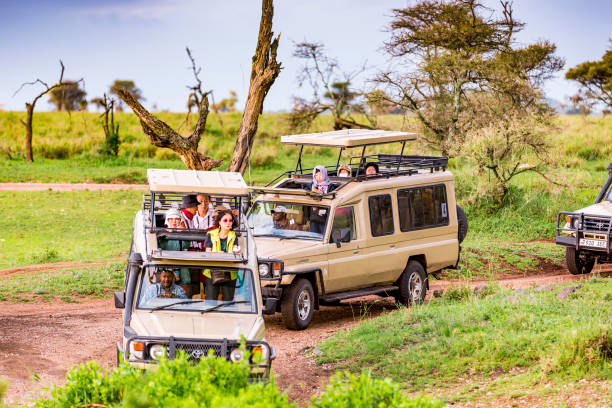
A safari vehicle should provide comfortable seating and suitable wildlife visibility for every passenger.
Large families sometimes assume that everyone can fit inside one extended vehicle.
However, seating capacity and viewing arrangements vary.
Safari Vehicle Options
| Vehicle arrangement | Best suited to |
|---|---|
| Standard 4WD safari vehicle | Small family |
| Extended 4WD | Medium-sized family |
| Two safari vehicles | Eight or more travellers |
| Private open-sided vehicle | Lodge-based game drives |
| Minibus for transfers | Larger groups on suitable roads |
Every passenger should have a proper seat and seat belt where required.
Children should use appropriate restraints according to their age, size and applicable regulations.
One Large Vehicle or Two Smaller Vehicles?
Families with eight or more participants may need to consider using two vehicles.
This can improve wildlife visibility and comfort.
Vehicle Comparison
| Consideration | One large vehicle | Two vehicles |
|---|---|---|
| Group interaction | Everyone together | Group divided |
| Cost | Potentially lower | Usually higher |
| Wildlife visibility | Depends on layout | Often improved |
| Flexibility | One schedule | Different interests possible |
| Children | One shared space | Separate arrangements possible |
| Photography | More competition for space | Greater flexibility |
Two vehicles can be particularly useful when some family members enjoy photography while others prefer shorter game drives.
How Much Does a Large Family Safari Cost?
Safari prices depend on accommodation, destination, season, group size and activities.
Larger groups can sometimes reduce their per-person transport costs by sharing vehicles and guides.
However, accommodation and national park charges remain important expenses.
Illustrative Daily Family Safari Costs
| Safari category | Estimated adult cost per day |
|---|---|
| Budget | $180–$300 |
| Mid-range | $300–$600 |
| Luxury | $650–$1,500+ |
These are broad US-dollar planning estimates for conventional road-based safaris, not confirmed quotations. Child rates vary considerably, and specialist permits, international flights and private charters may increase the total.
Example: Seven-Day Safari for Eight Family Members
Consider a family of six adults and two children booking a seven-day mid-range safari.
Assume an illustrative adult daily rate of $350 and a discounted child rate of $250.
Example Family Safari Budget
| Traveller category | Calculation | Total |
|---|---|---|
| Six adults | 6 × $350 × 7 days | $14,700 |
| Two children | 2 × $250 × 7 days | $3,500 |
| Estimated package total | $18,200 |
The average cost would be $2,275 per traveller.
Actual prices depend on children’s ages, accommodation arrangements and the operator’s final quotation.
Do Children Pay Full Safari Prices?
Children may qualify for reduced accommodation and national park fees, but discounts vary.
Some lodges allow younger children to share their parents’ room at reduced rates. Others charge according to age and meal arrangements.
Understanding Child Rates
| Expense | Possible child discount |
|---|---|
| Lodge accommodation | Age-dependent |
| National park entry | Published child tariffs |
| Meals | Children’s menus or reduced rates |
| Safari transport | Usually charged by seat or vehicle |
| Domestic flights | Airline-specific |
| Specialist activities | Minimum ages may apply |
Kenya Wildlife Service, for example, publishes separate adult and child conservation tariffs for several parks.
Always provide every child’s exact age when requesting a family safari quotation.
Gorilla Trekking With a Large Family
Mountain gorilla trekking is popular among families visiting Uganda and Rwanda, but it has important age restrictions.
The standard minimum age for gorilla trekking is 15 years in both countries.
Planning for Younger Children
Adults and eligible teenagers can participate in trekking while younger children enjoy suitable alternative activities under supervision.
Some families arrange separate activities or childcare through accommodation providers.
Gorilla trekking also requires advance permits, so families should confirm availability before booking flights.
Family-Friendly Safari Activities
Not every family member will enjoy demanding hikes or long game drives.
A successful family itinerary should combine wildlife experiences with relaxation.
Recommended Family Activities
| Activity | Suitable experience |
|---|---|
| Game drives | Wildlife viewing from vehicles |
| Boat safaris | Birds, hippos and elephants |
| Guided nature walks | Subject to age restrictions |
| Cultural activities | Community experiences |
| Birdwatching | Educational wildlife observation |
| Lodge swimming | Relaxation where facilities permit |
| Scenic boat excursions | Lakes and waterways |
Activities should be selected according to the youngest participant’s age and individual abilities.
Planning a Safari With Grandparents
Multi-generational safaris require particular attention to comfort and accessibility.
Older participants may prefer shorter transfers, easily accessible rooms and flexible schedules.
Ask whether accommodation involves steep steps, lengthy walks or uneven pathways.
Where necessary, include domestic flights to reduce exhausting road journeys.
A comfortable pace allows everyone to participate without feeling rushed.
Best Time for a Large Family Safari
School holidays often determine when families can travel.
June to September and December to February are popular periods in several East African destinations.
Seasonal Planning
| Season | Main consideration |
|---|---|
| June–September | Popular wildlife-viewing period |
| December–February | Family holiday demand |
| March–May | Rainfall and possible lower prices |
| October–November | Variable weather and availability |
Travelling outside peak periods may reduce accommodation costs, but families must consider rainfall and road conditions.
How to Reduce Large Family Safari Costs
Travelling together can provide useful opportunities to share expenses.
Private vehicles become more economical when several relatives divide the cost.
Family rooms may also reduce accommodation expenses.
Practical Savings
Compare family suites with separate rooms.
Request group accommodation quotations.
Travel during quieter periods when possible.
Choose destinations within one region.
Avoid unnecessary domestic flights.
Ask about genuine child discounts.
Compare packages using the same services and room arrangements.
The cheapest quotation is not necessarily the best value.
Sample Seven-Day Family Safari in Uganda
Uganda offers several destinations suitable for mixed-age groups.
Example Family Itinerary
| Day | Activity |
|---|---|
| 1 | Arrive in Entebbe |
| 2 | Travel towards Murchison Falls |
| 3 | Game drive and Nile boat safari |
| 4 | Additional wildlife viewing |
| 5 | Travel towards Kampala or Entebbe |
| 6 | Relaxation and family activities |
| 7 | Departure |
Families interested in gorilla trekking can design a longer itinerary with suitable alternative arrangements for younger members.
Meal Planning and Dietary Requirements
Large families frequently have different food preferences.
Some members may require vegetarian meals, allergy-aware preparation or children’s portions.
Inform accommodation providers about dietary requirements before arrival.
Carry suitable snacks for long transfers.
Never assume that remote lodges can accommodate every dietary request without advance notice.
Packing for a Large Family Safari
Packing requirements increase when several travellers share one itinerary.
Families should coordinate essentials rather than carrying unnecessary duplicate equipment.
Useful items include comfortable clothing, sun protection, insect repellent, personal medication and binoculars.
For children, bring familiar snacks and suitable entertainment for longer transfers.
Check baggage allowances carefully when domestic safari flights are included.
Travel Insurance and Family Safety
Family travel insurance should cover all participating relatives.
Check medical expenses, emergency evacuation, cancellations and planned activities.
Confirm whether children and older relatives have any relevant coverage restrictions.
Some adventure activities have minimum ages or additional insurance requirements.
A safari operator should explain emergency arrangements and vehicle safety procedures.
Questions to Ask Before Booking
| Question | Why it matters |
|---|---|
| How many rooms are required? | Accommodation planning |
| Are rooms interconnected? | Family convenience |
| How many vehicles are included? | Comfort and visibility |
| Does every passenger have a seat? | Transport safety |
| Are child rates available? | Budget accuracy |
| Are activities age-appropriate? | Participation |
| Are meals included? | Financial planning |
| Can schedules be adjusted? | Family flexibility |
| What are the cancellation terms? | Booking protection |
Request written confirmation of the complete arrangements.
Common Family Safari Booking Mistakes
Large families sometimes book accommodation without checking room layouts.
Others underestimate the number of vehicles required or plan exhausting road transfers.
Another common problem is arranging activities before confirming children’s ages and eligibility.
Avoid choosing a safari solely because it offers the lowest advertised price.
Comfort, safety and realistic scheduling are essential.
Planning a Comfortable Large Family Safari
Booking a safari for a large family can create unforgettable shared memories across several generations.
Uganda, Kenya, Tanzania and Rwanda offer outstanding wildlife destinations and accommodation options for different budgets.
The most important decisions involve selecting suitable rooms, providing comfortable transport and organising activities everyone can enjoy.
Large families can sometimes achieve excellent value by sharing vehicle expenses and booking suitable accommodation together.
The best family safari is one that balances wildlife experiences, comfort, safety and affordability while allowing every generation to enjoy the journey.



No comment