
Do Lions Really Fear Fire and Headlights? A Myth Check
Do lions really fear fire and headlights? This is a common question among travellers planning African safaris, particularly those interested in camping, night game drives and wildlife photography.
Stories about lions running away from flames or bright vehicle lights have circulated for generations. Some travellers believe that lighting a fire guarantees protection from lions. Others assume that switching on vehicle headlights will immediately frighten a lion away.
However, lion behaviour is more complicated than these popular beliefs suggest.
Lions are powerful predators, but they also assess unfamiliar situations and avoid unnecessary danger. Their reactions to fire, headlights and human activity depend on previous experiences, environmental conditions and the circumstances of each encounter.
Understanding these behaviours helps visitors make better decisions when travelling through lion habitats in Uganda, Kenya and Tanzania.
Do Lions Really Fear Fire?
Lions may avoid fire, particularly when flames, heat or smoke create unfamiliar or uncomfortable conditions.
However, this does not mean every lion will immediately retreat whenever it sees a flame.
Wild animals respond differently depending on the situation.
A lion that has encountered people around campfires may behave differently from one living in a remote area with limited human contact.
Why Fire Can Make Lions Cautious
Fire produces several things that animals may find threatening:
Heat.
Smoke.
Bright, moving flames.
Crackling sounds.
Changes in the surrounding environment.
These conditions can encourage animals to keep their distance.
However, there is insufficient evidence to claim that ordinary campfires reliably prevent lion attacks.
A small fire should never be treated as a guaranteed protective barrier.
Can Lions Approach a Burning Campfire?
Yes. Lions can approach areas where fires are burning.
A lion’s decision may depend on hunger, curiosity, available routes and familiarity with human activity.
Some lions may avoid a campsite entirely, while others may investigate nearby surroundings.
Travellers should never deliberately test whether a lion fears fire.
Do Vehicle Headlights Frighten Lions?
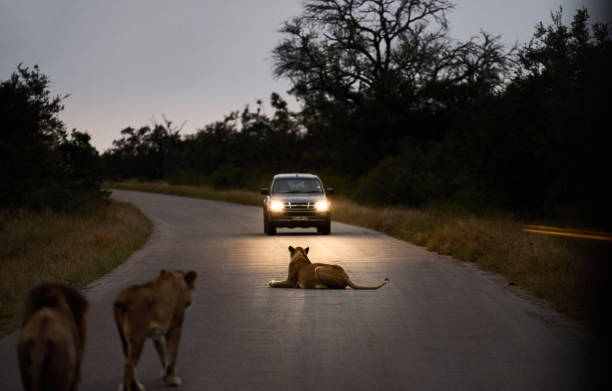
Vehicle headlights can influence lion behaviour, especially at night.
A sudden change in lighting may cause an animal to pause, look towards the source or move away.
However, lions do not respond to headlights in exactly the same way.
Why Some Lions Ignore Headlights
Lions living in frequently visited national parks may become accustomed to safari vehicles.
They regularly encounter engine sounds, people and vehicle movements.
Consequently, some individuals remain calm when vehicles approach at permitted distances.
Others may move away, particularly if they feel disturbed.
A lion that remains still beneath headlights is not necessarily frightened.
It may simply be resting, observing its surroundings or deciding whether to move.
Can Headlights Stop a Lion From Charging?
Headlights should never be relied upon to stop a charging lion.
A defensive or aggressive animal may continue moving towards a perceived threat despite bright lights.
Trying to frighten lions with headlights can also increase stress and produce unpredictable reactions.
Visitors should follow their guide’s instructions rather than attempting to control an encounter through lighting.
What Scientific Research Says About Lions and Lights
Researchers have studied whether artificial lights can help reduce attacks on livestock near protected areas.
In Kenya, some communities have installed flashing LED lights around livestock enclosures, commonly called bomas.
These systems are designed to create changing patterns of light that may discourage predators from approaching livestock at night.
The Lion Lights Experience in Kenya
Research around Nairobi National Park found that flashing LED lights installed around livestock enclosures reduced nighttime lion attacks at the protected locations.
Another study in southern Kenya reported reduced livestock predation during a six-month monitoring period.
These findings suggest that correctly installed lighting systems can sometimes help protect livestock.
However, other research has produced mixed results, and effectiveness may depend on enclosure construction, predator behaviour and local conditions.
Why Flashing Lights Differ From Headlights
Flashing livestock-protection lights operate differently from ordinary vehicle headlights.
| Feature | Flashing livestock lights | Vehicle headlights |
|---|---|---|
| Main purpose | Discourage predators near livestock | Illuminate roads and surroundings |
| Light pattern | Repeated or changing flashes | Usually steady |
| Location | Fixed around enclosures | Mounted on vehicles |
| Evidence | Some studies report reduced livestock attacks | No reliable guarantee of deterring lions |
| Main limitation | Effectiveness varies | May disturb wildlife |
Research supporting flashing lights around livestock enclosures does not prove that vehicle headlights provide protection during close lion encounters.
Why Lions Sometimes Avoid Humans
Lions generally have reasons to avoid unnecessary confrontations.
An injury can affect their ability to hunt, move or defend themselves.
However, lions are still dangerous wild animals, and their reactions cannot be predicted with certainty.
Previous Human Encounters
Lions living near settlements may associate people with particular experiences.
Some animals learn to avoid areas with frequent human activity.
Others become accustomed to vehicles or nearby communities.
This familiarity can influence how they respond to movement, noise and lighting.
Protecting Cubs
Female lions with young cubs may become defensive when they perceive a threat.
Approaching a lioness too closely can create unnecessary danger.
Visitors should never position themselves between a mother and her cubs.
Feeding and Hunting Behaviour
Lions may behave differently when feeding on a carcass or hunting.
A lion guarding food may react defensively if people approach.
For this reason, visitors should maintain suitable distances and avoid disturbing animals during feeding.
Is It Safe to Camp in Lion Country?
Camping in areas where lions occur requires careful planning.
Many national parks provide designated camping locations and established safety procedures.
However, visitors should understand that camping near wildlife carries risks.
Choose Authorised Campsites
Use designated camping areas managed by park authorities or established accommodation providers.
Avoid setting up camp in unfamiliar wildlife corridors or near animal feeding areas.
Never Depend on Fire Alone
A campfire may provide warmth and lighting, but it should never replace proper safety precautions.
Follow campsite rules concerning fires, food storage and nighttime movement.
Keep Food Secure
Food smells can attract wildlife and scavenging animals.
Store food according to campsite instructions.
Never leave food scraps around your sleeping area.
Avoid Walking Alone at Night
If your accommodation requires staff escorts after dark, follow that procedure.
Do not leave your tent to investigate animal sounds.
Remain inside and contact camp staff when assistance is needed.
Responsible Night Game Drives
Night game drives can provide opportunities to observe nocturnal wildlife.
However, they should only take place where permitted and under the supervision of authorised guides.
Use Lights Responsibly
Bright lights can disturb animals, particularly when directed towards their eyes.
Guides should follow local rules concerning spotlight use.
Avoid repeatedly shining bright lights directly into an animal’s face.
Remain Inside the Vehicle
Do not leave your vehicle to photograph lions.
Even a lion that appears relaxed can react quickly.
Avoid Blocking Wildlife
Give animals sufficient space to cross roads or move away.
Never surround lions with vehicles or prevent them from leaving an area.
Common Myths About Lions and Human Safety
| Safari myth | What you should know |
|---|---|
| Lions always fear fire | Some avoid flames, but reactions vary |
| Headlights stop attacking lions | Headlights offer no guaranteed protection |
| Lions never approach campsites | They can approach areas occupied by people |
| Lions fear every loud noise | Reactions depend on circumstances |
| Sleeping lions are harmless | Lions remain potentially dangerous |
| Flashing lights always stop predators | Research shows varying effectiveness |
Understanding these differences helps visitors avoid dangerous assumptions.
What Should You Do if You Encounter a Lion?
Your response depends on whether you are inside a vehicle, walking with a guide or staying at a campsite.
During a Game Drive
Remain inside your vehicle.
Avoid shouting, sudden movements or attempts to attract the lion’s attention.
Follow the guide’s instructions.
If a lion approaches, allow the guide to manage the situation.
During a Guided Walking Safari
Stay with your guide and follow instructions immediately.
Do not run, approach the animal or attempt to photograph it at close range.
Qualified guides assess animal behaviour and decide how the group should respond.
Around a Safari Camp
Stay inside your accommodation if lions are nearby.
Contact camp staff and wait for instructions.
Do not use a phone torch or campfire to test the animal’s reaction.
Frequently Asked Questions
Are Lions Naturally Afraid of Fire?
Lions may avoid fire because of heat, smoke and unfamiliar conditions, but their reactions vary. Fire is not a reliable safety barrier.
Do Flashing Lights Keep Lions Away?
Some studies in Kenya found that flashing lights reduced livestock attacks around protected enclosures. However, results vary, and lights do not provide complete protection.
Can Lions See Vehicle Headlights at Night?
Yes. Lions can detect artificial light, although their response depends on the situation.
Should You Flash Your Headlights at a Lion?
No. Avoid deliberately disturbing lions with headlights. Follow your guide’s instructions and local wildlife regulations.
Are Lions More Dangerous at Night?
Lions are often active during cooler hours, including nighttime. Visitors should follow established safety procedures whenever travelling or camping in lion habitats.
Lions may respond cautiously to fire and artificial lighting, but neither provides guaranteed protection.
Research in Kenya suggests that flashing lights can help reduce livestock attacks in certain circumstances. However, this does not mean ordinary headlights or campfires reliably frighten lions away.
The safest approach is to maintain appropriate distances, respect animal behaviour and follow professional safari guidance.
Understanding how lions respond to unfamiliar conditions helps you enjoy wildlife encounters without creating unnecessary risks.





No comment