
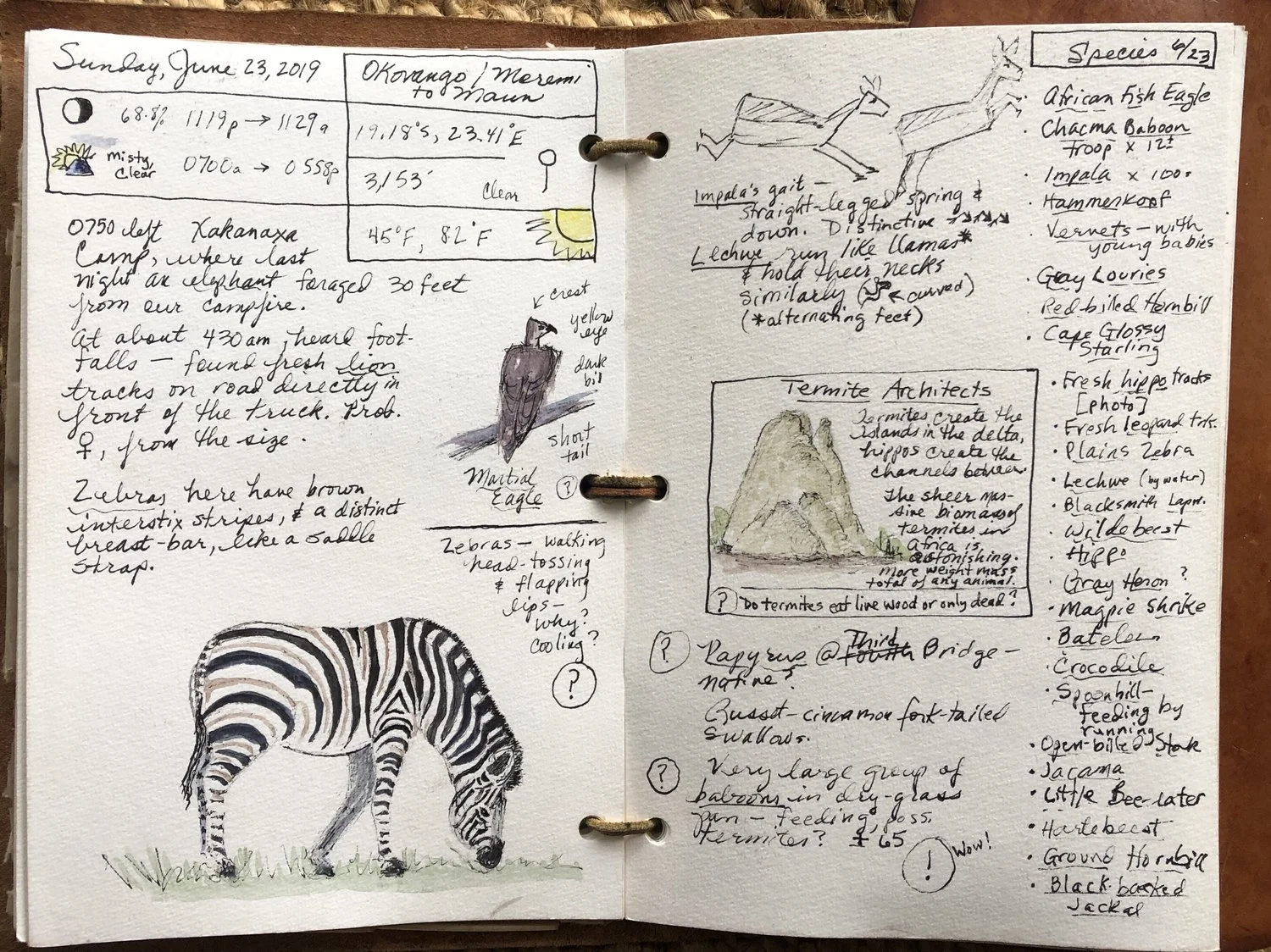
Safari Journals and Sketching: Keeping Notes That Last
Safari journals and sketching offer travellers a meaningful way to preserve memories of wildlife adventures across Uganda, Kenya, Tanzania and Rwanda. While cameras capture photographs and videos, a travel journal records personal experiences, observations, emotions and small details that photographs sometimes miss.
During an African safari, every day brings something different. Travellers may watch elephants crossing the savannah, hear lions roaring in the distance, observe mountain gorillas in a rainforest or enjoy beautiful sunsets over open grasslands.
These moments can be unforgettable, but details often fade after returning home.
A safari journal allows visitors to record what happened, where they travelled, which animals they encountered and how each experience felt. Sketching adds another dimension by encouraging closer observation of wildlife, landscapes and everyday safari life.
You do not need to be a professional writer or artist to keep a memorable safari journal. A small notebook, comfortable pen and willingness to record a few thoughts are enough.
This guide explains how to choose a safari journal, organise daily notes, create simple wildlife sketches and preserve travel memories for years.
Why Keep a Safari Journal?
A safari journal provides a personal record of experiences that photographs cannot always explain.
A photograph might show a lion resting beneath a tree, but written notes can describe the excitement of spotting it, the guide’s explanation and the atmosphere surrounding the encounter.
Benefits of Safari Journaling
| Benefit | Why it matters |
|---|---|
| Preserves memories | Records details before they fade |
| Encourages observation | Helps travellers notice small details |
| Records wildlife encounters | Creates a personal species log |
| Improves learning | Reinforces information from guides |
| Supports creativity | Encourages writing and sketching |
| Creates a keepsake | Provides lasting personal memories |
| Complements photography | Adds context to images |
A journal can become one of the most meaningful souvenirs from an African safari.
What Should You Write in a Safari Journal?
There are no strict rules about journal content.
Some travellers prefer detailed descriptions, while others record short observations.
Useful Journal Information
| Information | Example |
|---|---|
| Date | 15 July |
| Destination | Queen Elizabeth National Park |
| Activity | Morning game drive |
| Wildlife spotted | Elephants, buffaloes and lions |
| Weather | Cool morning, sunny afternoon |
| Landscape | Open grassland and scattered trees |
| Memorable moment | Watching elephants cross a track |
| Personal reflection | Favourite experience of the day |
Recording these details soon after an activity makes the information more accurate.
Choosing the Best Safari Notebook
Safari conditions can involve dust, rain, humidity and frequent movement.
A practical notebook should be durable and easy to carry.
Safari Notebook Comparison
| Notebook type | Main advantage | Limitation |
|---|---|---|
| Pocket notebook | Lightweight and convenient | Limited writing space |
| A5 notebook | Good balance of size and space | Slightly larger |
| Hardcover journal | Durable writing surface | Adds weight |
| Waterproof notebook | Useful in wet conditions | Often more expensive |
| Spiral notebook | Opens flat | Binding may catch on luggage |
| Sketchbook | Suitable for drawing | Some paper dislikes moisture |
For most safari travellers, an A5 notebook is a comfortable choice.
Should You Use Paper or a Digital Journal?
Both methods can preserve meaningful safari experiences.
Paper journals offer a traditional writing experience without requiring electricity.
Digital journals allow travellers to organise notes, photographs and recordings on electronic devices.
Paper vs Digital Journals
| Feature | Paper journal | Digital journal |
|---|---|---|
| Requires electricity | No | Yes |
| Wildlife sketching | Natural with pencil | Requires suitable device |
| Searching notes | Manual | Usually easier |
| Adding photographs | Printed copies | Convenient |
| Remote campsite use | Excellent | Battery-dependent |
| Backup options | Physical copies or scans | Digital backups |
| Personal appearance | Handwritten keepsake | Flexible presentation |
Travellers can combine both approaches by writing in a notebook and photographing the pages later.
How to Organise a Safari Journal
A clear structure makes journal entries easier to read after the journey.
One practical approach is dividing the notebook into sections.
Suggested Journal Sections
Safari itinerary and destinations.
Daily wildlife observations.
Memorable encounters.
Wildlife sketches.
Interesting facts from guides.
Personal reflections.
Favourite photographs and captions.
Leave space for unexpected experiences rather than planning every page in advance.
Writing Notes During Game Drives
Game drives often involve exciting moments that happen quickly.
Trying to write detailed paragraphs while the vehicle is moving can be uncomfortable.
Instead, record short keywords or observations.
Quick Game-Drive Notes
| Observation | Example note |
|---|---|
| Time | 7:15 am |
| Animal | Lioness |
| Location | Open grassland |
| Behaviour | Resting beneath a tree |
| Group size | Three lions |
| Weather | Clear morning |
| Photograph reference | Camera image 245 |
These brief notes can later become a more detailed journal entry at the lodge.
Wildlife Sketching for Beginners
Sketching is a simple way to connect with wildlife and landscapes.
You do not need advanced drawing skills.
A quick outline of an elephant, giraffe or bird can become a meaningful reminder of a particular encounter.
Easy Subjects to Sketch
Elephant silhouettes.
Giraffe necks and patterns.
Zebra stripes.
Bird shapes.
Acacia trees.
Mountain landscapes.
Safari vehicles.
Lodge surroundings.
Begin with basic shapes before attempting detailed drawings.
Why Sketching Improves Observation
Drawing encourages travellers to examine an animal’s shape, posture and proportions.
For example, sketching a giraffe may help you notice its distinctive coat pattern, long legs and movement.
Bird sketching can encourage attention to beak shape, tail length and markings.
The objective is not necessarily to create perfect artwork.
Instead, sketching encourages patience and deeper appreciation of the natural environment.
Essential Safari Sketching Equipment
A small collection of drawing materials is usually sufficient.
Sketching Packing List
| Item | Purpose |
|---|---|
| Small sketchbook | Wildlife drawings |
| HB pencil | General sketching |
| 2B pencil | Shading |
| Eraser | Correcting sketches |
| Pencil sharpener | Maintaining pencils |
| Waterproof pen | Permanent outlines |
| Small ruler | Page organisation |
| Protective pouch | Keeping materials together |
Expensive art equipment is unnecessary for beginners.
Sketching Wildlife Responsibly
Wildlife welfare should always take priority over drawing or photography.
Sketching must not interfere with guides, park rules or animal behaviour.
Responsible Sketching Rules
Remain inside permitted viewing areas.
Do not approach wildlife to improve a sketch.
Follow ranger instructions.
Avoid blocking other visitors.
Keep pencils and paper secured in moving vehicles.
Never leave a vehicle without authorisation.
If an animal becomes distressed or moves away, respect its space.
Keeping a Journal in Uganda
Uganda offers varied safari experiences, including gorilla trekking, chimpanzee tracking, savannah wildlife and boat excursions.
Uganda Journal Ideas
| Destination | What to record |
|---|---|
| Bwindi | Gorilla behaviour and rainforest sounds |
| Queen Elizabeth | Lions, elephants and Kazinga Channel wildlife |
| Murchison Falls | Nile scenery and waterfall experiences |
| Kibale | Chimpanzee encounters and forest observations |
| Kidepo Valley | Savannah landscapes and wildlife |
| Lake Mburo | Zebras, antelopes and birdlife |
Travellers may also record cultural experiences, local food and conversations with guides.
Journaling During Gorilla Trekking
Gorilla trekking in Uganda and Rwanda provides memorable encounters with endangered mountain gorillas.
However, visitors must follow strict viewing rules.
Writing or drawing during the encounter may distract from ranger instructions.
A more practical approach is to observe quietly and record details afterwards.
Gorilla Journal Prompts
How did the forest sound?
What was the trekking terrain like?
How did the gorillas interact?
Which behaviour was most memorable?
What surprised you about the experience?
How did you feel when the encounter ended?
Personal reflections often become more valuable than lengthy factual descriptions.
Safari Journals in Kenya
Kenya’s Maasai Mara, Amboseli and Samburu provide wonderful material for travel journals.
The wide landscapes and varied wildlife make these destinations especially suitable for sketching.
Kenya Journal Ideas
Record animal movements.
Sketch elephants against distant mountains.
Describe sunrise game drives.
Note interesting bird species.
Write about changing landscapes.
Describe favourite wildlife encounters.
Use the journal to capture experiences that photographs do not fully communicate.
Safari Journals in Tanzania
Tanzania offers diverse landscapes, including the Serengeti, Ngorongoro, Tarangire and Lake Manyara.
Travellers can record migration encounters, predator behaviour and interesting environmental details.
Tanzania Journal Prompts
What animals appeared first during the morning drive?
How did the landscape change throughout the day?
Which wildlife interaction was most interesting?
What information did the guide explain?
What sounds could be heard around the camp?
Short daily entries can create a detailed record of the journey.
Keeping Notes in Rwanda
Rwanda’s Volcanoes National Park, Nyungwe and Akagera provide contrasting environments.
Mountain forests offer opportunities to describe mist, vegetation and primate encounters.
Akagera’s savannah and wetland habitats provide excellent subjects for wildlife observation and sketching.
Travellers can use separate journal sections for forests, lakes, grasslands and cultural experiences.
Creating a Personal Wildlife Checklist
A wildlife checklist makes a journal more interactive.
Travellers can record species seen during each activity.
Sample Wildlife Checklist
| Wildlife | Seen | Notes |
|---|---|---|
| Elephant | ☐ | |
| Lion | ☐ | |
| Leopard | ☐ | |
| Buffalo | ☐ | |
| Giraffe | ☐ | |
| Zebra | ☐ | |
| Hippopotamus | ☐ | |
| Mountain gorilla | ☐ | |
| Chimpanzee | ☐ | |
| African fish eagle | ☐ |
Do not turn the checklist into pressure to see every animal. Wildlife encounters are unpredictable.
Combining Photographs With Written Notes
Photographs and journals work particularly well together.
A photograph records appearance, while written notes explain what happened.
Photo and Journal Organisation
| Photograph | Journal information |
|---|---|
| Lion portrait | Location and behaviour |
| Elephant herd | Time and group interactions |
| Gorilla photograph | Trekking experience |
| Sunset landscape | Weather and atmosphere |
| Bird photograph | Species identification |
| Safari lodge | Accommodation memories |
Record camera filenames or image numbers when practical.
This makes it easier to match photographs with written descriptions after returning home.
How to Find Time for Journaling
Safari itineraries can be busy, particularly when mornings begin early.
However, journal entries do not need to be long.
Practical Daily Routine
Spend a few minutes recording observations after each activity.
Write a short reflection before dinner.
Add wildlife names learned from the guide.
Sketch one memorable subject.
Review notes before bedtime.
Even ten minutes of writing can preserve details that might otherwise disappear from memory.
Protecting Journals From Rain and Dust
Rain and dust can damage paper, especially during forest trekking or open-vehicle game drives.
Journal Protection Tips
Use a waterproof pouch.
Keep notebooks away from open vehicle edges.
Choose suitable pens.
Avoid placing journals on wet surfaces.
Store drawing materials securely.
Dry damp pages carefully before closing the notebook.
A lightweight dry bag is useful during Uganda and Rwanda’s wetter trekking conditions.
Turning Safari Notes Into a Travel Story
After returning home, a journal can become the foundation for a longer travel story.
Travellers may combine sketches, photographs and written reflections into a personal album.
Creative Journal Projects
A printed safari memory book.
A family travel scrapbook.
A wildlife observation diary.
A collection of animal sketches.
A personal safari blog.
A photographic album with detailed captions.
These projects help preserve memories beyond the original holiday.
Keeping Journals for Children
Safari journals can be especially enjoyable for children.
Young travellers may prefer drawing animals, colouring landscapes or recording simple observations.
Child-Friendly Journal Activities
| Activity | Benefit |
|---|---|
| Draw an elephant | Encourages observation |
| Record animal names | Supports learning |
| Describe favourite moment | Develops writing |
| Count bird species | Encourages attention |
| Sketch landscapes | Builds creativity |
| Record daily highlights | Preserves memories |
Activities should remain enjoyable rather than feeling like school assignments.
Common Safari Journaling Mistakes
Some travellers attempt to record every detail and eventually abandon their notebooks.
Others write only after returning home, when small details have already faded.
Mistakes to Avoid
Writing excessively long entries during activities.
Trying to produce perfect sketches.
Forgetting dates and locations.
Failing to protect notebooks from rain.
Recording wildlife facts without checking them.
Spending more time writing than observing.
A safari journal should enhance the experience rather than interrupt it.
Frequently Asked Questions
Do I Need Drawing Skills to Keep a Safari Journal?
No. Simple sketches, short notes and personal reflections are enough to create a meaningful travel record.
Is a Paper Journal Better Than a Phone?
Both are useful. Paper works without electricity, while digital notes are easier to search and duplicate.
What Notebook Size Is Best for Safari?
An A5 notebook offers a practical balance between writing space and portability.
Can Children Keep Safari Journals?
Yes. Drawing animals and recording daily experiences can make wildlife holidays more educational and enjoyable.
Should I Journal During Gorilla Trekking?
Prioritise observing gorillas and following ranger instructions. Detailed notes are best written after the encounter.
Keeping Safari Memories That Last
Safari journals and sketching provide a personal way to remember African wildlife adventures.
Photographs capture appearances, but written observations preserve the sounds, emotions, discoveries and small details that make each journey special.
From gorilla trekking in Uganda and Rwanda to game drives in Kenya and Tanzania, every destination offers opportunities for meaningful notes and sketches.
The best safari journal is not the most expensive or beautifully illustrated notebook. It is the one you use regularly to capture genuine experiences in your own words.
A few thoughtful sentences and simple drawings can become treasured memories long after the safari ends.






No comment