
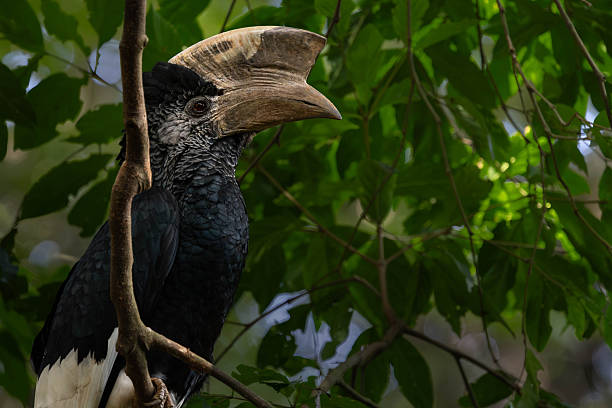
Hornbills of East Africa: Casques, Beaks and Nesting Habits
The hornbills of East Africa are among the most remarkable birds found in Uganda, Kenya, Tanzania and Rwanda. Recognised by their enormous curved bills, unusual head structures called casques and distinctive nesting behaviour, these fascinating birds occupy tropical forests, savannahs, woodlands and riverine habitats. Some hornbills are brightly coloured, while others have striking black-and-white feathers, but nearly all attract attention because of their unusual appearance.
Hornbills are especially interesting because of how many species reproduce. During breeding, the female enters a tree cavity and seals much of the entrance using mud, plant materials and other substances, leaving a narrow opening through which the male delivers food. This unusual nesting strategy helps protect the developing eggs and chicks, although it also creates considerable responsibility for the male.
For birdwatchers exploring East Africa, understanding hornbill identification, casque functions, feeding behaviour and nesting habits adds another interesting experience to a wildlife safari.
What Are Hornbills?
Hornbills are birds belonging to the order Bucerotiformes. Most species are placed in the family Bucerotidae, while the large ground-hornbills belong to the separate family Bucorvidae.
They occur across tropical and subtropical regions of Africa and Asia.
East African hornbills vary considerably in size. Small woodland species may measure around 35 centimetres, while Southern Ground-Hornbills can exceed one metre in length.
Most hornbills have large curved bills, strong neck muscles, relatively short legs and broad wings.
Their diets vary according to species and habitat. Forest hornbills consume considerable quantities of fruit, while many savannah hornbills feed on insects, reptiles and other small animals.
Quick Facts About East African Hornbills
| Feature | Description |
|---|---|
| Bird order | Bucerotiformes |
| Main families | Bucerotidae and Bucorvidae |
| Main habitats | Forests, savannahs and woodland |
| Distinctive feature | Large curved bill, sometimes with a casque |
| Diet | Fruits, insects and small animals |
| Nesting | Mainly natural tree cavities |
| Breeding behaviour | Females of most hornbill species seal themselves inside nests |
| Distribution | Uganda, Kenya, Tanzania, Rwanda and surrounding regions |
Why Do Hornbills Have Such Large Beaks?
The enormous bill is one of the most recognisable features of a hornbill.
Although these bills appear heavy, they are relatively lightweight because their internal structure contains air spaces supported by thin bony material.
Hornbills use their bills for several activities, including collecting food, handling prey, grooming and interacting with other birds.
Forest hornbills use their long bills to reach fruits growing on branches.
Savannah species use theirs to capture insects, reptiles and other small animals.
The large bill also plays a role in social displays, particularly when birds interact with potential mates or rivals.
How Hornbills Use Their Beaks
Hornbills use their beaks to:
Pick fruits from trees.
Capture insects and small animals.
Manipulate food before swallowing.
Pass food to nesting females.
Feed developing chicks.
Groom their feathers.
Participate in courtship displays.
Their powerful-looking bills are therefore important tools for survival and reproduction.
What Is a Hornbill Casque?
A casque is a raised structure found on the upper bill of many hornbill species.
It may appear as a ridge, helmet or enlarged projection above the beak.
Casques vary greatly between species. Some are small and barely noticeable, while others are large and prominent.
In several species, the casque contains lightweight internal structures rather than being completely solid.
Scientists believe casques serve different purposes, including visual communication, species recognition and sexual signalling.
In some hornbills, these structures may also influence the sounds produced during calling.
However, casque functions vary, and scientists have not established a single explanation that applies to every species.
Do Male and Female Hornbills Have Different Casques?
In some hornbill species, males have larger bills or more developed casques than females.
Differences may also occur in bill colour, facial markings and body size.
These characteristics can help birdwatchers distinguish males from females when observing a pair.
Common Hornbill Species Found in East Africa
East Africa supports several hornbill species, each adapted to particular habitats.
1. African Grey Hornbill
Scientific name: Lophoceros nasutus
The African Grey Hornbill is a relatively small species commonly associated with open woodland, savannah and riverine vegetation.
It has greyish plumage, a long curved bill and a relatively slender body.
African Grey Hornbills often move between trees searching for insects, fruits and small animals.
They are widespread in suitable habitats across East Africa.
2. Eastern Yellow-Billed Hornbill
Scientific name: Tockus flavirostris
The Eastern Yellow-billed Hornbill is one of the easiest hornbills to recognise.
It has black-and-white plumage, a long yellow bill and a distinctive spotted appearance.
This species favours dry savannah woodland and bushland.
It frequently searches for insects and other small animals among branches and on the ground.
Visitors exploring suitable habitats in Kenya and Tanzania may encounter these colourful birds.
3. Northern Red-Billed Hornbill
Scientific name: Tockus erythrorhynchus
The Northern Red-billed Hornbill is a small, active species with a long red bill, pale underparts and dark, spotted wings.
It occurs in dry woodland, scrubland and savannah environments.
These hornbills feed mainly on insects and other small animals, although they also consume plant materials.
They frequently move along branches or descend to the ground while searching for food.
4. Black-and-White-Casqued Hornbill
Scientific name: Bycanistes subcylindricus
The Black-and-white-casqued Hornbill is among Uganda’s most impressive tropical forest birds.
It has striking black-and-white plumage, a large bill and a prominent casque.
The species inhabits forests and wooded habitats where fruit-bearing trees provide important food sources.
It is particularly associated with Uganda’s western forests, including Kibale National Park.
Its large size and powerful wingbeats make it relatively easy to recognise during forest birdwatching.
5. Crowned Hornbill
Scientific name: Lophoceros alboterminatus
The Crowned Hornbill is a medium-sized species with dark plumage, a pale belly and a distinctive bill.
It occurs in woodland, forest edges and riverine vegetation.
Crowned Hornbills feed on insects, fruits and small animals.
They are often encountered in pairs or small groups and produce distinctive vocalisations.
6. Silvery-Cheeked Hornbill
Scientific name: Bycanistes brevis
The Silvery-cheeked Hornbill is a large forest bird recognised by its prominent casque and pale markings along the sides of its head.
It occurs in suitable forests and wooded highland areas, particularly in Kenya and Tanzania.
These hornbills are important fruit consumers and can travel considerable distances between feeding trees.
7. Southern Ground-Hornbill
Scientific name: Bucorvus leadbeateri
The Southern Ground-Hornbill is among Africa’s largest and most remarkable hornbill species.
It has predominantly black plumage, bright red facial skin and a powerful bill.
Unlike most other hornbills, it spends considerable time walking across open grassland and savannah.
Its diet includes insects, reptiles, amphibians, small mammals and other animals.
Southern Ground-Hornbills occur in suitable savannah habitats in parts of East Africa, including Tanzania and Kenya.
How to Tell East African Hornbills Apart
The most useful identification features include bill colour, casque shape, body size and preferred habitat.
| Species | Main identification feature | Typical habitat |
|---|---|---|
| African Grey Hornbill | Grey body and curved bill | Savannah woodland |
| Eastern Yellow-billed Hornbill | Bright yellow bill | Dry savannah |
| Northern Red-billed Hornbill | Long red bill | Dry woodland |
| Black-and-white-casqued Hornbill | Large casque and contrasting plumage | Tropical forest |
| Crowned Hornbill | Dark body and pale belly | Woodland and forest edges |
| Silvery-cheeked Hornbill | Large casque and pale cheek markings | Forest |
| Southern Ground-Hornbill | Large black body and red facial skin | Open savannah |
The Extraordinary Nesting Habits of Hornbills
Hornbill nesting behaviour is one of the most fascinating examples of parental care among African birds.
In many species, the female enters a natural cavity inside a tree before laying her eggs.
The pair then reduces the entrance using mud, plant fibres, droppings and other materials, depending on the species.
A narrow opening remains, allowing the male to deliver food.
This arrangement provides protection against some predators and environmental conditions.
How a Hornbill Nest Is Prepared
The breeding process usually follows several stages.
Selecting the cavity: The pair identifies a suitable hollow tree or another protected nesting space.
Preparing the entrance: The opening is gradually reduced after the female enters.
Laying eggs: The female lays her eggs within the protected chamber.
Feeding the female: The male brings fruits, insects and other food through the narrow opening.
Raising the chicks: Newly hatched chicks remain inside the cavity while their parents provide food and protection.
Leaving the nest: The female and chicks eventually emerge, although the timing differs between species.
In some hornbills, the female leaves before the chicks and the entrance is resealed, allowing the young birds to continue developing inside.
Research on Black-and-white-casqued Hornbills in Uganda has documented females remaining sealed in nest cavities while males provide food and defend the nesting area.
Why Do Female Hornbills Seal Themselves Inside Trees?
Sealing the nesting cavity reduces the size of the entrance and can make it harder for some predators to reach the eggs and chicks.
The protected chamber also provides shelter from weather conditions.
However, nesting in this way creates considerable dependence on the male.
If he cannot provide sufficient food, the female and chicks may face serious difficulties.
Hornbill breeding therefore requires suitable food supplies, healthy nesting trees and successful cooperation between parents.
Do Ground-Hornbills Seal Their Nests?
Ground-hornbills are an important exception to the nesting behaviour of most hornbills.
Southern Ground-Hornbills use large cavities in trees or other suitable locations but do not seal the female inside.
They are also cooperative breeders.
A social group normally contains a dominant breeding pair and additional individuals that help protect the territory and feed the young.
Ground-hornbills have slow reproductive rates, sometimes raising only one successful chick over several years.
This makes breeding success particularly important for maintaining their populations.
What Do East African Hornbills Eat?
Hornbills have varied diets depending on their species and environment.
Large forest hornbills consume significant quantities of fruit, particularly figs and other fruits available in tropical forests.
Smaller woodland species often hunt insects and small vertebrates.
Ground-hornbills are mainly terrestrial hunters, searching the ground for insects, reptiles and other prey.
Why Fruit-Eating Hornbills Are Important
When hornbills consume fruit, they may swallow seeds and transport them away from the parent tree.
Some seeds pass through the digestive system and are deposited elsewhere.
This makes several forest hornbill species valuable seed dispersers.
By moving seeds between different forest areas, they contribute to natural forest regeneration.
Where to See Hornbills in East Africa
Uganda, Kenya, Tanzania and Rwanda provide different opportunities to observe hornbills.
Forested destinations are particularly rewarding for large fruit-eating species, while savannah parks support woodland and ground-hornbills.
Uganda
Kibale National Park, Budongo Forest and Mabira Forest provide suitable habitats for several forest hornbills.
Queen Elizabeth, Murchison Falls and Lake Mburo national parks also support hornbills associated with woodland and savannah environments.
Kenya
Kenya’s savannah reserves, including Tsavo and Samburu, provide opportunities to observe yellow-billed, red-billed and other woodland hornbills.
Suitable forest habitats also support larger species.
Tanzania
Tanzania offers excellent hornbill birdwatching in Serengeti National Park, Tarangire National Park and other savannah destinations.
Southern Ground-Hornbills are particularly interesting birds to watch in suitable open grasslands.
Rwanda
Rwanda’s forested destinations, particularly Nyungwe National Park, offer opportunities to encounter forest hornbills.
Akagera National Park also provides suitable woodland and savannah habitats for other species.
Best Time to Watch Hornbills on Safari
Hornbills can be observed throughout the year in many East African destinations.
Early morning is often productive because birds are actively feeding and communicating.
Breeding activity varies by species and location, frequently responding to rainfall and seasonal food availability.
Forest hornbills may concentrate around fruiting trees, while savannah species become easier to locate in open woodland.
A knowledgeable birdwatching guide can identify suitable feeding areas and recognise hornbill calls.
Photography Tips for East African Hornbills
Hornbills provide excellent photography opportunities because of their distinctive bills and unusual silhouettes.
For forest species, a telephoto lens of approximately 300–500 mm can help capture birds high in the canopy.
Try photographing the bird from the side to reveal the shape of its bill and casque.
Ground-hornbills can sometimes be photographed at eye level from safari vehicles while they search for food.
Avoid approaching active nesting cavities or blocking the flight paths used by adults carrying food to chicks.
Conservation of East African Hornbills
Hornbills depend on healthy habitats containing suitable feeding areas and nesting sites.
The removal of mature trees is particularly harmful to species that require large natural cavities for breeding.
Forest fragmentation can also affect fruit availability and restrict movement between feeding areas.
Ground-hornbills face additional pressures because of their slow breeding rates, habitat loss and accidental poisoning.
Protecting forests, savannahs and mature nesting trees helps conserve these birds.
Responsible tourism can contribute by supporting protected areas, local conservation initiatives and knowledgeable birdwatching guides.
Why Hornbills Are Worth Watching on an East African Safari
Hornbills are among the most interesting birds found in East Africa because of their unusual bills, varied casques and remarkable nesting strategies.
Their behaviour demonstrates the importance of healthy forests, mature trees and successful parental cooperation.
Forest hornbills contribute to seed dispersal, smaller woodland species consume insects, and ground-hornbills hunt a wide variety of animals across open savannahs.
For travellers exploring Uganda, Kenya, Tanzania and Rwanda, identifying different hornbill species adds an interesting dimension to wildlife viewing.
Whether you encounter a Black-and-white-casqued Hornbill flying over Kibale Forest or a Southern Ground-Hornbill walking through Tanzanian grassland, observing these extraordinary birds can become a memorable part of your African safari.







No comment