
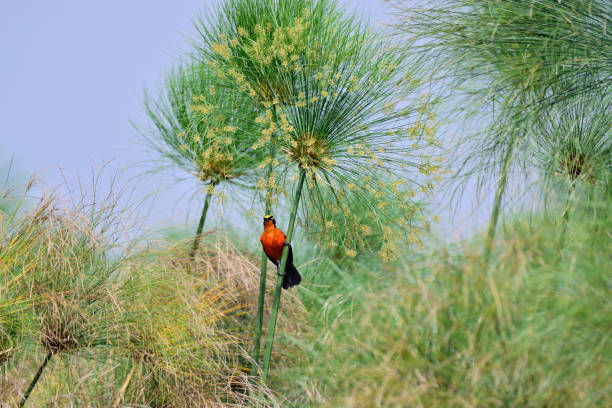
Papyrus Gonolek: Spotting a Red and Black Wetland Bird
The Papyrus Gonolek (Laniarius mufumbiri) is one of East Africa’s most colourful and fascinating wetland birds. Recognised by its striking red breast, black upperparts and yellowish crown, this secretive bird lives among dense papyrus vegetation surrounding lakes, rivers and freshwater swamps. Although its bright colours make it beautiful to photograph, spotting a Papyrus Gonolek can be challenging because it spends much of its time hidden within tall wetland plants.
For birdwatchers visiting Uganda, Rwanda, Kenya and Tanzania, the Papyrus Gonolek is a rewarding species to search for during a specialised birdwatching safari. Its distinctive calls often reveal its presence long before visitors see it. Locations such as Mabamba Wetland near Entebbe and suitable papyrus swamps around the Lake Victoria basin provide opportunities to encounter this remarkable bird.
What Is a Papyrus Gonolek?
The Papyrus Gonolek is a small African songbird belonging to the bushshrike family, Malaconotidae. Its scientific name is Laniarius mufumbiri, and it occurs in selected freshwater wetlands within East and Central Africa.
Unlike many birds that move between forests, grasslands and gardens, this species depends heavily on dense stands of papyrus vegetation.
Papyrus is a tall wetland plant that grows in shallow freshwater environments. Its thick stems provide the Gonolek with feeding areas, shelter and nesting habitat.
The bird occurs in Uganda, Rwanda, Burundi, western Kenya, north-western Tanzania and parts of the Democratic Republic of Congo.
Quick Facts About the Papyrus Gonolek
| Feature | Description |
|---|---|
| Common name | Papyrus Gonolek |
| Scientific name | Laniarius mufumbiri |
| Family | Malaconotidae |
| Bird group | Bushshrikes |
| Average length | Approximately 18–19 cm |
| Main colours | Black, crimson-red, yellow and white |
| Main habitat | Dense papyrus swamps |
| Primary diet | Insects and other small invertebrates |
| Behaviour | Secretive, usually alone or in pairs |
| Conservation status | Near Threatened |
| Distribution | East and Central Africa |
| Best observation method | Listening for calls and watching papyrus edges |
The species is currently classified as Near Threatened, mainly because papyrus wetlands continue to disappear or deteriorate.
The Papyrus Gonolek has a distinctive combination of bright colours that makes it relatively easy to recognise when clearly visible.
Its head, back, wings and tail are predominantly black, contrasting with the brilliant crimson-red plumage across its chest and upper belly.
The crown has a yellowish colour, while the wings contain a noticeable white marking that may become visible when the bird moves.
Its strong bill is suited to catching insects and other small animals.
Unlike some bird species in which males and females have noticeably different colours, both sexes of the Papyrus Gonolek have similar plumage.
Main Identification Features
Birdwatchers should look for the following characteristics:
Black head, back, wings and tail.
Bright crimson-red chest and upper belly.
Dull yellow or yellowish crown.
White wing marking.
Strong, slightly hooked bill.
Compact body and relatively long tail.
Quick movements among dense papyrus stems.
Although its colours are distinctive, vegetation frequently blocks the bird from view.
Visitors may only see a brief flash of red and black before it disappears into the swamp.
Why Does the Papyrus Gonolek Live in Papyrus Swamps?
The Papyrus Gonolek is a wetland specialist with a strong dependence on papyrus vegetation.
These dense wetlands provide important resources that allow the species to feed, shelter and reproduce.
Papyrus stands support insects and other small animals that form part of the bird’s diet.
The closely packed stems also provide hiding places, helping the bird remain concealed from potential predators.
Importance of Papyrus Wetland Habitat
| Habitat feature | Benefit to the bird |
|---|---|
| Dense papyrus stems | Shelter and protection |
| Wetland insects | Reliable feeding opportunities |
| Thick vegetation | Concealment from predators |
| Suitable nesting vegetation | Places for breeding |
| Freshwater environment | Supports aquatic and terrestrial invertebrates |
Because the Papyrus Gonolek depends on this specialised habitat, the loss of papyrus wetlands directly affects its survival.
It cannot simply relocate into ordinary woodland or farmland when suitable papyrus disappears.
How to Spot a Papyrus Gonolek in the Wild
Finding a Papyrus Gonolek requires patience, careful listening and an understanding of its habitat.
Unlike large waterbirds that stand openly along lakeshores, the Papyrus Gonolek generally remains concealed among tall stems.
Birdwatchers often hear its distinctive calls before they manage to see the bird.
Listen for Its Distinctive Calls
The Papyrus Gonolek produces whistles and harsh, grating notes that carry through the vegetation.
Pairs sometimes call back and forth, producing an exchange of sounds known as a duet.
Learning to recognise these vocalisations can greatly improve the chances of locating the species.
An experienced birdwatching guide may recognise the bird’s presence even when it remains completely hidden.
Watch the Edges of Papyrus Vegetation
Although Papyrus Gonoleks spend considerable time inside thick vegetation, they occasionally move towards more open edges.
Watch carefully for movement between stems and brief appearances on exposed perches.
Binoculars with 8× or 10× magnification are useful for observing birds without approaching too closely.
Avoid entering dense papyrus stands or disturbing vegetation to force a bird into the open.
What Does the Papyrus Gonolek Eat?
The Papyrus Gonolek feeds mainly on insects and other small invertebrates found within wetland vegetation.
Its diet includes beetles, ants, flies, caterpillars, weevils and snails.
The species may also consume some fruits and other available plant foods.
It searches among papyrus stems and leaves, collecting food from vegetation rather than hunting in open water like a heron or kingfisher.
Common Foods of the Papyrus Gonolek
| Food type | Feeding location |
|---|---|
| Beetles | Papyrus stems and leaves |
| Ants | Vegetation and plant surfaces |
| Caterpillars | Leaves and dense plant growth |
| Small flies | Wetland vegetation |
| Weevils | Plant stems and foliage |
| Snails | Moist wetland environments |
| Fruits | Available vegetation |
Its feeding habits help control insect populations within papyrus wetlands.
The Papyrus Gonolek has a limited geographical distribution compared with many common African birds.
Its presence depends on suitable papyrus wetlands rather than national park boundaries alone.
Uganda and Rwanda provide particularly interesting opportunities for travellers seeking this species.
Recommended Birdwatching Locations
| Country | Destination | Birdwatching opportunity |
|---|---|---|
| Uganda | Mabamba Wetland | Papyrus channels and dense vegetation |
| Uganda | Lake Mburo region | Suitable papyrus wetland areas |
| Uganda | Sango Bay wetlands | Extensive freshwater swamp habitat |
| Uganda | Lake Victoria wetlands | Papyrus stands around sheltered bays |
| Rwanda | Akagera National Park | Suitable papyrus swamps |
| Rwanda | Rweru-Mugesera wetlands | Papyrus-dependent bird species |
| Kenya | Yala Swamp | Large areas of papyrus vegetation |
| Tanzania | Lake Victoria basin | Suitable papyrus wetlands |
These areas contain suitable habitat, but sightings depend on local conditions, access and bird activity.
Papyrus Gonolek Birdwatching at Mabamba Wetland
Mabamba Wetland near Entebbe is one of Uganda’s best-known birdwatching destinations.
The wetland is particularly famous for the Shoebill, but its extensive papyrus vegetation also provides habitat for smaller wetland specialists.
Visitors normally explore accessible channels using locally operated boats accompanied by birdwatching guides.
During an excursion, birdwatchers can listen for the Papyrus Gonolek’s calls while observing the edges of dense vegetation.
Mabamba is particularly convenient for travellers arriving through Entebbe International Airport.
Papyrus Gonoleks in Rwanda
Rwanda contains important papyrus wetlands, particularly within its eastern regions.
Akagera National Park supports a variety of freshwater environments, including lakes, marshes and papyrus vegetation.
Birdwatchers interested in wetland specialists can explore suitable areas with knowledgeable guides.
The Rweru-Mugesera wetland complex is another important habitat where Papyrus Gonoleks have been recorded.
However, some wetlands are difficult to access, making local guidance essential.
Best Time to See the Papyrus Gonolek
The Papyrus Gonolek is a resident species, meaning it does not undertake long-distance seasonal migrations.
Birdwatchers may therefore search for it throughout the year.
Early morning is generally a good period because birds may be actively calling and feeding.
Late afternoon can also provide opportunities, particularly when wetland conditions are quiet.
Birdwatching Conditions
| Time or season | Expected experience |
|---|---|
| Early morning | Calling and feeding activity |
| Mid-morning | Opportunities around sheltered vegetation |
| Late afternoon | Feeding and vocal activity |
| Wet season | Dense vegetation and potentially difficult access |
| Dry season | Often easier access to some wetland areas |
| Throughout the year | Possible sightings in suitable habitat |
Rainfall influences wetland access, vegetation growth and the distribution of insects.
Papyrus Gonolek Breeding and Nesting Behaviour
The breeding biology of the Papyrus Gonolek remains less thoroughly documented than that of many familiar African birds.
The species usually occurs alone or in pairs, and breeding activity takes place within its specialised wetland habitat.
Its nest is believed to be constructed within dense vegetation, where surrounding stems provide concealment.
Because the bird is secretive and difficult to observe, detailed information about its nesting behaviour remains limited.
Researchers continue to study its ecology to improve understanding of breeding requirements and habitat use.
Visitors should never attempt to locate nests by cutting papyrus or disturbing vegetation.
Why Is the Papyrus Gonolek Near Threatened?
The Papyrus Gonolek faces conservation challenges because it depends on wetlands that are increasingly affected by human activities.
According to the IUCN’s 2025 assessment, the species remains Near Threatened, with a decreasing population trend.
Important threats include wetland drainage, agricultural expansion, vegetation harvesting, burning and pollution.
Major Conservation Threats
| Threat | Potential effect |
|---|---|
| Wetland drainage | Removes essential habitat |
| Agricultural expansion | Reduces papyrus coverage |
| Uncontrolled burning | Destroys vegetation and shelter |
| Water pollution | Changes wetland conditions |
| Excessive papyrus harvesting | Reduces habitat quality |
| Water management changes | Alters natural wetland systems |
Conservation efforts should focus on protecting remaining papyrus wetlands and supporting sustainable land use around freshwater habitats.
Local communities also play an important role because many wetlands provide resources for fishing, farming and traditional crafts.
Photography Tips for the Papyrus Gonolek
Photographing a Papyrus Gonolek can be difficult because the bird often remains hidden.
Its bright red chest may become visible for only a few seconds before vegetation blocks the view.
A telephoto lens of approximately 400–600 mm can help photographers capture images from a respectful distance.
Using a fast shutter speed, such as 1/1000 second, can reduce motion blur when the bird moves quickly.
Focus on gaps between papyrus stems and watch for natural opportunities when the bird briefly appears.
Avoid disturbing vegetation or repeatedly using recorded calls to attract the bird.
A patient approach provides better opportunities for natural wildlife photographs.
Combining Papyrus Gonolek Birdwatching With an East African Safari
Birdwatching for the Papyrus Gonolek can fit into a wider East African safari itinerary.
In Uganda, visitors may combine a Mabamba Wetland excursion with wildlife viewing in Queen Elizabeth National Park, chimpanzee tracking in Kibale Forest or gorilla trekking in Bwindi Impenetrable National Park.
Travellers visiting Rwanda can combine suitable wetland birdwatching with wildlife safaris in Akagera National Park.
Specialist birdwatching itineraries should allow enough time to search carefully rather than expecting immediate sightings.
Suggested Uganda Birdwatching Itinerary
| Day | Destination | Main activity |
|---|---|---|
| Day 1 | Entebbe | Arrival and nearby birdwatching |
| Day 2 | Mabamba Wetland | Shoebill and papyrus birdwatching |
| Day 3 | Lake Mburo National Park | Wetland and savannah birds |
| Day 4 | Lake Mburo National Park | Morning birdwatching and return journey |
This itinerary provides opportunities to observe several bird species, although Papyrus Gonolek sightings remain unpredictable.
Why the Papyrus Gonolek Is Worth Seeing
The Papyrus Gonolek is one of East Africa’s most attractive specialised wetland birds.
Its striking black and red feathers, unusual vocalisations and secretive behaviour make it a rewarding species for dedicated birdwatchers.
Unlike common garden birds, it depends on a particular habitat that is increasingly under pressure.







No comment