
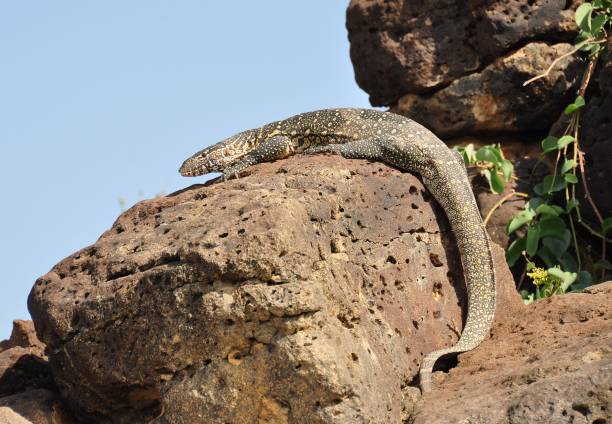
Nile Monitors and Rock Agamas
Nile Monitors and Rock Agamas: Reptiles Visitors Overlook
A large lizard moves quietly along the banks of Uganda’s Kazinga Channel. Its powerful claws grip the muddy ground, while its long, muscular tail trails behind. Suddenly, it raises its head, flicks its forked tongue and disappears into the water.
Several hundred kilometres away, on the rocky outcrops of Tanzania’s Serengeti National Park, a much smaller lizard sits in the sunshine. Its head glows bright red, while its body displays striking shades of blue.
These are two very different examples of East Africa’s fascinating reptile life.
Nile monitors and rock agamas are among the wildlife species safari visitors frequently overlook while searching for lions, elephants, giraffes and other large mammals.
Yet these reptiles reveal interesting stories about hunting, camouflage, territorial behaviour and adaptation to Africa’s changing environments.
Nile monitors are powerful, semi-aquatic predators found around rivers and lakes. Rock agamas are smaller, sun-loving lizards often seen on boulders, rocky hillsides and savannah outcrops.
Learning to recognise both adds an exciting new dimension to an East African safari.
1. What Are Nile Monitors and Rock Agamas?
Both animals are reptiles belonging to the order Squamata, but they are not closely related within that group.
The Nile monitor belongs to the family Varanidae, a group of large, active predatory lizards.
Rock agamas belong to the family Agamidae, which contains numerous smaller lizards found across Africa and Asia.
Quick Identification Comparison
| Feature | Nile Monitor | Rock Agama |
|---|---|---|
| Scientific identification | Varanus niloticus | Various Agama species |
| Family | Varanidae | Agamidae |
| Typical size | Large, sometimes exceeding 2 metres | Usually much smaller |
| Body shape | Long and muscular | Compact and slender |
| Tail | Very long and powerful | Long and relatively thin |
| Typical habitat | Rivers, lakes and wetlands | Rocks, outcrops and dry woodland |
| Diet | Carnivorous | Mainly insects and other small prey |
| Colour | Dark with pale or yellow markings | Brown, grey or brightly coloured |
| Movement | Swimming, running and climbing | Rapid running and climbing |
The term rock agama is used for several species, so exact identification may require a field guide.
2. How to Identify a Nile Monitor Lizard
The Nile monitor is one of Africa’s largest lizards.
Its scientific name is Varanus niloticus.
The animal has an elongated head, a strong neck, muscular limbs and sharp claws.
Its body is usually dark olive, brown or grey with lighter spots, bands and markings.
A long tail provides propulsion when swimming and helps the lizard manoeuvre on land.
One of its most distinctive behaviours is repeatedly extending its forked tongue to investigate the environment.
Important Identification Features
- Large, muscular body.
- Long, powerful tail.
- Dark skin patterned with pale spots.
- Strong limbs and sharp claws.
- Elongated head.
- Long, forked tongue.
- Frequent association with water.
A monitor seen swimming beside a riverbank may resemble a small crocodile at first glance, but its head, body and movement are different.
3. Where Do Nile Monitors Live?
Nile monitors occur across much of sub-Saharan Africa.
They use a wide range of environments, including woodland, savannah, swamps and forest margins.
However, they are particularly associated with water.
Rivers, lakes, wetlands and seasonal pools provide important feeding and shelter opportunities.
In East Africa, visitors may encounter monitors beside the Nile River, Uganda’s Kazinga Channel, Lake Victoria and other suitable waterways.
They are also capable climbers and sometimes rest on trees, logs or rocks beside water.
4. What Do Nile Monitors Eat?
Nile monitors are carnivorous and opportunistic feeders.
They consume a wide range of animals depending on age, habitat and available prey.
Their diet includes fish, frogs, insects, crabs, snails, smaller reptiles, birds and eggs.
They may also consume carrion.
Nile Monitor Feeding Habits
| Food | Hunting or Feeding Method |
|---|---|
| Fish | Captured in or near water |
| Frogs | Caught along wetlands and riverbanks |
| Crabs | Taken in aquatic habitats |
| Snails | Crushed using strong jaws |
| Bird eggs | Taken from accessible nests |
| Reptile eggs | Located through active searching |
| Small mammals | Captured opportunistically |
| Carrion | Consumed when available |
Their varied diet makes them important predators in many aquatic and terrestrial food webs.
5. Do Nile Monitors Really Steal Crocodile Eggs?
Yes. Nile monitors are known to raid crocodile nests.
They can locate buried eggs and use their powerful claws to excavate nest material.
However, crocodile nests may be guarded by adult females.
Approaching them therefore involves considerable danger.
Some accounts describe monitors using distractions or unusual tactics around guarded nests, but these behaviours should not be considered universal.
For safari visitors, witnessing a monitor approach a crocodile nesting area would be an unusual wildlife encounter.
Never approach either animal to obtain a closer view.
6. Can Nile Monitors Swim?
Nile monitors are excellent swimmers.
Their powerful tails help propel them through water, while their limbs assist with steering.
They may dive to escape danger or search for prey.
A monitor resting beside a river can disappear underwater almost instantly when disturbed.
These abilities explain why waterways are such important parts of their habitat.
However, Nile monitors also spend considerable time on land.
They bask in the sun, explore vegetation and shelter in burrows or other suitable hiding places.
7. Are Nile Monitor Lizards Dangerous?
Nile monitors generally avoid people when they have an opportunity to escape.
However, they are strong wild reptiles equipped with sharp claws, powerful jaws and muscular tails.
A cornered animal may bite, scratch, hiss or lash its tail defensively.
Large monitors can cause serious injuries.
Visitors should therefore never attempt to touch, catch or corner one.
During boat excursions and game drives, watch them from a safe distance and allow them to move naturally.
Their impressive appearance does not mean they are aggressive towards people without provocation.
8. What Is a Rock Agama?
Rock agamas are smaller lizards commonly seen in rocky habitats across Africa.
The name covers several species within the genus Agama.
One familiar East African species is the Mwanza flat-headed rock agama, Agama mwanzae.
Adult breeding males can display bright red or violet heads and shoulders with blue bodies.
Females and juveniles are usually much less colourful.
Other agama species may have different combinations of brown, orange, blue or grey.
Because rock agamas vary between regions, visitors should avoid assuming that every brightly coloured lizard belongs to the same species.
9. Why Are Some Rock Agamas Bright Red and Blue?
The brilliant colours of adult male agamas are associated with social and reproductive behaviour.
In some species, dominant or breeding males become more colourful than females and younger males.
These colours can help communicate information during territorial encounters and courtship.
A brightly coloured male may stand prominently on a rock while other lizards move nearby.
However, colour intensity varies with species, temperature, condition and behavioural state.
A brown agama is not automatically a female.
It could also be a juvenile or a male that is not displaying bright breeding colours.
10. How Do Rock Agamas Spend Their Day?
Rock agamas are primarily active during daylight.
They frequently bask on exposed surfaces to raise their body temperature.
After warming up, they may move around rocks searching for insects and other small prey.
When disturbed, they can retreat rapidly into cracks or beneath stones.
Typical Rock Agama Activity
| Time or Condition | Possible Behaviour |
|---|---|
| Cool morning | Basking to warm the body |
| Warm daylight | Hunting insects |
| Territorial encounter | Displaying and chasing |
| Extreme heat | Moving into shade |
| Approaching danger | Retreating into crevices |
| Evening | Seeking shelter |
These patterns vary with weather, species and habitat.
11. What Do Rock Agamas Eat?
Most rock agamas feed mainly on insects and other small invertebrates.
Their diet may include ants, beetles, termites, grasshoppers and spiders.
Some species also consume occasional plant material.
Rock agamas are active hunters that often move short distances to capture prey.
They may remain motionless on a rock before suddenly running after an insect.
By consuming invertebrates, they contribute to local food webs and help regulate some insect populations.
12. Why Do Rock Agamas Bob Their Heads?
Head-bobbing is one of the most interesting behaviours displayed by many agamid lizards.
A male may repeatedly raise and lower his head while standing in a prominent position.
The behaviour can be associated with territorial communication, interactions with rivals or courtship.
Other displays may include body movements and changes in posture.
However, the interpretation depends on the species and surrounding circumstances.
A head-bobbing lizard should not automatically be described as greeting a person or showing aggression.
13. Do Rock Agamas Defend Territories?
Males of several agama species establish and defend territories.
A dominant male may occupy a suitable rocky area containing basking sites, shelter and feeding opportunities.
Other males may approach and challenge him.
Territorial interactions can involve head-bobbing, chasing and physical confrontation.
In some species, a male may associate with several females within the same area.
These behaviours create opportunities for visitors to observe reptile social interactions without needing to leave normal safari viewing routes.
14. Nile Monitors vs Rock Agamas: How Their Lives Differ
Although both are lizards, they occupy very different ecological roles.
Nile monitors are large predators capable of swimming, climbing and consuming relatively substantial prey.
Rock agamas are smaller reptiles that often specialise in hunting insects around rocky surfaces.
Behaviour and Habitat Comparison
| Behaviour | Nile Monitor | Rock Agama |
|---|---|---|
| Swimming | Excellent swimmer | Not a defining behaviour |
| Climbing | Capable climber | Agile rock climber |
| Basking | Common | Very common |
| Hunting | Fish, eggs and varied prey | Mainly insects |
| Social behaviour | Often solitary | Some species form territorial groups |
| Escape response | Water, trees or burrows | Rock cracks and shelters |
| Safari observation | Often beside waterways | Often on sunlit rocks |
These differences make both interesting subjects for wildlife observation.
15. Where Can You See These Reptiles in East Africa?
Different habitats offer different opportunities.
Nile monitors are best sought around rivers, lakes and wetlands.
Rock agamas are commonly associated with rocky outcrops, stone surfaces and some dry woodland environments.
Safari Viewing Guide
| Destination | Reptile Viewing Opportunity |
|---|---|
| Queen Elizabeth National Park, Uganda | Nile monitors near suitable waterways |
| Murchison Falls National Park, Uganda | Monitors along Nile River habitats |
| Lake Mburo National Park, Uganda | Reptiles around wetland and rocky habitats |
| Serengeti National Park, Tanzania | Colourful agamas on rocky kopjes |
| Tarangire National Park, Tanzania | Agamas and other reptiles in suitable rocky and woodland areas |
| Tsavo ecosystem, Kenya | Reptiles along waterways and sunlit rocky habitats |
| Maasai Mara ecosystem, Kenya | Nile monitors near rivers and agamas in appropriate habitats |
Sightings depend on weather, habitat and the particular species present. A park’s inclusion does not guarantee either reptile.
16. Why Are Reptiles Important to African Ecosystems?
Reptiles occupy important positions within food webs.
Nile monitors feed on various animals and may consume carrion, helping recycle organic material.
Rock agamas consume insects and other invertebrates.
Both can also become prey for larger animals.
Ecological Roles
| Reptile | Ecological Contribution |
|---|---|
| Nile monitor | Predation on aquatic and terrestrial animals |
| Nile monitor | Opportunistic scavenging |
| Rock agama | Consumption of insects |
| Rock agama | Prey for birds and other predators |
| Both | Support diverse food-web relationships |
Protecting reptile habitats contributes to the health of larger ecosystems.
17. How Do These Reptiles Reproduce?
Both Nile monitors and rock agamas lay eggs.
Female Nile monitors select nesting locations that may include burrows and termite mounds.
Certain monitors deposit eggs in active termite nests, where the surrounding conditions can influence incubation.
Rock agamas generally lay eggs in suitable soil or sheltered nesting locations.
Their reproductive patterns vary between species and habitats.
Reproductive Comparison
| Feature | Nile Monitor | Rock Agama |
|---|---|---|
| Reproduction | Egg-laying | Egg-laying |
| Nesting sites | Burrows or suitable termite mounds | Soil or sheltered sites |
| Egg numbers | Often relatively large clutches | Generally smaller clutches |
| Young | Independent after hatching | Independent after hatching |
Reproduction is influenced by temperature, rainfall and local conditions.
18. Why Do Visitors Often Overlook These Reptiles?
Most East African safari itineraries focus on large mammals.
Travellers naturally become excited about lions, leopards, elephants and giraffes.
As a result, smaller wildlife may receive less attention.
A monitor resting on a riverbank might be mistaken for part of a fallen branch.
A rock agama may remain unnoticed until its colourful body moves across a boulder.
Taking time to observe these animals reveals behaviours that would otherwise be missed.
Their appearance, hunting strategies and environmental adaptations can be just as fascinating as those of larger wildlife.
19. How to Photograph Nile Monitors and Rock Agamas
Photographing reptiles requires patience and attention to their surroundings.
Nile monitors are often easiest to photograph when basking on riverbanks or logs.
Rock agamas may remain visible on sunlit rocks if approached quietly from an appropriate distance.
Photography Tips
- Use a telephoto lens instead of approaching closely.
- Focus on the eyes and detailed skin patterns.
- Photograph the entire animal for identification.
- Watch for tongue-flicking in Nile monitors.
- Look for head-bobbing displays in rock agamas.
- Include habitat features such as water or rocks.
- Avoid handling, feeding or disturbing reptiles.
Never move rocks or damage termite mounds to uncover hidden animals.
20. Frequently Asked Questions
Are Nile Monitors Found in Uganda?
Yes. Nile monitors occur in suitable wetland, lake and river habitats, including parts of Uganda’s major aquatic ecosystems.
Are Rock Agamas Poisonous?
Rock agamas are not considered venomous lizards. However, wild reptiles should never be handled unnecessarily.
Can Nile Monitors Eat Crocodile Eggs?
Yes. Nile monitors are known to take crocodile eggs and other animal eggs when opportunities arise.
Why Do Rock Agamas Have Blue Bodies and Red Heads?
Bright colours in adult males of some agama species are associated with reproductive and territorial displays.
Are Nile Monitors Related to Crocodiles?
Both are reptiles, but monitors are lizards belonging to a different evolutionary group from crocodilians.
The Reptiles Hiding in Plain Sight
Nile monitors and rock agamas show how diverse reptile life can be in East Africa.
One is a powerful semi-aquatic hunter, using water, strong limbs and a sensitive forked tongue to explore its surroundings.
The other is a smaller, sun-loving lizard that relies on rocks, speed, camouflage and colourful social displays.
Both play important ecological roles.
Nile monitors influence aquatic and terrestrial food webs through hunting and scavenging. Rock agamas consume insects and form part of the diet of larger predators.
For travellers exploring Uganda, Kenya, Tanzania and Rwanda, learning to recognise these reptiles can turn an ordinary game drive into a much richer wildlife experience.







No comment