
How Lions, Leopards and Cheetahs Avoid Each Other in One Park
The golden grasslands of Tanzania’s Serengeti National Park are home to three of Africa’s most remarkable predators: lions, leopards and cheetahs. All three hunt antelopes, share parts of the same landscape and compete for food. Yet they have developed different ways of surviving alongside one another.
Understanding how African big cats coexist reveals a fascinating side of wildlife behaviour. Lions rely on strength and social cooperation, leopards use stealth and cover, while cheetahs depend on speed and careful decisions about when to hunt.
Although these predators sometimes encounter one another, they often reduce dangerous competition by adjusting their movements, hunting times and choice of habitat.
For safari travellers, recognising these differences can make game drives more interesting and improve their understanding of East Africa’s ecosystems.
1. Why Do Lions, Leopards and Cheetahs Compete?
Lions, leopards and cheetahs are carnivores that sometimes hunt similar prey.
Their diets overlap, particularly where gazelles, impalas and other antelopes are abundant.
However, competition involves more than finding enough food.
A lion may steal a cheetah’s freshly caught gazelle or force a leopard to abandon its prey.
Larger predators can also injure or kill smaller competitors.
This creates a situation in which each species must balance access to food against the danger of encountering another predator.
Three Different Survival Strategies
| Predator | Main Advantage | Common Strategy |
|---|---|---|
| Lion | Strength and social cooperation | Defending resources and hunting larger prey |
| Leopard | Stealth and climbing ability | Using cover and protecting kills |
| Cheetah | Exceptional speed | Chasing prey while avoiding dangerous encounters |
These differences help all three species survive within the same ecosystem.
2. Lions: The Dominant Big Cats of the Savannah
Lions are generally the largest and most socially organised of these three predators.
They live in prides containing related females, their offspring and associated males.
Cooperation can help lions capture large prey and defend valuable resources.
Their strength also gives them an advantage during direct encounters with leopards and cheetahs.
Why Other Predators Avoid Lions
A leopard or cheetah confronting an adult lion risks serious injury.
Lions can also steal kills from smaller cats.
For this reason, leopards and cheetahs may retreat when lions approach.
However, lions do not control every part of the savannah at all times.
Their movements depend on territory, prey distribution and social relationships.
This creates opportunities for other predators to use the same landscape.
3. Leopards: Surviving Through Stealth and Cover
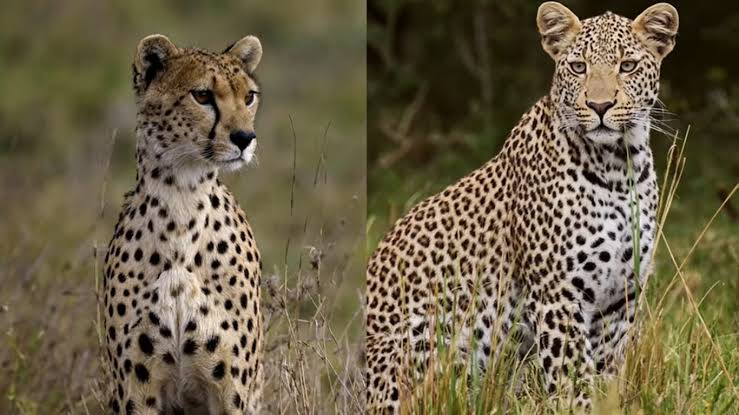
Leopards are solitary hunters that rely heavily on camouflage.
Their spotted coats help them disappear among branches, rocks and vegetation.
Unlike cheetahs, leopards are exceptionally strong climbers.
They frequently rest in trees and may carry kills into branches to reduce food theft.
Why Leopards Use Trees
A tree can provide a relatively secure feeding location away from many ground-dwelling competitors.
Leopards also use thick bushes, woodland and rocky habitats when suitable.
However, not every leopard hoists every kill.
Research has shown that this behaviour varies according to prey size, competition and habitat.
Leopards can therefore reduce some risks by using vegetation and elevated resting places rather than relying on direct confrontation.
4. Cheetahs: Avoiding Competition Through Speed and Timing
Cheetahs are smaller and more lightly built than lions.
Their slender bodies are specialised for high-speed pursuits across open ground.
Although they are impressive hunters, they are less capable of defending kills against larger carnivores.
A cheetah that encounters a lion or spotted hyena may abandon its meal rather than risk injury.
How Cheetahs Reduce Danger
Cheetahs may adjust where and when they hunt.
They often hunt during daylight, including mornings and afternoons.
This can reduce encounters with some predators that are frequently active at night.
However, cheetahs are flexible and sometimes hunt after dark.
Their survival depends on balancing access to prey against immediate threats.
5. Do These Predators Hunt at Different Times?
Differences in hunting activity can reduce some competition.
Lions and leopards are often active around dusk, dawn and night.
Cheetahs commonly hunt during daylight.
However, these patterns overlap.
Typical Activity Patterns
| Predator | Common Activity Periods |
|---|---|
| Lion | Night, dawn and dusk; sometimes daytime |
| Leopard | Night and twilight; also daytime |
| Cheetah | Daylight and twilight; occasionally night |
The important difference is flexibility.
Each species can change its activity according to prey availability, temperature and the presence of competitors.
A cheetah may temporarily avoid a location where a lion was recently active rather than abandoning the entire area.
6. What Serengeti Research Revealed
Scientists have studied predator competition in Serengeti National Park for decades.
One particularly interesting study used 225 camera traps across approximately 1,125 square kilometres.
Researchers examined how lions, spotted hyenas and cheetahs used the same landscape.
The results challenged the assumption that smaller predators must permanently avoid areas occupied by lions.
Cheetahs frequently continued using locations also visited by lions.
However, they tended to avoid those locations during the hours immediately following lion activity.
This behaviour is called short-term or reactive avoidance.
It allows cheetahs to use productive habitats without constantly exposing themselves to danger.
7. Why Sharing Space Does Not Mean Sharing Every Moment
Two predators may use the same grassland without meeting.
For example, a lion pride might cross an area during the night.
Several hours later, a cheetah may search that same area for gazelles.
The animals have shared the location but not necessarily interacted.
This distinction helps explain how competing predators coexist.
Scientists describe such differences as spatial and temporal patterns.
Spatial patterns concern where animals move.
Temporal patterns concern when they use particular places.
Understanding both is essential when studying predator competition.
8. Do Lions and Leopards Always Avoid Each Other?
Although direct encounters can be dangerous for leopards, research suggests that lions and leopards can share habitats extensively.
A multi-landscape study published in 2018 found no consistent evidence that lion presence caused leopards to abandon areas, shift their activity times or decline in population density.
This does not mean competition never occurs.
Instead, leopards may be able to coexist with lions without permanently avoiding lion habitats.
Their ability to use trees, vegetation and smaller prey may help them remain successful where lions are present.
9. How Different Prey Choices Reduce Competition
All three cats hunt mammals, but their preferred prey often differs.
Lions can capture large ungulates, especially when hunting cooperatively.
Leopards take a wide variety of animals, including antelopes, monkeys and smaller mammals.
Cheetahs commonly target gazelles and other manageable prey.
Comparing Their Diets
| Predator | Examples of Prey |
|---|---|
| Lion | Wildebeest, zebra, buffalo and antelopes |
| Leopard | Impala, monkeys, hares and other mammals |
| Cheetah | Thomson’s gazelle, Grant’s gazelle and young antelopes |
These are examples rather than exclusive diets.
Sharing some prey species does not mean that every predator competes equally for every meal.
10. Why Habitat Differences Matter
Serengeti National Park contains more than open grassland.
Its habitats include woodlands, riverine vegetation, rocky outcrops and extensive plains.
These different environments offer opportunities for predators with different hunting abilities.
Cheetahs often benefit from open areas where they can spot prey and accelerate rapidly.
Leopards frequently use wooded habitats and vegetation providing concealment.
Lions occupy many habitat types, including grasslands and woodland.
However, these preferences are not strict boundaries.
All three species may occur in overlapping areas, particularly where prey is abundant.
11. What Happens When a Lion Finds a Cheetah?
When a lion encounters a cheetah, the cheetah may retreat.
A cheetah’s greatest advantage is speed, not physical strength.
Avoiding contact is therefore usually safer than fighting.
If the cheetah has recently caught prey, it may abandon the carcass.
Lions can also kill cheetah cubs.
These risks influence the movements and behaviour of female cheetahs raising young.
However, not every encounter results in a chase or attack.
The outcome depends on distance, circumstances and the behaviour of the individual animals.
12. How Cheetah Mothers Protect Their Cubs
Young cheetahs face particularly serious risks from larger carnivores.
Mothers commonly hide small cubs in suitable vegetation while hunting.
As cubs grow, they accompany their mothers and gradually learn survival skills.
A mother may change direction or move away if she detects nearby lions.
Choosing suitable habitat is important because open areas offer good hunting opportunities but may provide limited shelter for young cubs.
Cheetah mothers must therefore balance feeding opportunities with the need for concealment and safety.
13. Where Can You Watch All Three Big Cats?
Several East African protected areas support lions, leopards and cheetahs.
| Destination | Country | Wildlife Viewing Opportunities |
|---|---|---|
| Serengeti National Park | Tanzania | Lions, leopards and cheetahs across varied habitats |
| Maasai Mara National Reserve | Kenya | All three cats in savannah and riverine areas |
| Ngorongoro Conservation Area | Tanzania | Lions and cheetahs, with leopards in suitable habitats |
| Amboseli National Park | Kenya | Lions, cheetahs and less frequently encountered leopards |
| Samburu ecosystem | Kenya | Big-cat sightings in northern savannah habitats |
Sightings vary considerably between locations.
Leopards are often more difficult to find because of their secretive behaviour.
Seeing all three cats during one safari is possible but never guaranteed.
14. What Should Safari Guides Look For?
Experienced guides study more than the predators themselves.
They observe prey behaviour, vegetation, tracks and alarm calls.
A group of gazelles staring intently towards one location may indicate a nearby predator.
A leopard’s resting place might be revealed by movement or alarm calls in woodland.
Cheetahs may be easier to identify when standing on mounds scanning open plains.
Guides also recognise that predators can change their movements in response to competitors.
Patience and knowledge of local habitats are therefore more useful than attempting to predict a fixed hunting schedule.
15. Why Protecting All Three Predators Matters
Lions, leopards and cheetahs contribute to healthy ecosystems through predation and interactions with other wildlife.
Their populations face threats from habitat loss, conflict with people and declining prey availability.
Cheetahs are particularly vulnerable to habitat fragmentation because they require extensive connected landscapes.
Protecting only one predator species is not enough.
Conservation planning must also consider suitable prey, movement corridors and the interactions between different carnivores.
Responsible safari tourism can support conservation when operators respect wildlife and protected-area rules.
Sharing the Same Park Without Constant Conflict
Lions, leopards and cheetahs demonstrate how different hunting strategies help predators survive within one ecosystem.
Lions depend on strength and cooperation, leopards use stealth and climbing ability, and cheetahs rely on speed and flexible movement.
They may share habitats and sometimes compete directly, but they do not need to confront one another constantly.
Research from the Serengeti shows that avoiding competitors for a few hours can be more practical than abandoning valuable hunting areas altogether.




No comment