
10-Day Rwanda & Uganda Gorilla Adventure Group Safari
Fixed Group Departure
Price: [PRICE TO BE CONFIRMED] per person sharing (based on a group of 6-16 travellers)
Upcoming departure dates:
- 15th – 24th December 2026
- 12th – 21st January 2027
- 20th – 29th June 2027
- 18th – 27th August 2027
Prefer your own schedule? This same route is available as a private departure any time of year — see our private 10 Days Rwanda Uganda Safari.
Overview
This fixed-date group departure is built for travellers who want two distinct gorilla trekking experiences, in Rwanda’s Volcanoes National Park and Uganda’s Bwindi Impenetrable Forest, plus golden monkey trekking and a relaxed stop at Lake Bunyonyi, without the cost of a fully private safari. Travelling with 6 to 16 fellow group members keeps the per-person cost down while still including the same permits, lodges and guiding as a private trip.
Ten days also gives this trip room to breathe in a way a rushed five or six-day gorilla-only trip cannot. Rather than flying in, trekking once and flying home, you get two full gorilla treks in two different countries, a dedicated golden monkey morning, a genuine cultural encounter with the Batwa community, and a full rest day on Lake Bunyonyi to let it all sink in before the journey back to Kigali.
The route crosses overland between Rwanda and Uganda through the Cyanika border post, giving you a genuine sense of both countries’ landscapes rather than flying between disconnected stops.
Trip Highlights
- Gorilla trekking in Volcanoes National Park
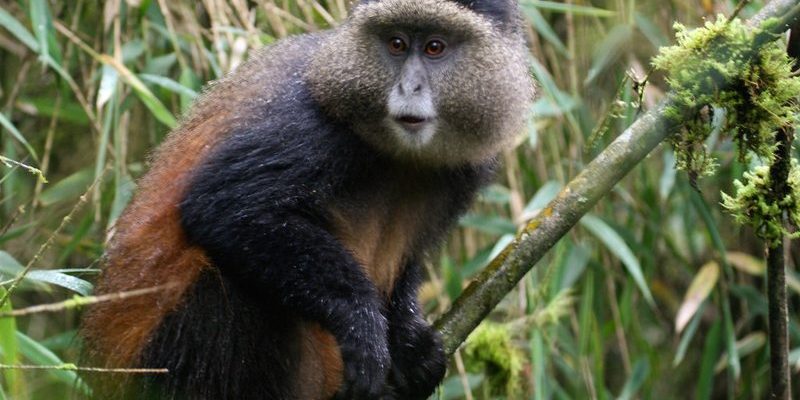
- Golden monkey trekking
- Lake Bunyonyi canoe excursion
- Gorilla trekking in Bwindi Impenetrable Forest
- Batwa cultural encounter
Detailed Itinerary
Day 1: Arrival in Kigali
Meet the group at Kigali International Airport and transfer to your hotel for a welcome briefing and dinner.
Meals: Dinner
Day 2: Transfer to Volcanoes National Park
Drive north to Kinigi through Rwanda’s scenic terraced hills, arriving in time to rest ahead of tomorrow’s trek.
Meals: Breakfast, Lunch and Dinner
Day 3: Gorilla Trekking in Volcanoes National Park
A full day tracking mountain gorillas through bamboo forest and volcanic slopes, spending a full hour with a habituated family once found.
Meals: Breakfast, Lunch and Dinner
Day 4: Golden Monkey Trekking
A shorter, livelier trek in the same park to track Rwanda’s endangered golden monkeys, followed by free time to rest or explore Kinigi.
Meals: Breakfast, Lunch and Dinner
Day 5: Cross into Uganda and Transfer to Lake Bunyonyi
Cross the Cyanika border into Uganda and continue to Lake Bunyonyi, one of Africa’s deepest lakes, arriving in the afternoon with time for a relaxed lakeside evening.
Meals: Breakfast, Lunch and Dinner
Day 6: Lake Bunyonyi Canoe Excursion and Transfer to Bwindi
A morning canoe excursion among Lake Bunyonyi’s 29 islands, followed by the drive to Bwindi Impenetrable Forest.
Meals: Breakfast, Lunch and Dinner
Day 7: Gorilla Trekking in Bwindi
Trek through Bwindi’s forest with Uganda Wildlife Authority rangers in search of a second, distinct gorilla family, spending a full hour observing them.
Meals: Breakfast, Lunch and Dinner
Day 8: Batwa Cultural Encounter
A guided cultural experience with the Batwa community, learning about their traditions, forest survival skills and history as Bwindi’s original forest inhabitants.
Meals: Breakfast, Lunch and Dinner
Day 9: Transfer Back to Kigali
Drive back across the border to Kigali, with a stop for lunch and photographs along the scenic route.
Meals: Breakfast, Lunch and Dinner
Day 10: Departure
Transfer to Kigali International Airport for your departure flight, marking the end of the group safari.
Meals: Breakfast
Your Destinations in Depth
Volcanoes National Park
Part of the wider Virunga Massif shared with Uganda and Congo, Volcanoes National Park holds roughly a third of the world’s remaining mountain gorillas across a dozen habituated families. It is also where primatologist Dian Fossey conducted her pioneering research from the 1960s until 1985, a legacy still visible in the park’s conservation approach today.
Lake Bunyonyi
One of the few lakes in the region considered free of bilharzia and therefore safe for swimming, Lake Bunyonyi is ringed by 29 islands and steeply terraced hillsides, making the canoe excursion here one of the most photographed stretches of this itinerary.
Bwindi Impenetrable Forest
A UNESCO World Heritage Site holding roughly half of the world’s remaining mountain gorillas, Bwindi’s forest terrain and gorilla families are distinct enough from Volcanoes National Park that trekking both on one trip genuinely feels like two different experiences rather than a repeat.
Why Two Gorilla Treks Instead of One
Every habituated gorilla family has its own personality, territory and forest environment, so trekking in both Rwanda and Uganda gives you two distinct encounters rather than the same experience twice. Volcanoes National Park’s bamboo and hagenia forest sits above 2,000 metres on volcanic slopes, while Bwindi’s terrain is denser, more tangled rainforest at a lower altitude, and rangers in each park track entirely different families.
The Batwa: Bwindi’s Original Forest Inhabitants
Before Bwindi became a national park, the Batwa people lived within the forest itself as hunter-gatherers, a way of life ended when the park was gazetted for conservation in 1991. The cultural encounter on Day 8 is arranged directly with Batwa community guides, covering traditional forest survival skills, music and history, and puts income directly into a community that lost access to its ancestral land when the park was created.
Mountain Gorilla Conservation Across Two Countries
Mountain gorillas were once projected to go extinct by the end of the twentieth century, with population estimates dropping below 250 individuals in the 1980s. Decades of coordinated ranger protection and veterinary care across the shared Virunga ecosystem spanning Rwanda, Uganda and Congo reversed that trajectory, and the wild population now stands at well over a thousand, split across habituated families in all three countries.
Group Safari FAQs
Why trek gorillas in both Rwanda and Uganda on one trip?
Each gorilla family is unique, and trekking in two different parks gives you two genuinely distinct forest environments and encounters rather than repeating the same experience, while the overland crossing lets you see more of the region between treks.
How physically demanding is the border crossing and overland travel?
The Cyanika border crossing itself is straightforward, and travel days are broken up with stops, meaning this itinerary is manageable for most reasonably fit travellers alongside the two gorilla treks.
What documents do I need at the Cyanika border?
A valid passport and your Rwanda and Uganda e-visa approvals (or East Africa Tourist Visa, which covers both countries on one visa) are required. Your driver-guide handles the practical logistics of the crossing itself, including any vehicle paperwork.
Will I need separate currency for each country?
It helps to have a small amount of both Rwandan francs and Uganda shillings, though US dollars are accepted widely enough at lodges in both countries that currency exchange is rarely urgent before the crossing.
What if the minimum group size isn’t reached?
If a departure doesn’t reach the minimum group size, we will offer an alternative date, a switch to a private departure at the private rate, or a full refund.
Are both gorilla permits included in the price?
Yes, both the Rwanda and Uganda gorilla permits, plus the golden monkey permit, are included in the per-person price.
How much deposit is required and what is the cancellation policy?
A deposit secures your place on the departure, with the balance due closer to travel. Because both countries’ gorilla and golden monkey permits must be purchased and confirmed well ahead of the trip and are non-refundable once booked, cancellation terms scale with how close to departure you cancel. Full terms are provided at booking, and travel insurance covering trip cancellation is strongly recommended.
Is there a trip leader with the group for the whole 10 days?
Yes, one driver-guide accompanies your group from the Kigali pickup through the border crossing and on to the Kigali departure, handling logistics and briefings throughout rather than switching at the border.
What is the typical group size and age range?
Groups run from 6 to 16 travellers, typically ranging from late twenties through seventies. Aside from the two treks, this itinerary is manageable for most reasonably fit adults.
Fitness, Permits and What to Pack
Both treks can take anywhere from under an hour to five or six hours round trip over steep, sometimes muddy terrain, and porters are available at both parks to help carry bags and assist on steeper sections. Rwanda and Uganda each issue a strictly limited number of permits per family per day, which is why we secure both well ahead of your departure date.
- Sturdy, ankle-supporting hiking boots
- Long trousers and long-sleeved shirts in neutral colours
- Gardening gloves for gripping vegetation
- A light rain jacket regardless of season
- Insect repellent and sun protection
- A change of clothes for the border crossing day
Conservation Impact
Gorilla permit revenue in both countries funds ranger patrols and veterinary monitoring through programmes like Gorilla Doctors, along with revenue-sharing schemes that return a portion of park income to communities bordering both parks. This cross-border model is a major reason mountain gorillas are now the only great ape species with a growing wild population after decades of decline.
Why Travel With All in Africa Safaris
Our driver-guides cross this exact Cyanika border route regularly and know the practical details, paperwork, timing and border etiquette that make the crossing smooth rather than stressful for a group. Running both private and group departures under one company means the group rate doesn’t come at the cost of lower-quality lodges or guiding compared to our private Rwanda and Uganda itineraries.
Meet the Guides Behind This Route
Guides assigned to our Rwanda-Uganda group departures are licensed in both countries where required, and most have run this specific cross-border circuit dozens of times, which matters more than it might seem: knowing exactly which border officials to greet first, how long the crossing realistically takes at different times of day, and which stretch of road tends to flood after rain all shape whether a group’s crossing day feels smooth or stressful.
Group Logistics on a Two-Country Trip
Running a fixed group departure across two countries adds coordination that a single-country trip doesn’t need, from syncing two national parks’ permit systems to timing the border crossing so the group arrives at Lake Bunyonyi with enough daylight left to enjoy it. We handle all of this centrally rather than treating the Rwanda and Uganda legs as two separate bookings stitched together, which is part of why the group rate on this itinerary matches what you’d expect from a well-run single-country trip rather than costing more for the added complexity.
Photography Notes
Forest light in both parks is dim and shifting, so prioritise a camera that performs well at higher ISO settings over one with a long zoom, since most gorilla encounters happen within three to eight metres. Lake Bunyonyi’s canoe excursion rewards a wide-angle lens for the terraced hillsides, and a dry bag for camera gear is worth carrying on the water.
Health and Travel Documents
Comprehensive travel insurance covering trip cancellation, medical evacuation and adventure activities is strongly recommended. Both countries require a yellow fever certificate for entry if arriving from an at-risk country, and most nationalities can apply for e-visas online for both Rwanda and Uganda before travel.
Why We Scheduled These Departure Dates
Our fixed dates cluster around the dry seasons in both countries, June to September and December to February, when trails in Volcanoes National Park and Bwindi are firmest for a group trekking together. The April-May window is generally avoided for fixed departures due to heavier rainfall, though it remains available on our private itinerary for travellers who prioritise lower rates and quieter parks over trail conditions.
What to Expect Travelling With a Group
Groups on this departure run from 6 to 16 travellers, small enough that the border crossing and two treks still feel personal rather than logistically overwhelming. Crossing from Rwanda into Uganda as a group, with your driver-guide handling the paperwork, tends to turn what could be a stressful process for independent travellers into a genuinely smooth part of the trip. Many groups find the shared achievement of two gorilla treks, in two different countries, becomes a natural talking point that carries through the rest of the trip.
Currency and Costs on the Ground
Rwandan francs and Uganda shillings are both useful for local purchases and tips in their respective countries, while US dollars printed after 2009 are widely accepted at lodges in both. Most lodges accept card payments for incidentals, though cash is more practical at the border crossing and smaller stops along the route.
Extend Your Group Safari
Travellers with extra time sometimes add a day in Kigali before the trip for the genocide memorial and city tour, or extend independently into Uganda afterward for chimpanzee tracking in Kibale Forest. Ask your booking consultant about combining this fixed departure with private extension days on either end.
A Trip Report From the Road
Guides who run this route often mention that the Lake Bunyonyi stop, positioned between the two gorilla treks, ends up being the group’s favourite unplanned highlight: a calm, scenic pause that gives everyone time to process the Volcanoes trek before the anticipation builds again for Bwindi. It is a reminder that a group itinerary built around real geography, not just a checklist of gorilla parks, tends to produce a better trip than back-to-back trekking days would.
Tour Includes
- Rwanda and Uganda gorilla permits
- Golden monkey permit
- Travel in a 4×4 car
- Professional guide
- Accommodation and meals as listed
Tour Excludes
- International flights
- Visas and insurance
- Alcoholic drinks
- Tips
- Single room supplement