
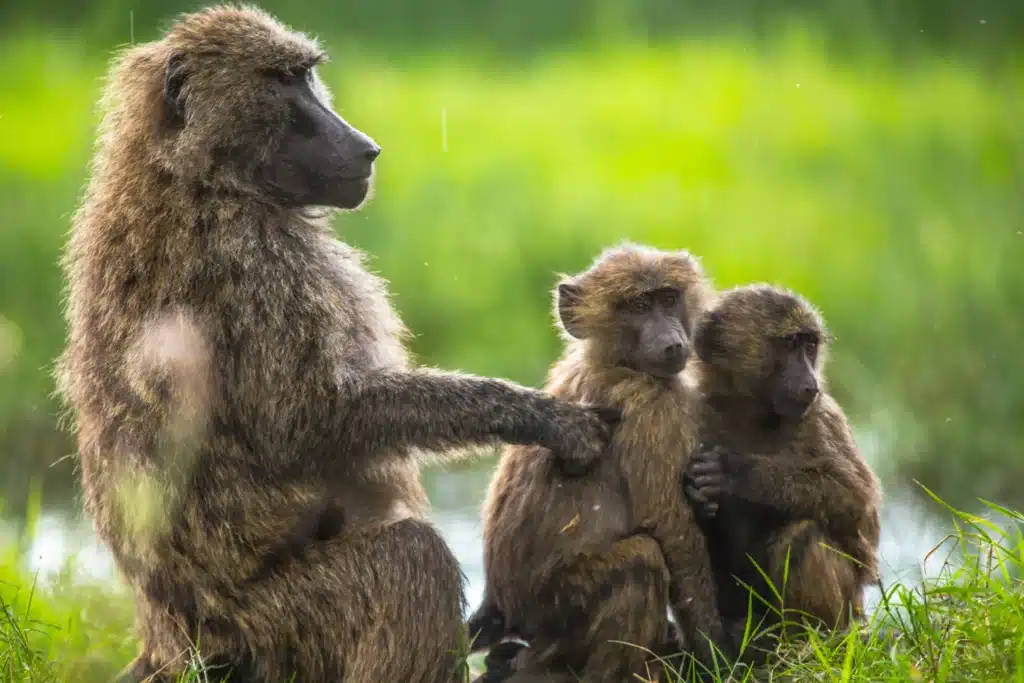
Olive Baboons on Safari: Troop Behaviour and Protecting Your Snacks
Imagine driving through Uganda’s Murchison Falls National Park when a group of baboons suddenly appears beside the road. Some are grooming each other, young ones are playing, and a large male sits quietly watching the surroundings. One curious baboon approaches your safari vehicle, seemingly interested in the food inside.
Olive baboons on safari are among the most entertaining primates to observe in East Africa. Their intelligence, complex social relationships and bold behaviour make them fascinating wildlife subjects. However, their curiosity around food can create problems for unprepared travellers.
Whether you are exploring Uganda, Kenya or Tanzania, understanding baboon behaviour and knowing how to protect your snacks can help you enjoy safe, responsible encounters.
What Are Olive Baboons?
The olive baboon, scientifically known as Papio anubis, is a large African monkey found across savannahs, woodlands and some forest habitats.
Its name comes from its olive-grey coat, which combines shades of grey, brown and greenish fur.
Olive baboons have long, dog-like muzzles, powerful limbs and distinctive tails. Adult males are generally much larger than females and possess prominent canine teeth.
Unlike many forest monkeys, baboons spend considerable time on the ground, although they also climb trees for resting, feeding and protection.
1. Understanding Baboon Troop Behaviour
Olive baboons live in social groups called troops.
A troop may contain several adult males, females, juveniles and infants. Group sizes vary considerably, sometimes reaching dozens of individuals.
Within each troop, baboons maintain complicated social relationships involving cooperation, competition and family bonds.
What Happens Inside a Baboon Troop?
During a game drive, you may observe:
- Adults grooming other troop members.
- Young baboons chasing and playing.
- Mothers carrying infants.
- Males displaying dominance.
- Individuals searching for food.
- Troop members watching for predators.
These behaviours help maintain relationships and support group survival.
Watching a troop for several minutes can reveal more than a brief photograph.
2. Why Baboons Groom Each Other
Grooming is one of the most recognisable baboon behaviours.
An individual carefully examines another baboon’s fur, removing dirt, loose skin and parasites.
However, grooming also serves an important social purpose.
Baboons use grooming to maintain relationships, strengthen bonds and sometimes reduce tension.
You may notice two adults grooming quietly while younger baboons play nearby.
Females often maintain long-term relationships with relatives, while males may form temporary alliances.
Your guide can explain how these interactions relate to the troop’s social structure.
3. How Baboon Hierarchies Work
Olive baboon troops contain dominance hierarchies.
Some individuals hold higher social positions than others, influencing access to food, mating opportunities and social support.
Female baboons commonly remain in their birth groups and maintain relationships with female relatives.
Males generally leave their birth troops as they mature and may join other groups.
Dominance does not depend entirely on physical strength.
Alliances, social relationships and individual behaviour also influence interactions.
For visitors, this means a troop is much more than a collection of animals moving together.
4. Why Baby Baboons Are So Entertaining
Young baboons are among the most enjoyable animals to observe.
They play, chase one another, climb branches and investigate their surroundings.
Very young infants often cling to their mothers before gradually becoming more independent.
Adult females may interact with infants belonging to other troop members.
However, mothers can become defensive when they perceive threats to their young.
Never approach infant baboons or attempt to attract them with food.
Observe family interactions from an appropriate distance.
5. What Do Olive Baboons Eat?
Olive baboons are omnivores, meaning they consume both plant and animal foods.
Their diet varies according to habitat and seasonal availability.
Common foods include:
- Fruits and berries.
- Grass and seeds.
- Roots and tubers.
- Leaves and flowers.
- Insects and other invertebrates.
- Bird eggs.
- Small vertebrates.
Their flexible diet helps them survive in different environments.
Unfortunately, this adaptability also makes human food attractive to some baboons.
6. Why Baboons Steal Food From Tourists
Baboons are intelligent, observant animals capable of learning where food is available.
In areas where visitors leave snacks unattended, some baboons begin associating people, bags and vehicles with food.
A baboon may investigate an open window or approach a picnic table after noticing food.
If this behaviour repeatedly results in food rewards, it can become more frequent.
This creates risks for both tourists and wildlife.
Baboons may become more assertive around visitors, while people may react unpredictably when food is taken.
Preventing food access is therefore an important part of responsible safari behaviour.
7. How to Protect Your Snacks on Safari
Keeping food secure is the easiest way to avoid unwanted baboon attention.
Follow these practical precautions:
- Keep snacks inside closed bags or secure vehicle compartments.
- Avoid displaying food near baboon troops.
- Close vehicle windows when baboons approach.
- Never leave food unattended at picnic areas.
- Dispose of rubbish in secure bins.
- Avoid feeding baboons, even small pieces of fruit.
- Follow your guide’s instructions during roadside encounters.
If a baboon approaches your belongings, remain calm.
Do not attempt to grab food directly from its mouth or hands.
Inform your safari guide and allow trained personnel to manage the situation.
8. Are Olive Baboons Dangerous?
Olive baboons are wild animals and should be treated with respect.
Although many encounters involve peaceful observation, baboons can become aggressive when threatened, cornered or encouraged to associate people with food.
Adult males have powerful jaws and sharp canine teeth.
Possible warning behaviours include threatening facial expressions, displaying teeth, lunging and aggressive vocalisations.
However, open-mouth displays can occur in different contexts, including ordinary yawning.
Avoid interpreting every visible canine tooth as a threat.
If a baboon behaves aggressively, do not challenge, chase or corner it. Follow your guide’s instructions and move away calmly when safe.
9. What Should You Do if a Baboon Takes Your Food?
If a baboon successfully takes a snack, do not attempt to recover it.
Trying to pull food away can provoke defensive behaviour.
Avoid shouting, throwing objects or approaching the animal.
Keep other food secured and inform your guide or lodge staff.
Never encourage children to chase baboons.
If an animal repeatedly approaches visitors for food, park personnel may need to manage the situation.
Prevention is much safer than confrontation.
10. Where Can You See Olive Baboons in Uganda?
Olive baboons occur in several Ugandan national parks and forest habitats.
| Destination | Typical Viewing Areas |
|---|---|
| Murchison Falls National Park | Savannah roads and woodland |
| Queen Elizabeth National Park | Game tracks and forest edges |
| Lake Mburo National Park | Woodland and surrounding habitats |
| Kibale National Park | Forest edges and nearby roads |
| Semuliki National Park | Forest and surrounding habitats |
| Kidepo Valley National Park | Savannah and woodland |
Baboons may also occur near roads outside protected areas.
However, roadside sightings should never encourage visitors to stop unsafely or feed wildlife.
11. Olive Baboons vs Other Ugandan Monkeys
Olive baboons are usually easier to identify than smaller forest monkeys.
| Feature | Olive Baboon | Typical Forest Monkeys |
|---|---|---|
| Body size | Relatively large and robust | Often smaller |
| Face | Long, dog-like muzzle | Generally shorter muzzle |
| Movement | Frequently travels on the ground | Many spend more time in trees |
| Social groups | Large, complex troops | Group structure varies |
| Diet | Highly varied omnivorous diet | Varies by species |
Baboons are particularly recognisable when walking through grassland or sitting beside roads.
12. Photographing Baboons Responsibly
Olive baboons provide interesting photography opportunities because of their facial expressions and social interactions.
You may photograph grooming adults, playing juveniles or a troop crossing a track.
Use optical zoom to maintain a respectful distance.
Avoid making noises to attract attention or encouraging animals to approach your vehicle.
Never place food near baboons to create a photograph.
If a group appears disturbed, allow more space.
Natural behaviour usually produces more meaningful wildlife photographs.
13. Why Feeding Baboons Harms Conservation
Feeding baboons may appear harmless, but it can create long-term problems.
Animals that regularly receive food from people may begin approaching roads, lodges and picnic areas more frequently.
This increases the potential for conflict, injuries and property damage.
Human foods may also be inappropriate for wild primates.
Baboons that become persistent food raiders can create serious management challenges for conservation authorities.
Keeping food secure helps protect visitors while allowing animals to maintain natural feeding behaviour.
Best Time to Watch Olive Baboons
Olive baboons are active mainly during daylight hours.
Early morning can be particularly interesting as troops leave sleeping areas and begin searching for food.
You may also observe grooming, resting and social interactions later in the day.
Baboons remain present throughout the year, although their movements can vary with rainfall and food availability.
There is no single season that guarantees the best encounters.
Enjoy Baboons Without Feeding Them
Olive baboons on safari offer fascinating opportunities to observe social relationships, intelligence and natural behaviour.
Their grooming rituals, playful youngsters and complicated troop hierarchies make them rewarding animals to watch.
However, their ability to learn from human behaviour means visitors must take food safety seriously.
Keep snacks secured, maintain a safe distance and never encourage baboons to approach vehicles or picnic areas.
The best baboon encounter is one where you enjoy watching their natural behaviour while keeping both your food and the animals safe.

No comment