
Blue Monkeys and Red-Tailed Monkeys: How to Tell Them Apart
Uganda’s tropical forests are home to fascinating primates, many of which can be difficult to identify during a guided nature walk. You might notice a grey monkey moving through the trees, followed by another with a reddish tail and a distinctive white mark on its nose. At first, they may appear similar, but they are two different species.
Learning how to identify blue and red-tailed monkeys can make your Uganda primate safari more interesting. Both species inhabit forest environments, feed on fruits and other plant materials, and sometimes travel together.
However, their facial markings, coat colours, tails and body sizes provide useful identification clues.
Whether you are exploring Kibale National Park, Bwindi Impenetrable Forest or Budongo Forest, understanding these differences will help you recognise the monkeys more confidently.
What Are Blue Monkeys and Red-Tailed Monkeys?
Blue monkeys and red-tailed monkeys belong to the genus Cercopithecus, a group of African primates commonly called guenons.
The blue monkey is scientifically known as Cercopithecus mitis, while the red-tailed monkey is Cercopithecus ascanius.
Both species are active during daylight and spend considerable time in trees.
They also possess cheek pouches that allow them to temporarily store food while feeding.
Despite these similarities, their appearances differ enough for experienced guides to identify them in suitable viewing conditions.
1. Coat Colour: Grey Compared With Brownish Fur
One useful distinction is the overall body colour.
Blue monkeys typically have greyish, olive-grey or dark grey coats. Their limbs may appear darker than their backs.
Despite their name, blue monkeys are not bright blue.
The name refers to their subdued colouring and the occasional bluish appearance of their facial skin.
Red-tailed monkeys generally have speckled brownish or grey-brown fur.
However, forest shadows can change how colours appear.
A monkey photographed beneath thick vegetation may look considerably darker than one standing in sunlight.
For reliable identification, examine several physical features together.
2. Facial Markings: The Easiest Identification Clue
The face is often the most helpful place to look when distinguishing these monkeys.
Blue Monkey Face
Blue monkeys have dark faces, often surrounded by lighter facial hair.
Many show a pale band of fur across the forehead, sometimes described as a diadem.
This feature explains why blue monkeys are also called diademed monkeys.
Red-Tailed Monkey Face
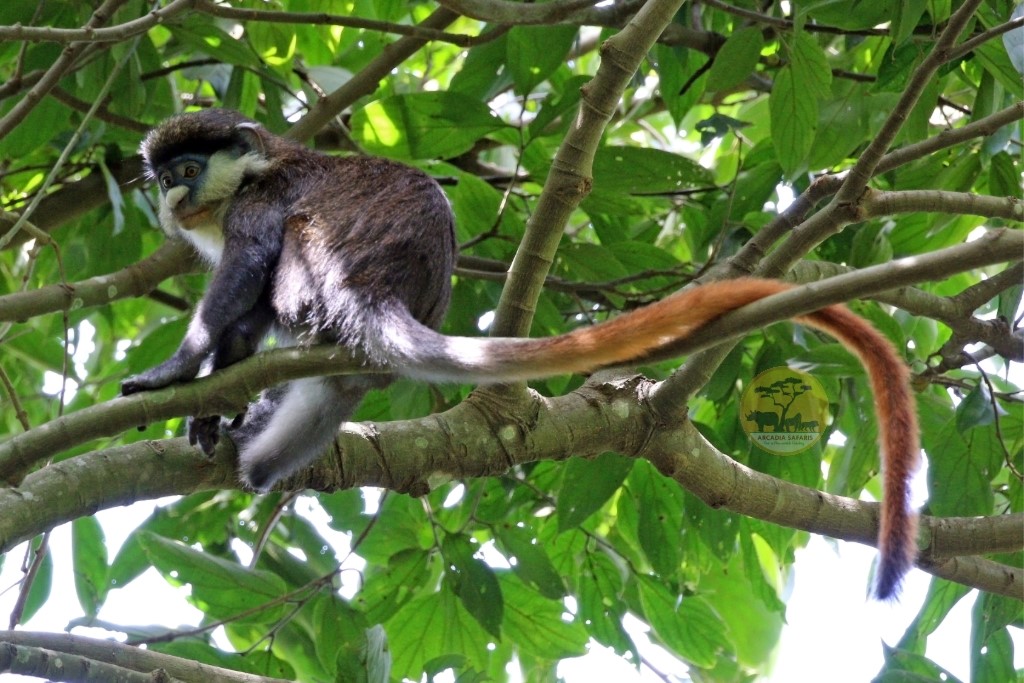
Red-tailed monkeys have dark faces with a conspicuous pale or white patch on the nose.
The patch may appear heart-shaped.
They also have lighter cheek whiskers that contrast with the surrounding dark facial colouring.
If you can clearly see a white nose spot, a red-tailed monkey is a strong possibility.
3. Tail Colour: Another Important Difference
The tail provides an excellent identification clue.
Blue monkeys generally have long, dark or greyish tails without the reddish colouring associated with red-tailed monkeys.
Red-tailed monkeys have long tails with noticeable chestnut or coppery colouring, particularly along parts of the tail.
When these animals jump between branches, the reddish tail may become visible before the rest of the body.
However, younger red-tailed monkeys may have less distinctive tail colouring.
Always combine tail colour with facial markings.
Blue Monkey vs Red-Tailed Monkey Comparison
| Feature | Blue Monkey | Red-Tailed Monkey |
|---|---|---|
| Scientific name | Cercopithecus mitis | Cercopithecus ascanius |
| Body colour | Grey or olive-grey | Brownish or speckled grey-brown |
| Face | Dark with pale forehead markings | Dark with distinctive white nose spot |
| Tail | Long, greyish or dark | Long, often coppery or reddish |
| Body size | Generally larger | Generally smaller |
| Main habitat | Tropical and montane forests | Tropical forests and forest edges |
| Diet | Fruits, leaves, flowers and invertebrates | Fruits, leaves and insects |
| Activity | Daytime | Daytime |
Individual appearance varies, so no single feature should determine every identification.
4. Body Size: Which Monkey Is Bigger?
Blue monkeys are generally larger and more heavily built than red-tailed monkeys.
Adult male blue monkeys can weigh approximately 4–8 kilograms, depending on the population.
Red-tailed monkeys are usually smaller, with adult males commonly weighing around 4 kilograms.
Females of both species are generally smaller than males.
However, comparing size can be difficult when monkeys occupy branches at different distances.
You may also encounter young blue monkeys that are smaller than adult red-tailed monkeys.
Body size is therefore a supporting clue rather than a definitive identification method.
5. Where Do Blue Monkeys Live in Uganda?
Blue monkeys occur in several Ugandan forest habitats.
They are particularly associated with tropical forests, wooded environments and areas containing suitable feeding trees.
Popular viewing destinations include:
- Kibale National Park.
- Bwindi Impenetrable National Park.
- Budongo Forest.
- Semuliki National Park.
- Selected forest reserves.
They often spend time feeding and moving through the forest canopy.
During guided walks, look for dark shapes resting along branches or travelling between trees.
Experienced guides may also recognise their territorial calls.
6. Where Can You Find Red-Tailed Monkeys?
Red-tailed monkeys have a widespread distribution in suitable Ugandan forest habitats.
They can be encountered in Kibale, Bwindi, Budongo and other forested destinations.
They are also associated with forests around Queen Elizabeth National Park and Semuliki.
These monkeys are agile climbers and frequently move through middle and upper canopy vegetation.
Their distinctive facial markings may be visible when individuals pause to feed.
Red-tailed monkeys can also occur near forest edges where suitable vegetation remains.
However, they should never be fed or encouraged to approach tourists.
Best Places to See Both Species in Uganda
| Destination | Blue Monkeys | Red-Tailed Monkeys |
|---|---|---|
| Kibale National Park | Present | Present |
| Bwindi Impenetrable National Park | Present | Present |
| Budongo Forest | Present | Present |
| Semuliki National Park | Present | Present |
| Bigodi area near Kibale | Possible | Possible |
Kibale and Budongo are especially worthwhile for travellers interested in observing different forest monkeys during the same journey.
Sightings depend on animal movements, forest conditions and the walking route.
7. Feeding Habits: Do They Eat the Same Food?
Both species consume fruits, leaves, flowers and small invertebrates.
However, their feeding preferences can differ according to habitat and seasonal food availability.
Blue monkeys regularly feed on fruits and other plant materials, supplementing their diet with insects.
Red-tailed monkeys also eat fruits and insects and may use their cheek pouches to carry food while moving.
During a forest walk, you might notice a monkey collecting fruits from branches before travelling to another tree.
Your guide can explain which plants are important food sources in that particular forest.
8. Social Behaviour: Why They Sometimes Travel Together
Blue monkeys and red-tailed monkeys are social primates that usually live in groups.
A group may contain adult females, young monkeys and adult males.
Both species also sometimes form mixed-species associations.
This means you may observe blue and red-tailed monkeys feeding or travelling in the same area.
Such associations can provide opportunities for increased vigilance against predators.
However, the species maintain their own social relationships.
Researchers have also documented occasional hybridisation between blue and red-tailed monkeys in Kibale, making some individual identifications more complicated.
9. How to Identify Their Calls
Forest monkeys communicate through different vocalisations.
Blue monkeys are known for distinctive calls produced by adult males, including loud territorial vocalisations.
Red-tailed monkeys also produce contact calls and alarm vocalisations.
An experienced guide may recognise a species from its sounds before seeing it.
However, calls can be difficult for beginners to distinguish.
During a guided walk, ask your guide to explain the vocalisations you hear.
Avoid imitating calls or playing recordings to attract wild monkeys.
10. Best Time to Spot Blue and Red-Tailed Monkeys
Both species are active during daylight hours.
Early morning can be a rewarding period for forest observation because monkeys may be feeding and travelling between trees.
However, sightings are also possible later in the day.
Their movements depend on food availability, weather and social activities.
Uganda’s relatively drier months, particularly June to August and December to February, may provide more comfortable forest walking conditions.
Nevertheless, monkeys remain active throughout the year.
11. Photography Tips for Forest Monkeys
Photographing monkeys in dense forest can be challenging.
Branches, leaves and uneven sunlight may obscure important identification features.
Use binoculars to locate the monkeys before attempting photographs.
For identification, try capturing:
- The face and nose markings.
- The entire tail.
- The body colour.
- A side view showing body proportions.
Avoid flash photography and sudden movements.
If you cannot identify a monkey confidently, ask your guide or compare your photographs with a reliable regional field guide.
12. Conservation and Responsible Monkey Viewing
Blue monkeys and red-tailed monkeys depend on healthy forest habitats.
Forest clearance, fragmentation and human disturbance can affect local populations.
Protected areas such as Kibale and Bwindi help conserve important habitats for these species.
Travellers can contribute by following park regulations, maintaining respectful viewing distances and avoiding contact with wildlife.
Never offer food to monkeys because feeding can change their behaviour and create risks for people and animals.
Recognising Uganda’s Forest Monkeys
Learning how to identify blue and red-tailed monkeys helps you appreciate the diversity of Uganda’s forest primates.
The blue monkey usually has greyish fur and pale forehead markings, while the red-tailed monkey is recognised by its white nose spot and reddish tail.
Although both species may share the same forest habitats, observing these features will help you distinguish them.
During your next forest walk in Kibale, Bwindi or Budongo, watch the branches carefully and listen to your guide.
A clear view of the face and tail can turn a confusing monkey sighting into a rewarding wildlife identification experience.


No comment