
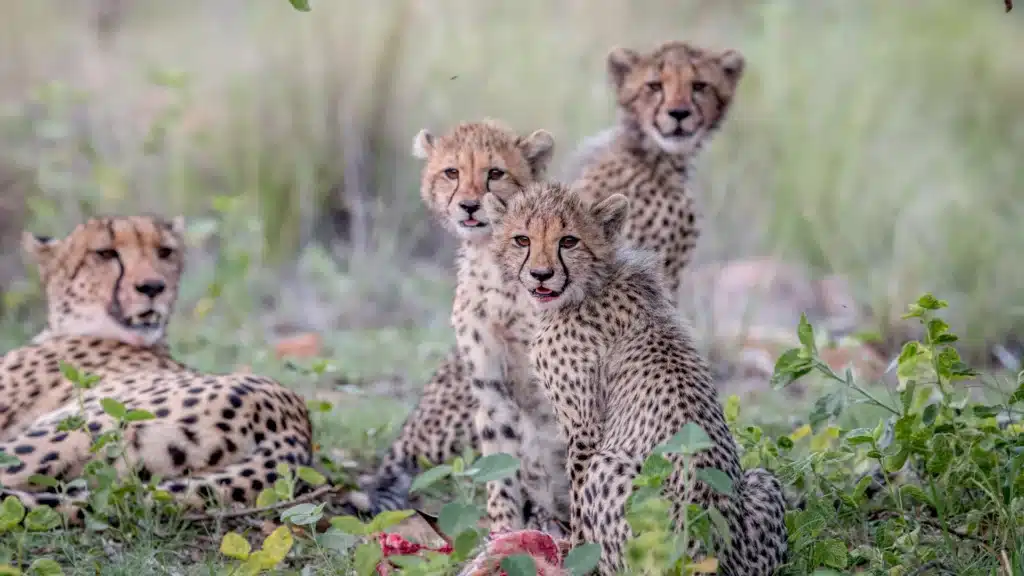
Cheetah Cubs
Why Few Survive and How Guides Protect Sightings
A mother cheetah walks carefully through the golden grasslands of Tanzania’s Serengeti National Park. Behind her, three small cubs follow closely, occasionally stopping to play. Their fluffy grey coats and curious faces make them some of Africa’s most appealing wildlife. Yet beneath this beautiful scene lies a difficult reality: raising cheetah cubs in the wild is exceptionally challenging.
Understanding cheetah cub survival on safari reveals how predators, food availability, habitat conditions and human activity affect young cheetahs. Lions and hyenas present serious threats, while mothers must constantly balance hunting with protecting their offspring.
Experienced safari guides also have an important responsibility. By maintaining suitable viewing distances and avoiding unnecessary disturbance, they can help ensure tourists do not make an already difficult situation worse.
This guide explains why cheetah cub mortality can be high and how responsible tourism supports their survival.
1. Why Are Cheetah Cubs So Vulnerable?
Cheetahs are exceptional hunters, but their physical adaptations favour speed rather than fighting larger predators.
Adult cheetahs have slender bodies, long legs and relatively lightweight frames.
These features help them chase prey at remarkable speeds, but they provide limited advantages during confrontations with lions or spotted hyenas.
Young cubs are even more vulnerable.
They cannot run fast enough to escape most predators and depend heavily on their mothers for food, protection and shelter.
During their earliest weeks, cubs remain hidden while their mothers search for prey.
2. How Many Cheetah Cubs Survive in the Wild?
Cheetah cub survival varies considerably between habitats.
A well-known study conducted in Tanzania’s Serengeti found that only approximately 4.8% of cubs survived to independence.
This means around 95% died before becoming independent in that particular study population.
However, this figure should not be applied to all cheetahs across Africa.
Later research in the Kgalagadi Transfrontier Park of southern Africa documented substantially higher survival.
Cheetah Cub Survival Comparison
| Research Location | Reported Survival |
|---|---|
| Serengeti Plains, Tanzania | Approximately 4.8% survived to independence |
| Kgalagadi Transfrontier Park | Around 29% survived in a later study |
| Other African populations | Varies according to habitat and local threats |
These differences show why protecting suitable habitats and understanding local conditions are essential.
3. Lions: A Major Threat to Young Cheetahs
Lions are among the natural predators of cheetah cubs.
Adult lions are much larger and stronger than cheetahs.
If a lion discovers unattended cubs, the young animals may have little opportunity to escape.
Research in the Serengeti identified lion predation as an important cause of cub mortality.
However, the exact influence of lions differs between ecosystems.
Not every lion that encounters a cheetah will attack, and different predator communities create different risks.
Mother cheetahs frequently avoid areas where lions are active.
4. Why Spotted Hyenas Are Also Dangerous
Spotted hyenas are another serious threat.
They may kill young cheetahs or steal prey from adult females.
A mother cheetah that loses her kill may need to hunt again, increasing the time she spends away from dependent cubs.
Hyenas also compete with cheetahs for food and space.
However, the relationship is not always a direct confrontation.
Cheetahs often reduce risk by hunting when larger predators are less active or by moving away from dangerous areas.
5. Why Mothers Hide Their Cubs
Female cheetahs usually give birth in concealed locations containing grass, bushes or other suitable cover.
A litter commonly contains three to six cubs, although numbers vary.
During their earliest weeks, the cubs remain in hiding while their mother hunts.
She returns to nurse and care for them.
Why Do Mothers Change Hiding Places?
Moving cubs can reduce the chance that predators discover one location repeatedly.
It may also help mothers use nearby feeding opportunities.
However, moving young cubs carries its own risks.
The mother must transport or guide them through potentially dangerous habitats.
This is why visitors should never approach suspected cheetah den sites.
6. Why Cheetah Cubs Have Fluffy Grey Fur
Young cheetahs have distinctive long, greyish hair along their backs.
This covering is known as a mantle.
It makes cubs appear unusually fluffy compared with adults.
The mantle may provide camouflage and protection against environmental conditions.
Some researchers have proposed that its appearance resembles the colouring of a honey badger, potentially discouraging predators.
However, the protective value of this resemblance has not been conclusively demonstrated.
As cubs grow, their long mantle gradually becomes less prominent.
7. How Mothers Teach Cubs to Hunt
Cheetah mothers provide food and opportunities for their young to develop hunting skills.
Older cubs accompany their mothers and observe how they approach prey.
They gradually learn stalking, chasing and handling captured animals.
Sometimes mothers provide opportunities for cubs to practise with prey.
These experiences help youngsters develop coordination and confidence.
However, hunting successfully requires considerable practice.
Cubs that lose their mothers before learning essential survival skills face serious difficulties.
8. When Do Cheetah Cubs Become Independent?
Young cheetahs usually remain with their mothers for approximately 18 to 22 months.
During this period, they learn to identify prey, avoid danger and travel across their home ranges.
Eventually, the mother separates from her growing offspring.
Siblings may remain together for some time after becoming independent.
Young males sometimes form long-term coalitions, while females generally become more solitary as they mature.
Independence is an important milestone, but it does not eliminate the risks facing young cheetahs.
9. Can Safari Tourism Affect Cub Survival?
Yes. Poorly managed tourism can disturb cheetah families.
Cheetahs are attractive subjects for photographers, especially when cubs are present.
Unfortunately, large numbers of vehicles may gather around a mother and her young.
Vehicles can interfere with hunting, separate family members or prevent the animals from watching for predators.
Research in the Maasai Mara ecosystem identified tourism pressure as an important consideration in cub recruitment.
How Crowded Sightings Cause Problems
Potential disturbances include:
- Vehicles surrounding a mother and her cubs.
- Driving too close to young animals.
- Blocking movement routes.
- Interrupting hunting attempts.
- Following families repeatedly.
- Creating excessive noise.
- Approaching protected denning areas.
Responsible guiding aims to prevent these situations.
10. How Professional Safari Guides Protect Cheetah Families
A knowledgeable guide understands that seeing a cheetah family should never come at the expense of the animals’ welfare.
Good guides assess the situation before approaching.
If cubs are very young or the mother appears uncomfortable, they may decide not to approach at all.
Responsible Viewing Practices
| Guiding Practice | Why It Matters |
|---|---|
| Maintain adequate distance | Reduces disturbance |
| Limit vehicles | Prevents crowding |
| Keep movement routes open | Allows family members to travel freely |
| Avoid den sites | Protects vulnerable young cubs |
| Stay quiet | Reduces stress |
| Do not interfere with hunting | Allows natural feeding behaviour |
| Leave when animals show distress | Prioritises wildlife welfare |
A Maasai Mara conservation study recommended a minimum viewing distance of 30 metres and no more than five vehicles at a sighting.
These were research recommendations, not universal park regulations. Guides must follow the applicable rules of the specific reserve or national park, using greater distances when necessary.
11. Why Guides Avoid Cheetah Den Sites
A hidden litter should remain undisturbed.
Repeated visits to a den can reveal its location and potentially interfere with a mother’s normal movements.
Vehicles approaching too closely may cause the mother to relocate her cubs.
Professional guides therefore avoid advertising or visiting sensitive den locations.
If young cubs are discovered, the responsible choice may be to leave the area quietly.
A sighting is not worth increasing the danger facing vulnerable animals.
12. What Should Tourists Do When They See Cheetah Cubs?
Visitors also have a responsibility to protect wildlife.
During a cheetah sighting:
- Remain inside the safari vehicle where required.
- Follow your guide’s instructions.
- Avoid shouting or making sudden noises.
- Never ask the driver to approach cubs closely.
- Do not block the animals’ direction of travel.
- Avoid flash photography.
- Never attempt to touch or feed cubs.
- Accept your guide’s decision to leave a sensitive sighting.
If you encounter cubs without their mother, do not assume they have been abandoned.
Female cheetahs often leave young cubs hidden while hunting.
Never attempt to rescue them yourself. Report concerns to authorised wildlife personnel.
13. Where Can You See Cheetah Families in East Africa?
Several East African destinations support breeding cheetah populations.
| Destination | Country | Viewing Opportunities |
|---|---|---|
| Serengeti National Park | Tanzania | Cheetahs across open plains and surrounding habitats |
| Maasai Mara National Reserve | Kenya | Resident cheetahs and occasional family groups |
| Amboseli National Park | Kenya | Cheetahs in suitable open habitats |
| Samburu ecosystem | Kenya | Cheetahs in northern savannah landscapes |
| Ngorongoro Conservation Area | Tanzania | Cheetahs in selected grassland habitats |
Uganda also has a small, localised cheetah population, principally associated with Kidepo Valley National Park.
However, visitors specifically hoping to observe cheetahs generally have stronger opportunities in established Kenyan and Tanzanian safari ecosystems.
Cheetah cub sightings are never guaranteed and should not be actively pursued at sensitive den sites.
14. Why Habitat Matters for Cheetah Cubs
Cheetahs are often associated with open grasslands, but young cubs also depend on vegetation that provides concealment.
Dense grass, bushes and other suitable cover can help mothers hide vulnerable offspring.
Research in the Maasai Mara found that more open habitats could be associated with lower cub recruitment.
This demonstrates why protecting a mixture of habitats is important.
Conservation planning must consider both the open landscapes used for hunting and the sheltered areas needed for raising young.
15. Why Protecting Cheetah Cubs Matters
Cheetahs face threats from habitat fragmentation, declining prey availability and conflict with people.
Their populations require extensive landscapes containing suitable hunting areas and breeding habitat.
When few cubs survive, maintaining stable populations becomes more difficult.
Conservation initiatives therefore support habitat protection, population monitoring and responsible tourism.
Safari operators can contribute by training guides, respecting protected-area regulations and discouraging crowded sightings.
Travellers can also choose operators that prioritise wildlife welfare.
Giving Cheetah Cubs a Better Chance
Cheetah cubs face considerable challenges from the moment they are born.
Lions, spotted hyenas, food shortages and difficult environmental conditions can threaten their survival.
Their mothers must constantly balance hunting, feeding and protecting them.
Although tourism cannot remove these natural dangers, responsible guiding can prevent unnecessary human disturbance.
Keeping vehicles at suitable distances, protecting den sites and respecting the animals’ movements are simple but important actions.
The best cheetah cub sighting is not the closest photograph. It is an encounter where the mother and her young remain safe, behave naturally and continue their lives without interference.







No comment