
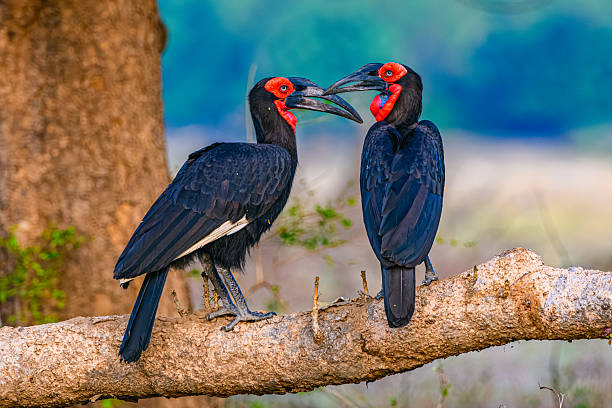
Southern Ground Hornbill: Africa’s Largest Hornbill
The morning sun rises over Tanzania’s Tarangire National Park, illuminating the golden grasslands and scattered acacia trees. Beside a dusty game-drive track, a large black bird walks slowly through the vegetation, examining the ground with its powerful eyes.
Its enormous curved bill, bright red throat pouch and long dark legs make it look unlike any ordinary bird.
A second bird emerges from the grass, followed by another. Together, they move across the savannah, searching for insects, reptiles and small animals hidden among the dry vegetation.
These are southern ground hornbills, the largest and heaviest members of the hornbill family.
For many safari visitors, southern ground hornbill sightings in East Africa are unexpected highlights. While travellers usually focus on lions, elephants and giraffes, these magnificent birds reveal a different side of African wildlife.
Unlike most hornbills that spend considerable time in trees, southern ground hornbills are primarily terrestrial hunters. They walk through open grasslands, communicate through deep booming calls and live in unusually cooperative family groups.
Unfortunately, they are also threatened by habitat loss, poisoning and slow reproduction.
This guide explores their identification, feeding habits, family behaviour, nesting, conservation and the best places to look for them on safari.
1. What Is a Southern Ground Hornbill?
The southern ground hornbill is a large African bird belonging to the genus Bucorvus.
Its scientific name is Bucorvus leadbeateri.
It is one of only two living ground hornbill species. The other is the northern ground hornbill, also known as the Abyssinian ground hornbill.
Southern ground hornbills occur across suitable savannah and woodland habitats from parts of East Africa southwards into southern Africa.
They are powerful birds with strong legs, large bills and distinctive vocalisations.
Southern Ground Hornbill Quick Facts
| Feature | Description |
|---|---|
| Common name | Southern ground hornbill |
| Scientific name | Bucorvus leadbeateri |
| Family | Bucorvidae |
| Height | Approximately 90–110 cm |
| Male weight | Approximately 3.5–6.2 kg |
| Main plumage | Black |
| Facial skin | Bright red in adults |
| Wings | Black with contrasting white flight feathers |
| Habitat | Savannah, open grassland and woodland |
| Diet | Insects, reptiles and small animals |
| Social structure | Cooperative family groups |
| Conservation status | Vulnerable globally |
Its large size and striking appearance make it one of Africa’s most recognisable birds.
2. Why Is It Called the Largest Hornbill?
Hornbills are a diverse group of birds found across Africa and Asia.
Many have unusually large bills, often with a raised structure called a casque.
The southern ground hornbill stands out because of its overall size and weight.
Adult males can weigh considerably more than most other hornbill species.
Its strong legs and broad body reflect its largely ground-based lifestyle.
Although some large Asian hornbills have impressive wingspans and enormous bills, the southern ground hornbill is generally recognised as the heaviest hornbill species.
The bird’s size becomes especially noticeable when it walks beside smaller savannah birds.
3. How Can You Identify a Southern Ground Hornbill?
The easiest identification feature is its combination of black plumage and bright red bare skin.
Adult males have red skin around the eyes and across the inflatable throat pouch.
Adult females generally have a distinctive blue patch within the red throat area.
The large black bill curves downwards and has a relatively small casque.
When the bird opens its wings, striking white primary feathers become visible.
Main Identification Features
| Body Part | Appearance |
|---|---|
| Head | Large and black-feathered |
| Eyes | Surrounded by red bare skin |
| Throat | Red inflatable pouch |
| Female throat | Red with blue patch |
| Bill | Large, dark and curved |
| Body | Predominantly black |
| Wings | White primaries visible in flight |
| Legs | Long and strong |
| Juveniles | Duller facial colours |
Young birds develop the bright adult facial colours gradually over several years.
4. Southern vs Northern Ground Hornbill
East Africa is important because both ground hornbill species occur within the wider region.
The southern ground hornbill is more closely associated with southern and eastern African savannahs.
The northern ground hornbill occurs across northern tropical Africa and reaches Uganda and northern Kenya.
Ground Hornbill Identification Comparison
| Feature | Southern Ground Hornbill | Northern Ground Hornbill |
|---|---|---|
| Scientific name | Bucorvus leadbeateri | Bucorvus abyssinicus |
| Other name | Southern ground hornbill | Abyssinian ground hornbill |
| Male facial skin | Mostly red | Blue around eyes, red throat |
| Female throat | Red with blue patch | Mainly blue |
| Bill casque | Relatively modest | More prominent |
| East African range | Mainly southern Kenya and Tanzania, locally farther west | Uganda and northern Kenya |
| Habitat | Savannah and woodland | Often drier open country |
Colour patterns and geographical location are the most useful identification clues.
5. Where Do Southern Ground Hornbills Live?
Southern ground hornbills favour open savannah, grassland and lightly wooded landscapes.
They need enough open ground for walking and hunting.
Mature trees are also important because they provide suitable nesting cavities and night-time roosting sites.
The species occurs in parts of Kenya, Tanzania, Rwanda, Burundi and neighbouring African countries.
Its range extends into Zambia, Zimbabwe, Botswana, Mozambique and South Africa.
However, populations are unevenly distributed.
A large national park may provide suitable habitat without supporting many birds in a particular area.
6. Where Can You See Southern Ground Hornbills in East Africa?
Some East African national parks provide opportunities to observe southern ground hornbills.
East African Viewing Guide
| Destination | Country | Viewing Opportunity |
|---|---|---|
| Tarangire National Park | Tanzania | Open woodland and savannah |
| Serengeti National Park | Tanzania | Grassland and lightly wooded areas |
| Lake Manyara National Park | Tanzania | Suitable woodland and grassland |
| Maasai Mara ecosystem | Kenya | Savannah and scattered woodland |
| Suitable southern Kenyan savannahs | Kenya | Local populations |
| Akagera National Park | Rwanda | Possible in suitable savannah habitats |
| Southwestern Ugandan savannahs | Uganda | Ground hornbill records require careful species identification |
In Uganda, the northern or Abyssinian ground hornbill is particularly associated with northern savannah landscapes, including Kidepo and Murchison Falls.
Visitors should not assume that every large black ground hornbill seen in Uganda is the southern species.
An experienced bird guide can help confirm the identification.
7. Why Do Southern Ground Hornbills Spend So Much Time Walking?
Southern ground hornbills are mainly terrestrial hunters.
Their long legs allow them to walk through grasslands while searching for prey.
Unlike many other hornbills that forage primarily in trees, ground hornbills spend much of the day examining vegetation and soil.
Their powerful bills help them capture and handle animals found on the ground.
They may walk considerable distances while foraging across their territories.
However, they are still capable of flight.
They regularly fly into trees to roost and reach nesting sites.
8. What Do Southern Ground Hornbills Eat?
Southern ground hornbills are mainly carnivorous.
They feed on insects and a variety of small vertebrates.
Their diet changes according to habitat, season and prey availability.
Southern Ground Hornbill Diet
| Food | Feeding Behaviour |
|---|---|
| Grasshoppers | Captured while walking |
| Beetles | Taken from ground vegetation |
| Termites | Collected when available |
| Snakes | Seized and subdued with the bill |
| Lizards | Captured on the ground |
| Frogs | Taken opportunistically |
| Small rodents | Hunted in suitable grassland |
| Small birds | Occasionally consumed |
| Other invertebrates | Important supplementary prey |
Their varied diet makes them effective predators in savannah food webs.
9. Can Southern Ground Hornbills Kill Snakes?
Yes.
Southern ground hornbills can capture and kill snakes.
They use their powerful bills to seize prey and may strike or shake it before swallowing.
Their approach differs from that of secretary birds, which specialise in delivering forceful kicks with their feet.
Ground hornbills rely more directly on their bills.
However, snakes represent only one component of their diet.
A group may spend much of its feeding time searching for insects and other small animals.
Watching these birds investigate grassland is therefore often more productive than waiting specifically for a snake encounter.
10. Why Do Southern Ground Hornbills Live in Family Groups?
Southern ground hornbills have one of the most interesting social systems among African birds.
They commonly live in territorial groups containing a breeding pair and additional members.
Some group members are offspring from previous breeding seasons.
These birds may help defend the territory, locate food and care for the breeding female and chick.
This arrangement is known as cooperative breeding.
It allows several birds to contribute to raising a relatively small number of young.
Cooperative Family Roles
| Group Member | Main Contribution |
|---|---|
| Breeding male | Territory defence and food provision |
| Breeding female | Egg laying, incubation and chick care |
| Helpers | Food delivery, vigilance and defence |
| Young birds | Learn social and foraging behaviour |
The exact group composition varies between territories.
11. How Do Southern Ground Hornbills Communicate?
Ground hornbills are famous for their deep, booming calls.
Their voices can carry across open country, particularly during the early morning.
A typical call consists of repeated low notes that may sound like distant booming or drums.
Pairs and group members sometimes call together.
These vocalisations help maintain contact and advertise territorial presence.
The throat pouch is associated with their vocal behaviour, although calling involves the bird’s wider vocal anatomy.
Common Communication Behaviours
- Deep booming calls.
- Group vocalisations.
- Body movements and displays.
- Bill positioning.
- Visual signals involving the throat pouch.
- Close social interactions.
Listening for their calls can help guides locate them before the birds become visible.
12. Where Do Southern Ground Hornbills Nest?
Southern ground hornbills usually nest in large cavities within mature trees.
They may use hollows in trunks or broken branches.
Unlike many other hornbill species, the breeding female is not sealed inside the nest cavity.
She remains in the nesting area while receiving support from other group members.
The female commonly lays two eggs.
However, typically only one chick survives to leave the nest.
Breeding Stages
| Stage | Description |
|---|---|
| Pair preparation | Breeding pair selects suitable cavity |
| Egg laying | Usually two eggs |
| Incubation | Approximately 40 days |
| Chick care | Female and helpers provide care |
| Nestling development | Young remains in nest for an extended period |
| Fledging | Surviving chick eventually leaves nest |
| Continued dependence | Young bird remains with family group |
The breeding process is slow and requires substantial parental investment.
13. Why Do Southern Ground Hornbills Breed So Slowly?
Southern ground hornbills are long-lived birds with a slow reproductive strategy.
Young birds take several years to mature.
Not every breeding attempt succeeds.
Even when two eggs are laid, one chick usually receives most of the resources and survives.
Family groups may also fail to breed successfully in some years.
This slow reproduction becomes a major conservation problem when adult birds are killed.
A population cannot quickly replace individuals lost through poisoning, persecution or collisions.
14. How Long Do Southern Ground Hornbills Live?
Southern ground hornbills can live for several decades.
Their long lifespan is associated with delayed maturity and slow breeding.
Young birds may remain in their family group for several years before finding opportunities to join or establish another group.
This extended period may help them learn feeding, territorial and social behaviour.
However, surviving to adulthood is particularly important.
When an established breeding bird dies, the loss can affect reproduction within the entire group.
15. Why Are Southern Ground Hornbills Vulnerable?
The southern ground hornbill is classified as Vulnerable globally.
Its populations face several threats.
Habitat conversion is important because the species requires extensive territories and suitable nesting trees.
Poisoning can also cause mortality when birds consume contaminated prey or bait.
Main Conservation Threats
| Threat | Impact |
|---|---|
| Habitat loss | Reduces hunting and breeding areas |
| Mature tree removal | Eliminates nesting cavities |
| Poisoning | Can kill adult birds |
| Persecution | Direct loss of individuals |
| Power infrastructure | Collisions and electrocution risks |
| Habitat fragmentation | Isolates family groups |
| Slow reproduction | Limits population recovery |
Because these birds reproduce slowly, conservation requires long-term protection.
16. Why Are Mature Trees Important?
Although southern ground hornbills spend much of the day walking, large trees are essential for nesting and roosting.
Suitable cavities generally develop in mature trees.
Removing these trees can eliminate breeding opportunities.
Even landscapes with abundant grassland prey may become unsuitable if appropriate nesting cavities disappear.
Conservation therefore involves protecting both open feeding habitat and old trees.
This combination is a defining requirement of the species.
17. How Are Conservationists Protecting Southern Ground Hornbills?
Conservation programmes work to reduce mortality, protect nesting sites and improve breeding success.
In South Africa, the Mabula Ground Hornbill Project is particularly well known for its work with the species.
Activities include research, education, artificial nest provision and carefully managed interventions intended to support population recovery.
Community engagement is also important.
Conservationists explain the ecological value of the birds and work to reduce deliberate killing.
Important Conservation Actions
- Protecting mature nesting trees.
- Monitoring breeding groups.
- Reducing poisoning risks.
- Installing suitable artificial nests where appropriate.
- Improving electricity infrastructure safety.
- Supporting scientific research.
- Educating communities.
- Maintaining large connected savannah habitats.
Successful conservation depends on addressing several threats together.
18. What Makes Southern Ground Hornbills Important to Ecosystems?
Southern ground hornbills are predators within African savannah food webs.
They consume insects, reptiles and small mammals.
Their feeding contributes to the ecological relationships between predators and prey.
Their dependence on mature trees and open savannah also makes them useful indicators of habitat quality.
Protecting a large ground hornbill territory can help conserve landscapes used by many other species.
Their decline is therefore relevant to broader grassland and woodland conservation.
19. How to Photograph Southern Ground Hornbills
Southern ground hornbills are impressive photography subjects.
Their black feathers contrast dramatically with bright red facial skin.
However, photographing dark plumage can be challenging because the camera must retain feather detail without overexposing the red face.
Early morning light is often useful.
Photography Tips
| Situation | Recommended Approach |
|---|---|
| Walking birds | Use continuous autofocus |
| Portraits | Focus on the eye and facial skin |
| Group interactions | Include several birds in frame |
| Flight photography | Capture contrasting white wing feathers |
| Dark plumage | Check exposure and shadow detail |
| Calling behaviour | Wait patiently at a respectful distance |
A telephoto lens allows natural behaviour to be photographed without approaching the birds.
Never disturb an active nest.
20. Southern Ground Hornbill vs Secretary Bird
These two large African birds are sometimes compared because both spend considerable time hunting on foot.
However, their appearance and hunting methods differ significantly.
| Feature | Southern Ground Hornbill | Secretary Bird |
|---|---|---|
| Body colour | Mainly black | Grey and black |
| Facial markings | Bright red bare skin | Orange-red facial skin |
| Bill | Large and heavy | Shorter hooked bill |
| Legs | Strong and relatively shorter | Exceptionally long |
| Hunting method | Captures prey with bill | Uses powerful foot strikes |
| Social behaviour | Cooperative groups | Often pairs or family associations |
| Main habitat | Savannah and woodland | Open grassland |
Both are remarkable examples of birds adapting to ground-based hunting.
Frequently Asked Questions
Is the Southern Ground Hornbill Africa’s Largest Hornbill?
Yes. It is widely recognised as the largest and heaviest living hornbill species.
Can Southern Ground Hornbills Fly?
Yes. They can fly and regularly use trees for roosting and nesting, despite spending much of the day on the ground.
Are Southern Ground Hornbills Dangerous?
They have powerful bills and should never be handled or cornered. In normal safari situations, they generally avoid direct confrontation with people.
Do Southern Ground Hornbills Eat Snakes?
Yes. They capture snakes along with insects, lizards, frogs, rodents and other small prey.
Are Southern Ground Hornbills Endangered?
They are classified as Vulnerable globally, although some regional populations face more severe threats.
Where Can I See Southern Ground Hornbills in Tanzania?
Tarangire, Serengeti and Lake Manyara are among the destinations where visitors may encounter them.
Protecting Africa’s Largest Hornbill
The southern ground hornbill is one of Africa’s most extraordinary birds.
Its powerful bill, bright red facial skin, glossy black plumage and enormous size make it immediately recognisable.
Yet its behaviour is even more fascinating than its appearance.
These birds walk across savannahs hunting small animals, communicate through deep booming calls and work together in family groups to raise their young.
Their slow reproduction makes every successful breeding attempt important.
Unfortunately, habitat loss, poisoning and other human-related threats continue to place pressure on their populations.
For travellers exploring Tanzania, Kenya and other parts of East Africa, seeing southern ground hornbills provides an opportunity to appreciate wildlife beyond the familiar mammals.







No comment