
Secretary Birds: How They Hunt Snakes on Foot
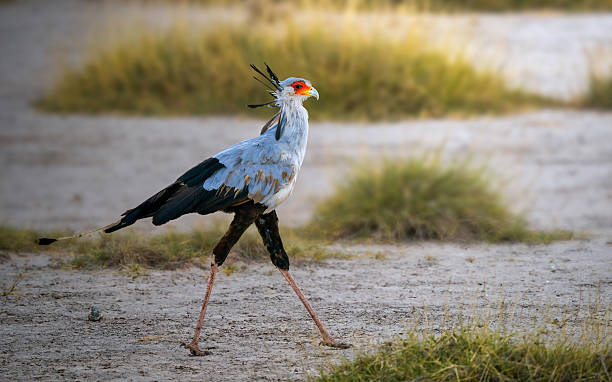
The morning sun rises over Kenya’s Maasai Mara, lighting the golden grasslands as a tall, grey bird walks steadily through the savannah. Its long legs resemble those of a crane, but its curved beak and piercing eyes reveal that it is a bird of prey.
Suddenly, the bird stops. Something is moving in the grass.
A snake emerges between the dry stems. The bird approaches cautiously, spreads its wings and raises one powerful leg. With an incredibly fast downward strike, it stamps towards the snake’s head.
The snake attempts to escape, but the bird delivers another carefully directed kick.
This remarkable hunter is the secretary bird, one of Africa’s most unusual birds of prey.
Unlike eagles and hawks, which typically attack from the air, secretary birds hunt snakes on foot, using their long legs and powerful kicks to overpower prey.
Their hunting technique is so extraordinary that scientists have studied the speed, force and accuracy of their strikes.
For safari visitors exploring Uganda, Kenya and Tanzania, watching a secretary bird walk through open grassland is an experience worth stopping for.
1. What Is a Secretary Bird?
The secretary bird is a large terrestrial bird of prey found across sub-Saharan Africa.
Its scientific name is Sagittarius serpentarius.
It belongs to the family Sagittariidae and is the only living species in that family.
Although it walks like a crane, it is more closely related to other birds of prey than to cranes.
Its most recognisable features include exceptionally long legs, grey body feathers, black flight feathers and a crest of long black feathers extending behind its head.
Secretary Bird Quick Facts
| Feature | Description |
|---|---|
| Common name | Secretary bird or secretarybird |
| Scientific name | Sagittarius serpentarius |
| Family | Sagittariidae |
| Height | Approximately 1.2–1.5 metres |
| Wingspan | Approximately 1.9–2.2 metres |
| Habitat | Open grasslands and savannah |
| Diet | Insects, reptiles and small mammals |
| Hunting method | Walking, stamping and kicking |
| Nesting | Large nests in trees |
| Conservation status | Endangered |
| Distribution | Sub-Saharan Africa |
The secretary bird is one of the few large birds of prey that spends much of its hunting time walking across the ground.
2. Why Is It Called a Secretary Bird?
The name secretary bird has an interesting but uncertain history.
One popular explanation suggests that the long black feathers behind its head resemble quill pens once carried behind the ears of office secretaries.
Another explanation connects the name to older regional terms for the bird.
The precise origin remains debated.
What is certain is that its head feathers are among the most distinctive features of any African bird.
When raised, the crest gives the secretary bird a dramatic appearance.
Its orange-red facial skin, dark eyes and hooked beak complete the unmistakable profile.
3. Why Do Secretary Birds Hunt on Foot?
Most familiar birds of prey locate and capture animals from the air.
Secretary birds have developed a different strategy.
Their long legs allow them to walk efficiently across grasslands while searching for prey.
They may travel considerable distances during the day, carefully inspecting the ground.
When an animal is discovered, the secretary bird can attack using its feet rather than depending primarily on its beak.
This hunting method is particularly useful for animals hiding in grass.
Secretary Bird vs Eagle Hunting
| Feature | Secretary Bird | Typical Eagle |
|---|---|---|
| Main hunting position | On the ground | Often airborne or perched |
| Legs | Exceptionally long | Relatively shorter |
| Primary attack | Stamping or kicking | Grasping with talons |
| Preferred terrain | Open grassland | Varies by species |
| Prey detection | Walking and visual searching | Visual searching from height |
| Flight | Strong flyer | Strong flyer |
Secretary birds can fly very well, but walking is central to their daily feeding behaviour.
4. How Do Secretary Birds Find Snakes?
Secretary birds rely heavily on their excellent eyesight.
They walk through open vegetation, scanning the ground for movement.
A snake may reveal itself while travelling between patches of grass or attempting to escape.
The bird may also investigate disturbed vegetation or places where prey is likely to be hiding.
Secretary birds sometimes stamp on grass to flush smaller animals from cover.
Once prey is detected, the bird moves into a position from which it can attack.
Unlike some snake-hunting mammals, secretary birds are not known for depending on smell to locate their targets.
Their hunting is mainly visual.
5. How Do Secretary Birds Kill Snakes?
The secretary bird’s most extraordinary weapon is its powerful downward foot strike.
After locating a snake, it may spread its wings to help maintain balance and respond to sudden movement.
It then raises one leg and delivers a fast, forceful stamp towards the prey.
The strike may stun, injure or kill the snake.
If the prey continues moving, the bird can deliver repeated kicks.
Secretary Bird Snake-Hunting Sequence
| Stage | What Happens |
|---|---|
| 1. Search | Bird walks through grassland looking for prey |
| 2. Detection | Snake movement attracts attention |
| 3. Approach | Bird positions itself within striking distance |
| 4. Balance | Wings may spread during the encounter |
| 5. Strike | One foot delivers a rapid downward kick |
| 6. Repeat | Additional strikes may subdue the prey |
| 7. Feeding | Bird consumes the captured animal |
Not every snake encounter follows precisely the same sequence.
The behaviour depends on the prey’s size, movement and response.
6. How Powerful Is a Secretary Bird’s Kick?
Scientists have measured the secretary bird’s exceptional kicking ability.
A 2016 study published in Current Biology investigated foot strikes by a trained secretary bird.
The researchers recorded a strike lasting approximately 15 milliseconds.
They also measured peak forces around five times the bird’s body weight.
For comparison, a blink of a human eye generally takes much longer than the striking phase.
Secretary Bird Kick: Research Findings
| Measurement | Finding |
|---|---|
| Strike duration | Around 15 milliseconds |
| Peak strike force | Approximately five times body weight |
| Main weapon | Foot and leg |
| Important ability | Accurate targeting |
| Scientific research | Published in 2016 |
These results demonstrate remarkable speed and power.
However, the measurements came from a studied individual under controlled conditions and should not be treated as identical for every wild secretary bird.
7. Can Secretary Birds Kill Venomous Snakes?
Yes. Secretary birds can hunt venomous snakes.
Their long legs and rapid striking ability help them attack potentially dangerous prey while keeping much of their body away from the snake.
The bird may attempt to strike the head to reduce the risk of being bitten.
However, secretary birds are not immune to snake venom.
A successful bite from a dangerous snake can injure or kill a bird.
This makes precision especially important.
The hunting method is therefore not simply about strength. It requires speed, balance, visual coordination and accurate foot placement.
8. Do Secretary Birds Eat Only Snakes?
No. Although secretary birds are famous for hunting snakes, reptiles are only part of their diet.
They eat a wide range of small animals.
Insects often make up a large proportion of their prey, depending on season and habitat.
What Secretary Birds Eat
| Prey | How They Capture It |
|---|---|
| Grasshoppers | Walking and rapid pecking or stamping |
| Beetles | Searching the ground |
| Small rodents | Pursuit and foot strikes |
| Lizards | Chasing and stamping |
| Snakes | Powerful, accurate kicks |
| Frogs | Opportunistic capture |
| Small birds | Ground-level hunting |
| Eggs | Taken when encountered |
This flexible diet allows secretary birds to feed even when snakes are not abundant.
Their reputation as snake hunters reflects their remarkable technique, not an exclusive dependence on snakes.
9. Why Do Secretary Birds Spread Their Wings When Fighting Snakes?
Secretary birds sometimes extend their wings during prey encounters.
This can help them maintain balance while moving quickly or delivering a forceful strike.
The wings may also influence the bird’s appearance and body positioning during an attack.
However, the specific function varies with the situation.
A wing-spreading movement should not automatically be interpreted as an attempt to frighten a snake.
Secretary birds must continually adjust their posture to remain stable while striking.
The combination of long legs, wings and precise movements makes their hunting behaviour particularly fascinating to observe.
10. How Far Do Secretary Birds Walk?
Secretary birds can travel long distances while searching for food.
Scientific accounts describe birds covering approximately 20–30 kilometres during daily foraging in some habitats.
They walk with deliberate, steady movements, often examining the ground as they go.
Open grasslands are especially useful because dense woodland can restrict visibility and movement.
The birds may occasionally fly between feeding areas, particularly when travelling longer distances.
Their ability to combine efficient walking with strong flight makes them well adapted to expansive African savannahs.
11. Where Do Secretary Birds Live in East Africa?
Secretary birds favour open landscapes, including grassland, lightly wooded savannah and some agricultural environments.
They generally avoid dense forests.
Their range extends across much of sub-Saharan Africa, but populations are declining.
East African Secretary Bird Viewing Areas
| Destination | Country | Habitat |
|---|---|---|
| Maasai Mara National Reserve | Kenya | Open savannah |
| Amboseli National Park | Kenya | Grassland and open plains |
| Tsavo ecosystem | Kenya | Suitable open savannah |
| Serengeti National Park | Tanzania | Extensive grasslands |
| Ngorongoro Conservation Area | Tanzania | Open plains and grassland |
| Tarangire National Park | Tanzania | Open savannah and grassland |
| Kidepo Valley National Park | Uganda | Open grassland |
| Murchison Falls National Park | Uganda | Suitable savannah habitat |
These are suitable wildlife areas rather than guaranteed sighting locations.
Secretary birds occur at low densities and may be difficult to find even within appropriate habitat.
12. Where Can You See Secretary Birds in Uganda?
Uganda supports secretary birds in suitable open savannah habitats.
Kidepo Valley National Park is a worthwhile destination to consider because of its extensive grasslands.
Murchison Falls National Park also contains suitable open-country habitats.
However, the species is not a common sighting on every Ugandan game drive.
Visitors should distinguish secretary birds from grey crowned cranes, which have a different body shape and feeding strategy.
A knowledgeable bird guide can help locate and identify large ground-dwelling birds.
13. Do Secretary Birds Build Nests in Trees?
Yes.
Despite spending much of their feeding time on the ground, secretary birds usually nest in trees.
Pairs construct large platforms using sticks and other vegetation.
Flat-topped acacias and similar trees can provide suitable nesting locations.
The nests may be reused and enlarged during subsequent breeding attempts.
Females commonly lay one to three eggs.
Both parents participate in caring for their young, although their precise roles vary during incubation and feeding.
Young secretary birds remain dependent on their parents for an extended period before becoming fully independent.
14. Why Are Secretary Birds Endangered?
The secretary bird is classified as Endangered by the IUCN.
Although it occupies an extensive African range, populations have declined considerably in many regions.
Loss and degradation of suitable grassland are major concerns.
Other threats include disturbance around nests, hunting, capture and collisions with human-made structures.
Main Conservation Threats
| Threat | Impact |
|---|---|
| Grassland conversion | Reduces feeding habitat |
| Agricultural intensification | Alters prey availability |
| Nest disturbance | Can reduce breeding success |
| Poisoning | Risks direct and secondary exposure |
| Power lines and fences | May cause collisions |
| Illegal capture | Removes birds from the wild |
| Habitat fragmentation | Restricts access to suitable areas |
Because secretary birds require extensive landscapes, conservation must extend beyond individual protected areas.
15. Why Do Secretary Birds Matter to African Ecosystems?
Secretary birds are predators that contribute to the regulation of smaller animal populations.
They feed on insects, rodents, reptiles and other prey.
Their presence reflects the ecological complexity of open grassland habitats.
Protecting secretary birds also supports broader savannah conservation.
Healthy grasslands provide habitat for antelopes, bustards, raptors and numerous smaller animals.
The secretary bird’s decline is therefore an important warning about pressures affecting African open-country ecosystems.
16. How to Watch Secretary Birds Hunting on Safari
Watching a secretary bird hunting can require patience.
The birds may walk for long periods without making an obvious attack.
A sudden pause, change in posture or focused movement towards the ground may indicate that the bird has discovered prey.
If a hunting opportunity develops, remain quiet and observe from an appropriate distance.
Safari Observation Tips
- Search open grasslands during daylight.
- Carry binoculars to examine distant birds.
- Watch for the distinctive black head crest.
- Observe slowly walking birds for hunting behaviour.
- Avoid asking guides to drive across protected grassland.
- Never approach a secretary bird on foot to force it to fly.
- Allow natural predator-prey interactions to continue undisturbed.
A successful safari experience does not require witnessing a snake being killed. The bird’s walking behaviour and appearance are remarkable on their own.
17. How to Photograph Secretary Birds
Secretary birds are excellent wildlife photography subjects because of their height, unusual appearance and dramatic hunting techniques.
Photographers often aim to capture the bird walking through golden grass or striking at prey.
A telephoto lens helps maintain a safe distance.
Photography Tips
| Situation | Suggested Technique |
|---|---|
| Walking portrait | Focus on the eye and crest |
| Wide landscape photograph | Include grassland surroundings |
| Hunting action | Use a fast shutter speed |
| Bird taking flight | Continuous autofocus |
| Close-up portrait | Capture facial skin and hooked beak |
| Nest observation | Stay distant and avoid disturbance |
For rapid hunting movements, start with a shutter speed around 1/2000 second or faster when lighting permits.
Avoid using bait or attempting to provoke a hunting display.
Frequently Asked Questions
Can Secretary Birds Really Kill Snakes With Their Feet?
Yes. They use rapid, forceful foot strikes to injure or kill snakes and other prey.
How Strong Is a Secretary Bird’s Kick?
Researchers studying one trained bird measured peak forces of approximately five times its body weight.
Are Secretary Birds Immune to Snake Venom?
No. They depend on speed and accurate strikes to reduce the danger of being bitten.
Do Secretary Birds Fly?
Yes. They are strong flyers despite spending much of their hunting time walking.
Do Secretary Birds Eat Only Snakes?
No. Their diet includes insects, rodents, lizards, frogs and other small animals.
Are Secretary Birds Endangered?
Yes. They are classified as Endangered because of substantial population declines and continuing threats.
Africa’s Extraordinary Walking Bird of Prey
The secretary bird is one of the most unusual hunters in the African savannah.
Its long legs, elegant feathers and distinctive crest make it instantly recognisable.
However, its greatest attraction is its remarkable hunting technique.
Instead of relying mainly on aerial attacks, this bird walks through grasslands searching for prey and uses exceptionally fast, powerful kicks to subdue snakes and other animals.
Scientific research confirms that these foot strikes can deliver enormous force in only milliseconds.
Unfortunately, the secretary bird is now Endangered, and protecting its grassland habitat has become increasingly important.
For travellers exploring the Maasai Mara, Serengeti, Amboseli, Kidepo or Murchison Falls, encountering a secretary bird offers a memorable opportunity to observe one of Africa’s most specialised predators.







No comment