
Grant’s and Thomson’s Gazelles: Telling Two Look-Alikes
A herd of small antelopes grazes across the golden plains of Tanzania’s Serengeti National Park. Their slender legs, curved horns and reddish-brown coats make them look almost identical from a distance.
Your safari guide points towards two animals standing beside one another. One is noticeably larger, with a pale coat and long horns. The smaller animal has a bold black stripe along its side.
The guide identifies them as Grant’s gazelle and Thomson’s gazelle.
For first-time safari visitors, these two antelopes are among the easiest animals to confuse. Both live in East African grasslands, feed on vegetation and rely on speed and alertness to escape predators.
However, learning how to identify Grant’s and Thomson’s gazelles is surprisingly straightforward once you understand their differences.
This guide explains their body markings, size, horns, feeding habits and behaviour, including where to find them in Kenya, Tanzania and parts of Uganda.
1. What Are Grant’s and Thomson’s Gazelles?
Grant’s gazelle and Thomson’s gazelle are two closely related African antelopes belonging to the family Bovidae.
Grant’s gazelle is generally classified as Nanger granti, while Thomson’s gazelle is commonly classified as Eudorcas thomsonii.
Both have slender bodies, long legs, pale underparts and distinctive facial markings.
Their similar appearance reflects their shared evolutionary history and adaptation to open African landscapes.
Despite these similarities, they are different species.
Grant’s gazelle is generally larger and better adapted to relatively dry habitats. Thomson’s gazelle is smaller and particularly associated with open grasslands.
2. Grant’s Gazelle vs Thomson’s Gazelle: Quick Comparison
| Feature | Grant’s Gazelle | Thomson’s Gazelle |
|---|---|---|
| Scientific name | Nanger granti | Eudorcas thomsonii |
| Common nickname | Grant’s | Tommy |
| Body size | Larger | Smaller |
| Typical adult weight | Around 45–80 kg | Around 15–35 kg |
| Shoulder height | Approximately 75–95 cm | Approximately 55–82 cm |
| Coat colour | Often pale sandy-brown | Usually richer reddish-brown |
| Side stripe | Often faint or absent | Usually bold and black |
| White rump | Extends above the tail | Usually stops near the tail base |
| Male horns | Longer and strongly curved | Generally shorter |
| Main diet | Grass and browse | Mainly grass |
| Habitat | Grassland and drier savannah | Open plains and short grassland |
Measurements overlap between sexes and populations, so physical markings are often more helpful than size alone.
3. The Black Side Stripe: Your First Identification Clue
One of the easiest differences to notice is the dark stripe running along the animal’s side.
Thomson’s gazelles usually have a thick black band separating their brown upper bodies from their white underparts.
The stripe is especially noticeable in good daylight.
Grant’s gazelles often have a much lighter stripe or no obvious stripe at all.
However, this feature is not completely reliable.
Some Grant’s gazelles also have clearly visible dark side stripes, depending on individual and geographical variation.
Therefore, use the stripe as an initial clue rather than the only identification feature.
4. Look at the White Rump Patch
The rump is one of the most useful places to look when distinguishing these gazelles.
Grant’s gazelles have a broad white area extending above the base of the tail and onto the lower back.
Thomson’s gazelles have a smaller white patch that generally stops around the tail base.
Rump Identification Guide
| What You See | Likely Species |
|---|---|
| Broad white patch reaching above the tail | Grant’s gazelle |
| Smaller white rump patch | Thomson’s gazelle |
| Very pale hindquarters | Often Grant’s gazelle |
| Black side stripe combined with limited white rump | Often Thomson’s gazelle |
Wait until the animal turns around or gives you a three-quarter view.
A clear photograph of the rump may provide better identification evidence than a close-up of the face.
5. Which Gazelle Is Bigger?
Grant’s gazelles are noticeably larger than Thomson’s gazelles.
An adult Grant’s often appears taller, longer-legged and more strongly built.
Thomson’s gazelles have relatively compact bodies and a delicate appearance.
This difference becomes particularly obvious when adults of both species stand together.
However, size can be misleading when comparing an adult Thomson’s gazelle with a young Grant’s gazelle.
Distance can also make a large animal appear smaller.
For reliable identification, compare body size with the coat markings.
6. How Are Their Horns Different?
Both male and female gazelles may possess horns, although females generally have smaller and thinner horns.
In some Thomson’s gazelle females, horns may be absent.
Grant’s males usually carry longer, heavier horns with a broad, lyre-shaped curve.
Thomson’s males typically have shorter, prominently ridged horns that sweep backwards before curving towards the front.
Horn appearance varies with age, sex and individual development.
Consequently, horns should support identification rather than determine it alone.
7. Can You Identify Them by Their Faces?
Both gazelles have dark facial stripes and contrasting pale markings.
Grant’s gazelles often display a particularly prominent facial pattern, with a dark stripe extending from the muzzle past the eye towards the horn base.
Thomson’s gazelles also have dark facial markings, but their arrangement can appear shorter or less extensive.
Experienced observers sometimes use these details when examining photographs.
However, viewing angle and individual variation can make the distinction difficult.
For beginners, the combination of body size, flank stripe and rump colour is generally more dependable.
8. Where Do Grant’s Gazelles Live?
Grant’s gazelles occur across parts of eastern Africa, including Kenya, Tanzania, Ethiopia and neighbouring regions.
They are associated with open grasslands, semi-arid plains and savannah habitats.
Their ability to obtain moisture from vegetation helps them occupy relatively dry environments.
They may also feed on leaves and shoots when grass is less suitable.
In Uganda, Grant’s gazelles have been recorded in the Karamoja region, particularly within the Pian Upe and surrounding wildlife reserve landscapes.
However, they are not typical sightings on the country’s popular western savannah safari circuits.
9. Where Do Thomson’s Gazelles Live?
Thomson’s gazelles are particularly familiar on the open plains of southern Kenya and northern Tanzania.
They are closely associated with the Serengeti–Mara ecosystem.
Their preferred habitat includes short grassland where suitable grazing is available.
Large numbers may occur in areas supporting seasonal wildlife movements.
Thomson’s gazelles are especially rewarding to observe because their smaller size and quick movements make them important prey for several predators.
They are not among the characteristic antelopes of Uganda’s main tourist parks.
10. Why Can Both Species Live in the Same Grasslands?
The two gazelles can share broad habitats because their feeding preferences and ecological requirements differ.
Thomson’s gazelles are mainly grazers, often favouring short, nutritious grass.
Grant’s gazelles have a more flexible diet and can consume both grass and browse.
This reduces some of the competition between them.
Feeding Differences
| Feeding Feature | Grant’s Gazelle | Thomson’s Gazelle |
|---|---|---|
| Main feeding style | Mixed feeding | Mainly grazing |
| Preferred vegetation | Grass, leaves and shoots | Short grasses |
| Dry conditions | Generally well adapted | More dependent on suitable grazing |
| Water requirements | Can obtain substantial moisture from plants | Generally more water-dependent |
| Typical landscape | Open and semi-arid savannah | Short-grass plains |
Their feeding differences are not absolute. Both species adjust their diet according to local conditions.
11. Are These Gazelles Part of the Great Migration?
Thomson’s gazelles are associated with the wider Serengeti–Mara ecosystem, where millions of herbivores move in response to seasonal rainfall and grazing conditions.
However, they do not simply follow the same migration routes as wildebeest every year.
Their movements can be more localised and depend on food availability.
Grant’s gazelles also move in response to changing environmental conditions, but they are generally not considered one of the principal species defining the famous wildebeest migration.
During a safari, visitors may see both species grazing near zebras, wildebeest and other herbivores.
12. How Do Grant’s and Thomson’s Gazelles Escape Predators?
Both gazelles depend heavily on speed, vigilance and rapid movement.
Their slender legs and lightweight bodies help them accelerate across open ground.
They may also use sudden changes of direction when pursued.
Cheetahs are particularly well-known predators of Thomson’s gazelles, although both species face threats from several carnivores.
Other predators include lions, leopards, spotted hyenas and African wild dogs.
Young gazelles may also be vulnerable to smaller predators.
What Is Stotting?
Gazelles sometimes perform high, stiff-legged leaps known as stotting or pronking.
The animal springs upwards with its legs relatively straight.
Scientists have proposed several possible functions, including signalling physical condition to predators.
However, the interpretation depends on the species and circumstances.
Visitors should not assume that every leap is a response to an approaching predator.
13. How Do Gazelle Herds Work?
Both species form social groups, but their arrangements vary with habitat and breeding conditions.
Females and young animals may gather in herds.
Males can establish territories and compete for access to receptive females.
Some non-territorial males form bachelor groups.
Thomson’s gazelles can gather in relatively large herds, especially where grass is abundant.
Grant’s gazelles may occur in smaller or more dispersed groups in some habitats.
However, group size changes with local circumstances, making it an unreliable identification method.
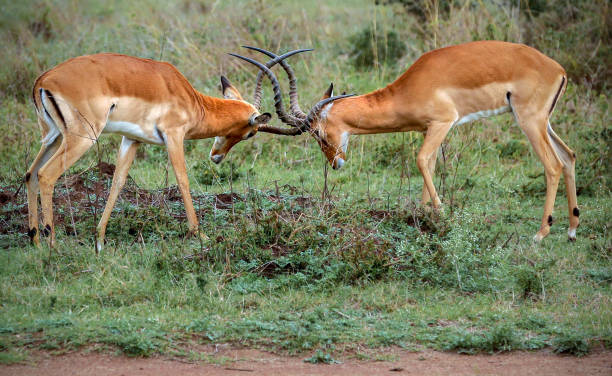
14. Do Male Gazelles Fight?
Yes. Males of both species compete during reproductive activity.
A territorial male may chase rivals, display his horns or engage in physical confrontation.
When fighting occurs, two males may lower their heads and lock horns.
The animals push and twist in an attempt to force the rival away.
Some encounters are brief, while others involve repeated clashes.
Not every confrontation results in injury.
Displays and withdrawals can settle competition without prolonged fighting.
These interactions can provide memorable wildlife encounters during a game drive.
15. When Are Gazelle Calves Born?
Both Grant’s and Thomson’s gazelles usually produce a single calf after a pregnancy of approximately six months, although gestation varies.
Birth timing is influenced by habitat and seasonal conditions.
Young calves may remain concealed in vegetation during their earliest days.
Their mothers return to nurse and protect them.
As calves develop, they become more mobile and gradually join other gazelles.
For visitors, a young gazelle lying quietly in grass should not automatically be considered abandoned.
Never approach or disturb a concealed calf.
16. Where Can You See Both Species on Safari?
Kenya and Tanzania provide some of the best opportunities to compare these two gazelles.
The Serengeti–Mara ecosystem is particularly useful because both species occur in suitable areas.
East African Gazelle Viewing Guide
| Destination | Country | Gazelle Viewing |
|---|---|---|
| Serengeti National Park | Tanzania | Both species in suitable plains habitats |
| Maasai Mara National Reserve | Kenya | Good opportunities to compare both |
| Ngorongoro Conservation Area | Tanzania | Both species in suitable grasslands |
| Amboseli National Park | Kenya | Gazelles in open savannah habitats |
| Parts of northern Kenya | Kenya | Grant’s gazelles and other dry-country antelopes |
| Pian Upe Wildlife Reserve | Uganda | Grant’s gazelle in suitable habitats |
Wildlife sightings depend on season, habitat and animal movements. Neither species is guaranteed on a particular drive.
17. How to Identify Gazelles During a Game Drive
When your guide points towards a distant gazelle, begin with its general appearance.
Does the animal look relatively tall and pale, or small with a bold dark stripe?
Then look at its rump.
Finally, check the horns and facial markings.
Five-Step Identification Checklist
- Check the size: Grant’s is usually larger.
- Look at the side stripe: Thomson’s usually has a bold black band.
- Examine the rump: Grant’s has more white extending above the tail.
- Compare the horns: Grant’s males generally have longer horns.
- Consider the habitat: Use location as supporting evidence, not proof.
Using several features together will make your identification more reliable.
18. How to Photograph Both Gazelles
Photographing gazelles can be challenging because they are alert and move quickly.
A telephoto lens allows visitors to capture natural behaviour without approaching too closely.
Side-on photographs are useful for comparing stripes and body proportions.
Rear photographs can reveal the rump differences.
If both species are standing together, include them in one frame to show the size contrast.
Early morning and late afternoon often provide attractive natural lighting.
Avoid asking your guide to frighten animals into running for dramatic pictures.
19. Why Gazelles Matter in East African Ecosystems
Grant’s and Thomson’s gazelles contribute to the ecological relationships between grasslands, herbivores and predators.
Their grazing influences vegetation.
They also provide food for several carnivores, particularly in ecosystems where gazelles are abundant.
Different feeding preferences allow them to use habitats in complementary ways.
Protecting these antelopes requires maintaining suitable grasslands, wildlife movement corridors and healthy predator-prey relationships.
Although they may seem ordinary beside elephants and lions, gazelles are essential parts of East Africa’s savannah ecosystems.
20. Frequently Asked Questions
What Is the Easiest Way to Tell Grant’s and Thomson’s Gazelles Apart?
Look at the rump. Grant’s gazelles have a broad white patch extending above the tail, while Thomson’s gazelles have a smaller white patch.
Which Gazelle Is Bigger?
Grant’s gazelle is generally larger, taller and heavier than Thomson’s gazelle.
Do Both Gazelles Have Black Side Stripes?
Thomson’s gazelles usually have bold black stripes. Grant’s gazelles often have faint or absent stripes, although some individuals have dark markings.
Do Female Gazelles Have Horns?
Females of both species may have horns, but they are usually smaller than male horns. Some Thomson’s gazelle females are hornless.
Can You See Both Species in Uganda?
Grant’s gazelles occur in parts of northeastern Uganda, but Thomson’s gazelles are not typical of Uganda’s main safari destinations. Kenya and Tanzania offer better opportunities to compare both.
Two Gazelles, Three Important Differences
Grant’s and Thomson’s gazelles are among the most easily confused antelopes on an East African safari.
Their similar colours, slender bodies and curved horns can make identification difficult at first.
However, three features provide a practical starting point: size, the black side stripe and the shape of the white rump patch.
Grant’s gazelles are generally larger and paler, with broad white rump markings. Thomson’s gazelles are smaller, with a more prominent black side stripe and a smaller white rump area.
Both play important roles in Africa’s grassland ecosystems.





No comment