
What to Do When a Male Chimpanzee Charges Past You
Imagine standing quietly in Uganda’s Kibale National Park, watching a group of chimpanzees feeding in the forest. Suddenly, a large adult male begins calling loudly. He shakes branches, rushes across the forest floor and passes close to your group. The entire encounter lasts only seconds, but your heart is racing.
Knowing what to do when a chimpanzee charges can make an important difference during a guided primate safari. Chimpanzees are powerful wild animals, and adult males sometimes perform dramatic displays involving running, vocalisations and striking vegetation.
Although a charging display does not necessarily mean an attack, visitors should never treat it as harmless entertainment. Staying composed and following your ranger’s instructions are essential.
This guide explains why male chimpanzees charge, how to respond safely and what travellers should understand before entering Uganda’s chimpanzee forests.
1. Why Do Male Chimpanzees Charge?
Adult male chimpanzees sometimes perform dominance displays during social interactions.
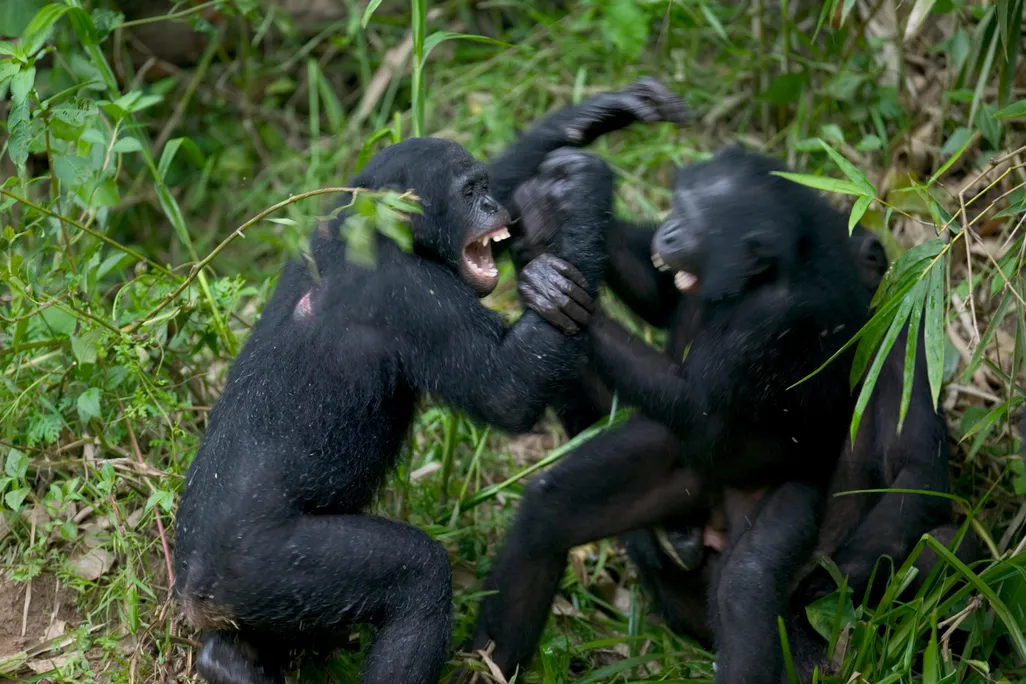
These displays can involve loud pant-hoots, rapid movement, branch shaking and striking tree trunks or the ground.
Males may display when excited, during dominance competition or in response to social tension.
Not every display is directed at people.
A chimpanzee may rush through an area because it is interacting with other community members or travelling during a period of excitement.
However, a charging animal can still be dangerous even when humans are not its intended target.
Understanding this distinction helps visitors respond without panicking or becoming careless.
2. The First Rule: Never Run
Your instinct may tell you to escape when a large chimpanzee rushes towards your group.
However, suddenly running can make an already unpredictable situation more dangerous.
You could fall, collide with another visitor or move directly into the animal’s path.
Running also separates you from the ranger responsible for managing the encounter.
What Should You Do Instead?
Stop unnecessary movement, remain composed and pay attention to your guide.
If the chimpanzee is already charging past you, avoid stepping suddenly into its route.
Do not scream or attempt to frighten it away.
Your ranger is better positioned to assess the animal’s behaviour and direct the group.
3. Avoid Direct Eye Contact
Prolonged direct staring can be interpreted as threatening during some primate interactions.
If a male chimpanzee approaches or displays nearby, avoid fixing your gaze directly on its eyes.
Keep your head and body relaxed.
You can remain aware of the animal’s movement without staring at it.
Do not make exaggerated submissive gestures or suddenly throw yourself to the ground unless your ranger specifically directs you to adopt a particular position.
The appropriate response depends on the chimpanzee’s location and behaviour.
4. Give the Chimpanzee Space
Chimpanzees need room to move through their forest habitat.
During a tracking encounter, visitors should avoid surrounding an animal or blocking its intended route.
If a chimpanzee approaches, your ranger may instruct everyone to remain still or move slowly towards a safer position.
Do not independently decide to cross in front of the animal.
Never attempt to photograph a charging chimpanzee at close range.
Your safety and the animal’s welfare come before obtaining a dramatic image.
5. Follow Your Ranger’s Instructions Immediately
Experienced chimpanzee tracking rangers understand the behaviour of the communities they monitor.
They may recognise individual chimpanzees and their characteristic displays.
During an encounter, the ranger might instruct visitors to stand still, remain together or retreat carefully.
Follow these directions without arguing or attempting to manage the situation yourself.
Why Rangers Matter
Rangers help visitors:
- Maintain appropriate viewing distances.
- Recognise signs of agitation.
- Avoid blocking chimpanzee movement.
- Respond calmly to sudden displays.
- Leave an area when conditions become unsafe.
A guided chimpanzee trek is designed to reduce risks while allowing people to observe natural behaviour.
6. How to Recognise a Male Chimpanzee Display
Chimpanzee displays can be dramatic and noisy.
A displaying male may combine several behaviours.
| Behaviour | What It May Indicate |
|---|---|
| Loud pant-hoots | Excitement or social communication |
| Branch shaking | A display or heightened arousal |
| Rapid running | Dominance display or other intense activity |
| Striking tree trunks | Display behaviour |
| Hair standing upright | Heightened arousal |
| Chasing another chimpanzee | Social conflict or competition |
These behaviours do not have one fixed meaning.
A ranger considers the full situation, including the identities and movements of nearby chimpanzees.
Visitors should not attempt to diagnose an animal’s intentions from one movement or sound.
7. What if the Chimpanzee Passes Extremely Close?
Sometimes a chimpanzee moves closer than the normal viewing distance.
This can happen quickly, particularly when a male is travelling or displaying.
If a chimpanzee passes directly beside you, remain still unless the guide instructs otherwise.
Keep your hands close to your body and avoid reaching towards the animal.
Do not attempt to touch its back, shoulders or fur.
Wait until the chimpanzee has moved away before changing position.
The ranger may then guide the group to a safer viewing area.
8. Can a Chimpanzee Charge Without Attacking?
Yes. Some chimpanzee charges are displays rather than attempts to make physical contact.
A male may rush past a group, strike vegetation or continue moving through the forest.
However, visitors cannot reliably distinguish every display from a potentially dangerous encounter.
Chimpanzees possess powerful muscles, strong jaws and large canine teeth.
Even brief physical contact can cause serious injuries.
For this reason, never assume a charging chimpanzee is simply playing or performing for tourists.
Treat every close charge seriously and follow professional guidance.
9. Common Mistakes Visitors Should Avoid
Certain reactions can increase danger or disturb chimpanzees.
| Avoid | Safer Response |
|---|---|
| Running away suddenly | Stay composed and follow the ranger |
| Screaming or shouting | Keep quiet |
| Staring directly into the eyes | Avoid prolonged eye contact |
| Blocking the chimpanzee’s path | Leave its route clear |
| Trying to touch the animal | Maintain separation |
| Moving closer for photographs | Put the camera down |
| Copying chimpanzee calls | Remain silent |
| Leaving the group | Stay with your guide |
These precautions should be explained during the pre-trekking safety briefing.
10. What if a Chimpanzee Actually Makes Contact?
Physical contact is a different situation from a display that passes without injury.
If a chimpanzee grabs, strikes or attacks a visitor, the group must prioritise immediate safety.
Follow the ranger’s emergency instructions and do not attempt to restrain or fight the animal.
Other visitors should avoid rushing towards the incident unless trained personnel direct them to help.
Once the situation is safe, any person who has been bitten, scratched or otherwise injured should receive urgent medical assessment.
Chimpanzee injuries can involve deep wounds and infection risks.
Report every incident to the ranger and park management, even if the injury initially appears minor.
11. Where Might Travellers Encounter Displaying Chimpanzees?
Chimpanzee displays can occur in any habitat supporting wild chimpanzee communities.
In Uganda, authorised tracking experiences are available in several forest destinations.
| Destination | Chimpanzee Experience |
|---|---|
| Kibale National Park | Guided chimpanzee tracking and habituation |
| Budongo Forest | Guided tracking in designated areas |
| Kyambura Gorge | Guided chimpanzee tracking |
| Kalinzu Forest | Guided chimpanzee tracking |
Displays are part of chimpanzee behaviour, but visitors should not expect a dramatic encounter on every trek.
Many observations involve chimpanzees quietly feeding, grooming, resting or travelling.
12. How Can You Reduce the Risk Before Trekking?
Preparation begins before entering the forest.
Attend the ranger briefing and ask questions about chimpanzee behaviour.
Follow the current minimum viewing distance required by the park.
Avoid wearing loose items that could interfere with movement, and keep camera equipment secured.
Do not eat near chimpanzees or carry food openly during observations.
Never mimic their vocalisations or attempt to attract their attention.
If you are unwell with a contagious illness, postpone the activity because chimpanzees are vulnerable to some human diseases.
Responsible conduct protects both visitors and animals.
13. Are Male Chimpanzees Always Aggressive?
No. Male chimpanzees are not constantly aggressive.
They spend considerable time feeding, grooming and maintaining social relationships.
Adult males can cooperate, form alliances and participate in peaceful interactions.
Dominance displays are only one part of their behaviour.
A powerful male sitting quietly beside another chimpanzee may look completely different from the same individual during an excited display.
Avoid judging an entire species from one dramatic encounter.
14. What Can Visitors Learn From a Charging Display?
A controlled encounter, observed safely under ranger supervision, may provide insight into chimpanzee social behaviour.
Displays can reveal information about excitement, relationships and competition within a community.
Researchers study these behaviours to understand social rank, communication and cooperation.
However, tourists should never attempt to provoke a display for educational purposes or photography.
Natural behaviour is best observed without interference.
Stay Calm and Respect the Chimpanzee
Knowing what to do when a male chimpanzee charges past you is an important part of preparing for a Uganda primate safari.
A sudden charge can be frightening, but panic and unnecessary movement may increase the danger.
Remain calm, avoid running, give the chimpanzee space and follow your ranger’s instructions.
Remember that a display is not necessarily an attack, but every close encounter deserves caution.
The safest chimpanzee experience is one where visitors respect the animals’ behaviour, maintain appropriate distances and allow trained rangers to manage unexpected situations







No comment