
Why the 7 Metre Rule Exists
Why the 7 Metre Rule Exists and What Happens When Gorillas Come Closer
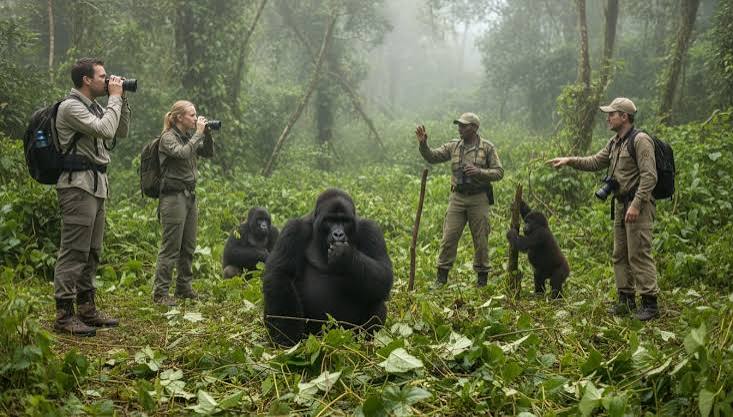
Deep inside Uganda’s Bwindi Impenetrable National Park, eight travellers stand quietly as a mountain gorilla family feeds among the trees. The ranger has positioned everyone at a safe viewing distance. Suddenly, a curious young gorilla leaves its mother and walks towards the visitors.
The group remains still, waiting for instructions. The gorilla pauses, looks around and continues through the vegetation.
Such encounters raise an important question: why does the 7 metre gorilla rule exist if the animals can approach people themselves?
The rule is primarily designed to protect mountain gorillas from human diseases. It also helps reduce disturbance and dangerous encounters.
Understanding the rule, and knowing how to respond when gorillas move closer, helps travellers enjoy responsible gorilla trekking in Uganda and Rwanda.
1. What Is the 7 Metre Gorilla Trekking Rule?
The seven-metre rule establishes a minimum separation between visitors and mountain gorillas during a standard trekking encounter.
Seven metres is approximately 23 feet.
Visitors must not deliberately approach gorillas more closely than the distance specified by park authorities.
The ranger determines where the group should stand.
Although seven metres appears in established Uganda and Rwanda trekking guidance, stricter distances may be required during particular periods or under updated operating procedures.
Always follow the distance announced at your official briefing.
2. Why Is Seven Metres Important?
Mountain gorillas share a close biological relationship with humans.
This makes them susceptible to some human infectious diseases, particularly respiratory infections.
When a person coughs, sneezes, speaks or breathes, infectious particles can enter the surrounding air.
Increasing the distance between people and gorillas helps reduce certain exposure risks.
However, seven metres is not a scientifically guaranteed disease-free boundary.
Transmission risks depend on the pathogen, ventilation, duration of exposure, masks and other factors.
The distance rule is therefore one important precaution among several.
3. Which Human Diseases Can Affect Gorillas?
Conservation specialists are particularly concerned about respiratory infections.
Some viruses that circulate among humans can also infect great apes.
Diseases of concern include influenza, respiratory syncytial virus, human metapneumovirus and other respiratory pathogens.
COVID-19 has also increased attention to infection prevention in great ape tourism.
Why an Infection Can Be Serious
Gorillas live in close family groups.
They groom, rest and travel near one another.
Once an infectious disease enters a group, transmission between individuals may become possible.
Young infants, older gorillas and animals with existing health problems may face additional risks.
This is why visitors who are sick must report their symptoms and should not participate in trekking while potentially contagious.
4. Does Distance Also Reduce Gorilla Stress?
Yes. Maintaining space can help prevent unnecessary disturbance.
Mountain gorillas are generally peaceful animals that spend much of their time feeding, resting and interacting socially.
Visitors approaching too closely may interrupt these activities.
Some gorillas move away from disturbances, while others may display defensive behaviour.
A large silverback may become particularly attentive when unfamiliar people approach his family.
Appropriate distance allows the animals more freedom to continue their natural routines.
5. Why Can’t Visitors Simply Stand Closer for Photographs?
A close photograph is not worth increasing the risk to endangered wildlife.
Moving forward for a better camera angle can reduce the protective distance and interfere with the ranger’s positioning instructions.
Good gorilla photography depends on patience, suitable equipment and natural behaviour.
Visitors can use a modest telephoto lens or appropriate camera zoom instead of approaching.
Flash photography is prohibited.
Even if another person appears closer to the animals, visitors should not assume that moving forward is permitted.
6. What Happens When a Gorilla Approaches You?
Gorillas move freely and do not understand human distance regulations.
A young gorilla may become curious, while an adult may simply be moving towards another feeding area.
If a gorilla approaches, remain calm.
Follow the ranger’s instructions immediately.
Where there is a clear, safe route, the ranger may ask you to step backwards slowly.
If movement could put you in the gorilla’s path or cause a fall, the ranger may direct you to remain still.
Never reach towards the animal.
Immediate Response Guide
| Situation | Recommended Response |
|---|---|
| Gorilla walks closer | Stay calm and follow the ranger |
| Safe space behind you | Step backwards slowly if instructed |
| Gorilla passes nearby | Remain still if directed |
| Young gorilla approaches | Do not touch or encourage it |
| Gorilla appears agitated | Avoid sudden movement and direct staring |
| Gorilla blocks your path | Wait for the ranger’s directions |
There is no single movement that is appropriate in every encounter.
7. What if a Young Gorilla Tries to Touch You?
Young gorillas can be playful and curious.
A juvenile may approach a visitor’s boots, walking stick or clothing.
Although this may seem harmless, visitors must not encourage contact.
Do not offer your hand, reach towards the gorilla or invite it closer.
Touching can introduce disease risks and may cause a protective adult to react.
Keep still or move away only as directed.
The ranger will assess how to restore a suitable distance.
8. What if a Silverback Comes Very Close?
An adult silverback is enormously powerful.
Although habituated silverbacks often tolerate visitors, they remain wild animals.
If one moves towards your group, do not run or make sudden gestures.
Avoid prolonged direct eye contact, particularly if the animal appears agitated.
The ranger may ask everyone to lower their posture, look down or remain still.
Allow the silverback room to continue moving.
Never attempt to challenge, imitate or photograph a threatening display at close range.
9. Can a Gorilla Charge When Visitors Are Too Close?
Yes. Gorillas sometimes use threatening displays when they feel disturbed.
These can involve chest-beating, vocalisations, rapid movement or charges.
Some charges stop without physical contact.
However, visitors cannot safely assume that every charge is a bluff.
The appropriate response is to remain calm and follow the ranger’s instructions.
Do not run, shout or attempt to escape independently.
Respecting viewing distance reduces unnecessary disturbance, although it cannot eliminate every behavioural risk.
10. Does the Rule Apply in Uganda and Rwanda?
Both countries use ranger-led trekking systems designed to protect mountain gorillas.
| Rule | Uganda | Rwanda |
|---|---|---|
| Gorilla trekking parks | Bwindi and Mgahinga | Volcanoes National Park |
| Established viewing buffer | 7 metres in published guidance | 7 metres in official guidance |
| Maximum standard tourists | 8 per family | 8 per family |
| Standard viewing time | 1 hour | 1 hour |
| Flash photography | Prohibited | Prohibited |
| Sick visitors | Must not expose gorillas | Must not expose gorillas |
More cautious spacing or additional health measures may apply.
The official ranger briefing takes priority over older travel articles.
11. What Does Research Say About Close Encounters?
A scientific study published in 2020 investigated visitor behaviour during mountain gorilla tourism in Bwindi.
Researchers observed 53 gorilla trekking encounters conducted in 2014.
They found that the seven-metre distance rule was breached during 52 of those encounters.
Across recorded distance observations, approximately 68% took place within seven metres.
Some close encounters resulted from gorillas approaching people, while others involved tourists moving too close.
These findings demonstrated that understanding the rule does not always result in proper compliance.
They also highlighted the importance of ranger intervention and visitor education.
The figures describe the observed treks, not every gorilla trek taking place today.
12. Why Are Face Masks Important?
Face masks can provide an additional barrier against some respiratory particles.
They work alongside distancing rather than replacing it.
Visitors must follow the current mask requirements of the park they are visiting.
Use an appropriately fitting mask if required, and keep it in position throughout the encounter.
Do not remove it simply because a gorilla comes closer or because you want a photograph.
Visitors with symptoms of contagious illness should not assume that wearing a mask makes trekking acceptable.
13. Why Are Only Eight Tourists Allowed Per Family?
The distance rule works together with the eight-person visitor limit.
Smaller groups are easier to position and supervise in dense forest.
They also reduce the number of people potentially exposing gorillas to infections.
During standard tourism visits, one habituated family normally receives a single tourist group for up to one hour daily.
These measures limit the number and duration of human encounters.
However, trackers, rangers and other authorised personnel must also observe disease-prevention and wildlife-welfare precautions.
14. What if the Forest Is Too Dense to Keep Seven Metres Away?
Mountain gorilla habitats contain thick vegetation, steep slopes and narrow spaces.
Maintaining an appropriate distance can sometimes be difficult.
The correct response is not to push closer for a clearer photograph.
Your ranger may reposition the visitor group, wait for the gorillas to move or select another viewing angle.
Sometimes the best available view will be partly obstructed.
Accepting a less-than-perfect photograph is part of responsible wildlife tourism.
15. How Should Visitors Prepare Before Trekking?
Preparation begins at the briefing point.
Listen carefully to the instructions about viewing distance, health, photography and gorilla behaviour.
Ask questions before entering the forest.
Practical Gorilla Trekking Checklist
- Confirm the current minimum viewing distance.
- Report contagious symptoms honestly.
- Wear a mask if required.
- Remain with the assigned ranger.
- Keep cameras on non-flash settings.
- Do not touch or feed gorillas.
- Avoid sudden movements and loud voices.
- Never move closer without permission.
- Follow instructions if a gorilla approaches.
These precautions make encounters safer and less disturbing.
16. Why Responsible Distance Matters for Conservation
Mountain gorilla tourism contributes to conservation funding, employment and community livelihoods.
However, bringing people into close contact with endangered primates creates responsibilities.
Disease transmission and behavioural disturbance are among the risks conservation authorities must manage.
The seven-metre rule provides a practical standard for separating visitors from gorillas.
Combined with group limits, veterinary monitoring, ranger supervision and health precautions, it helps make tourism more compatible with gorilla welfare.
Every visitor plays a part by respecting these safeguards.
Let Gorillas Remain Wild
The seven-metre rule exists mainly to reduce the risk of human disease transmission and unnecessary disturbance during gorilla trekking.
It is not intended to prevent visitors from enjoying memorable encounters.
Instead, it encourages observation from a respectful distance.
Sometimes gorillas approach people voluntarily. When that happens, visitors should remain calm, avoid touching the animals and follow their ranger’s instructions.
The forest belongs to the gorillas, and they must remain free to move naturally.




No comment