
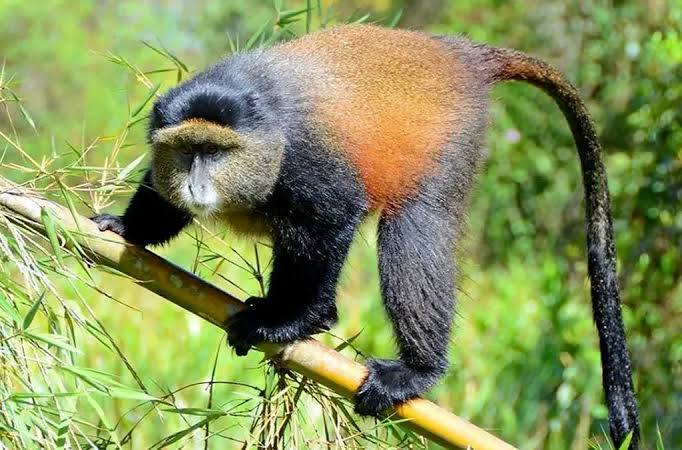
Golden Monkeys and Bamboo: Diet, Speed and Behaviour
High on the volcanic slopes of southwestern Uganda and northern Rwanda, golden monkeys move through thick bamboo forests with remarkable agility. Their orange-gold coats stand out against the green vegetation as they leap between stems, search for fresh shoots and chase one another through the undergrowth.
Golden monkeys and bamboo have a close ecological relationship. Bamboo provides food, shelter and important habitat for these endangered primates. Unlike mountain gorillas, which often spend long periods feeding quietly, golden monkeys can be exceptionally active, making them interesting animals to observe during a guided forest trek.
Understanding their diet, speed and social behaviour helps travellers appreciate why these monkeys are so well adapted to the forests of the Virunga Mountains.
What Are Golden Monkeys?
The golden monkey, Cercopithecus kandti, is a rare African primate closely related to the blue monkey. Some scientific publications classify it as Cercopithecus mitis kandti, a subspecies of the blue monkey.
Golden monkeys are recognised by their bright orange-gold fur, dark limbs, rounded faces and expressive eyes.
Their coats provide an attractive contrast with the bamboo vegetation in which they frequently live.
They are naturally found in parts of the Albertine Rift, particularly the Virunga mountain region shared by Uganda, Rwanda and the Democratic Republic of Congo.
Unlike many widespread African monkeys, golden monkeys have a relatively restricted distribution, making habitat protection especially important.
1. Why Golden Monkeys Depend on Bamboo
Bamboo is one of the most important plants in the golden monkey’s mountain habitat.
It provides feeding opportunities, cover from predators and a network of stems through which the monkeys can travel.
The monkeys frequently use bamboo forests at high elevations, especially where young shoots and leaves are available.
Their relationship with bamboo is particularly strong in Rwanda’s Volcanoes National Park and Uganda’s Mgahinga Gorilla National Park.
How Bamboo Supports Golden Monkeys
| Bamboo Feature | Importance to Golden Monkeys |
|---|---|
| Young shoots | Important seasonal food |
| Tender leaves | Regular feeding resource |
| Stems and branches | Support climbing and movement |
| Dense vegetation | Provides cover and resting areas |
| Seasonal growth | Influences feeding and travel patterns |
However, golden monkeys are not completely dependent on bamboo everywhere.
Research shows that populations in different forests can adjust their diets according to available food.
2. What Do Golden Monkeys Eat?
Golden monkeys are mainly plant eaters, but their diet is more varied than many visitors expect.
Common foods include bamboo leaves, young shoots, fruits, flowers and other vegetation.
They may also consume insects and small invertebrates.
In bamboo-rich forests, shoots and leaves can form a substantial part of their diet.
Why Are Young Bamboo Shoots Important?
Fresh bamboo shoots contain growing plant tissues that golden monkeys can process and eat.
Researchers studying golden monkeys in Rwanda have documented how the animals use their teeth to remove or break through tough outer material.
A 2025 scientific study found that bamboo shoots required more crushing with the back teeth than several other food categories.
This helps explain why feeding behaviour and tooth wear are important subjects in golden monkey research.
3. Does Their Diet Change With the Seasons?
Yes. Golden monkeys change their feeding patterns as different plants become available.
During periods of fresh bamboo growth, they may concentrate on young shoots.
At other times, leaves, fruits and alternative forest foods become more important.
Researchers comparing golden monkey populations in Rwanda found considerable dietary flexibility.
This means the animals do not follow exactly the same feeding pattern throughout the year.
For visitors, seasonal food availability can influence where monkeys are found and how much they move.
However, no single month guarantees the opportunity to watch golden monkeys eating bamboo shoots.
4. How Fast Can Golden Monkeys Move?
Golden monkeys are agile climbers and jumpers.
They can move quickly between bamboo stems, branches and patches of vegetation.
Their long limbs, flexible bodies and strong grasping hands help them navigate uneven forest habitats.
Young monkeys are particularly energetic and may chase one another through the vegetation.
Although some tourism publications provide exact running speeds, reliable species-specific measurements are limited.
It is therefore more accurate to describe golden monkeys as fast, agile forest primates than to claim a particular maximum speed.
Why Are They So Agile?
Golden monkeys use a combination of climbing, leaping and running along vegetation.
Their long tails help maintain balance during movement.
Because bamboo stems can bend, the animals must adjust their position carefully.
During a trek, you may watch one monkey jump between stems while another moves along the forest floor.
These different movements make golden monkeys exciting wildlife subjects.
5. Do Golden Monkeys Live in Groups?
Golden monkeys are social animals that live in groups, often called troops.
Group size varies between habitats and populations.
Some troops contain dozens of monkeys, while others are considerably larger.
A troop may include adult males, females, juveniles and infants.
Within these groups, monkeys spend time feeding, resting, grooming and interacting.
Common Social Behaviours
Visitors may observe golden monkeys:
- Grooming other troop members.
- Playing and chasing one another.
- Feeding together in bamboo patches.
- Carrying and protecting infants.
- Resting on branches.
- Communicating through calls and body movements.
These activities help maintain social relationships and support group life.
6. Why Do Young Golden Monkeys Play So Much?
Young golden monkeys are often among the most active members of a troop.
They chase one another, climb bamboo stems and practise jumping between branches.
Play helps young primates develop physical coordination and social skills.
It may also help them learn how to interact with other group members.
During guided golden monkey tracking, juveniles sometimes provide excellent opportunities for observation because of their energetic behaviour.
However, visitors should never encourage play by offering food or attempting to interact with the animals.
7. How Do Golden Monkeys Communicate?
Golden monkeys use different vocalisations, facial expressions and body movements.
Calls can help individuals remain in contact while feeding in dense vegetation.
Other sounds may be associated with alarm, social tension or interactions between group members.
Because bamboo forests can limit visibility, communication is particularly useful when monkeys become separated.
Researchers investigate these vocalisations to understand group relationships and responses to possible threats.
Visitors should listen quietly and allow guides to explain the sounds.
Never imitate monkey calls or play recordings to attract them.
8. Where Can You See Golden Monkeys in Uganda?
Mgahinga Gorilla National Park is Uganda’s principal destination for golden monkey tracking.
The park lies in southwestern Uganda near Kisoro and forms part of the Virunga mountain landscape.
Its bamboo and montane forest habitats support golden monkeys alongside other wildlife.
Golden Monkey Tracking in Mgahinga
Visitors join an authorised ranger-led trek to locate habituated golden monkeys.
The activity provides opportunities to watch them feeding, travelling and interacting.
Mgahinga also offers a specialised golden monkey habituation experience under separate arrangements.
The difficulty of the walk depends on the troop’s location, terrain and weather.
Although golden monkey tracking is often less demanding than some gorilla treks, visitors should still prepare for slopes, muddy paths and high-altitude conditions.
9. Where Can You See Golden Monkeys in Rwanda?
Volcanoes National Park in northern Rwanda is another established destination for golden monkey tracking.
The park protects volcanic mountains and extensive bamboo habitats.
Visitors normally begin their tracking activities around the Kinigi park headquarters area.
After a briefing, guides lead groups towards habituated golden monkey troops.
The monkeys may be found feeding, resting or moving through bamboo.
Because their movements are unpredictable, viewing conditions vary between visits.
Golden Monkey Tracking: Uganda vs Rwanda
| Feature | Mgahinga, Uganda | Volcanoes, Rwanda |
|---|---|---|
| Main habitat | Bamboo and montane forest | Bamboo and montane forest |
| Main activity | Golden monkey tracking | Golden monkey tracking |
| Special experience | Habituation experience may be available | Guided tracking |
| Nearby attraction | Mountain gorilla trekking | Mountain gorilla trekking |
| Gateway | Kisoro | Musanze |
| Viewing | Wild habituated troops | Wild habituated troops |
Both destinations offer rewarding opportunities to observe golden monkeys in their natural habitats.
Choose according to your wider travel itinerary, accessibility and available permits.
10. Best Time to See Golden Monkeys
Golden monkey tracking is available throughout much of the year, subject to park arrangements.
The relatively drier periods of June to September and December to February often provide more comfortable walking conditions.
However, rainfall remains possible in the Virunga Mountains.
During wetter months, trails may become muddy, but vegetation can be particularly lush.
Golden monkeys remain active throughout the year.
Their movements depend more directly on food availability and local conditions than on tourist seasons.
11. Photography Tips for Fast-Moving Golden Monkeys
Golden monkeys can be challenging to photograph because they move quickly and frequently disappear behind vegetation.
Their bright coats contrast beautifully with green bamboo.
For better photographs:
- Use a camera with a fast autofocus system.
- Choose a sufficiently fast shutter speed for moving animals.
- Photograph monkeys when they pause to feed.
- Look for openings between bamboo stems.
- Avoid flash photography.
- Keep a respectful viewing distance.
Patience is particularly important when photographing young monkeys at play.
Do not disturb wildlife to obtain a clearer view.
12. Are Golden Monkeys Endangered?
Golden monkeys are classified as Endangered.
Their limited range makes them vulnerable to habitat loss and degradation.
Threats include pressures on forests surrounding protected areas and human activities affecting habitat quality.
Bamboo harvesting, agricultural expansion and other disturbances can reduce suitable feeding and shelter areas.
Conservation efforts in the Virunga region focus on habitat protection, research and responsible tourism.
Visitor fees contribute to protected-area management when trekking is conducted through authorised programmes.
Why Bamboo Matters to Golden Monkeys
Golden monkeys and bamboo share an important relationship shaped by food availability, forest structure and survival.
Bamboo provides feeding resources and habitat, while the monkeys’ agility allows them to travel through dense vegetation with impressive speed.
Their playful behaviour, social relationships and distinctive orange-gold colouring make them rewarding primates to observe.
Mgahinga Gorilla National Park in Uganda and Volcanoes National Park in Rwanda offer excellent opportunities to see these endangered monkeys in the wild.
Watching golden monkeys move through bamboo is a reminder that conserving one plant-rich habitat can help protect an entire community of remarkable wildlife.







No comment