
Black-and-White Colobus Monkeys
Black-and-White Colobus Monkeys: How to Spot Them on Forest Walks
Walking through Uganda’s tropical forests offers opportunities to observe wildlife that often goes unnoticed during traditional game drives. High above the forest floor, branches move as monkeys travel between trees. Suddenly, a long white tail appears among the leaves, followed by a black body surrounded by flowing white fur. You have discovered one of Uganda’s most attractive forest primates.
Black-and-white colobus monkeys in Uganda are known for their striking appearance, remarkable jumping abilities and social behaviour. They spend much of their lives in trees, feeding on leaves and moving through the forest canopy.
Although chimpanzees and mountain gorillas attract considerable attention, colobus monkeys offer equally interesting moments during guided nature walks. Knowing where to look, what to listen for and how to recognise their movements can improve your chances of finding them.
What Are Black-and-White Colobus Monkeys?
Black-and-white colobus monkeys belong to the genus Colobus, a group of African leaf-eating primates.
The species commonly encountered in Uganda is the mantled guereza, scientifically known as Colobus guereza.
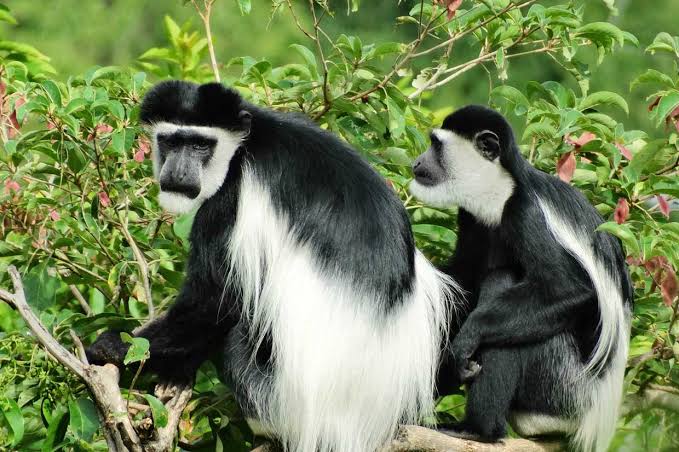
It has a glossy black body, long white hair along its sides, white facial markings and a distinctive tail ending in a large white tuft.
These monkeys are primarily arboreal, meaning they spend most of their lives in trees.
Unlike many other monkeys, colobus have greatly reduced thumbs. Their specialised hands help them grip branches while moving through forest canopies.
1. Look for Their Distinctive Black-and-White Fur
The easiest way to identify a black-and-white colobus monkey is by examining its coat.
Its dark body contrasts with long white hair extending along the shoulders and sides.
This white mantle becomes particularly noticeable when the monkey moves between branches.
The face is dark and surrounded by white hair.
What Should You Look For?
- Glossy black body fur.
- Long white hair along the shoulders and back.
- Dark face framed by white markings.
- Long tail ending in a white tuft.
- Slender body adapted for tree movement.
These features help distinguish colobus monkeys from other primates such as red-tailed monkeys and grey-cheeked mangabeys.
2. Watch for Their Long White Tails
A colobus monkey may remain partly hidden by thick foliage, making its body difficult to see.
However, its long tail can reveal its location.
When a monkey jumps between trees, the white tail often becomes visible against darker vegetation.
Sometimes you may notice the tail before recognising the animal itself.
Experienced safari guides frequently scan branches for white shapes hanging below the canopy.
If you notice unusual movement, stop quietly and examine the area with binoculars.
Avoid shouting or making sudden movements that could disturb the monkeys.
3. Listen for Movement Above the Forest Trail
Forest wildlife is often detected through sound before it becomes visible.
Black-and-white colobus monkeys can produce rustling noises as they travel through vegetation.
Branches may shake or bend when several individuals move between trees.
Adult males also produce loud roaring calls, particularly during territorial communication.
These calls can travel through forest habitats.
Your guide may pause to listen and determine whether the sounds come from colobus monkeys or another species.
However, forest echoes can make it difficult to judge the exact direction of a call.
4. Search the Upper Forest Canopy
Colobus monkeys spend considerable time feeding and resting high in trees.
This makes the upper canopy one of the most important places to search.
During a guided forest walk, many visitors concentrate on the trail directly ahead.
However, regularly looking upward may reveal monkeys resting on branches.
Search trees with clear openings between leaves.
You may see a monkey sitting quietly, grooming another individual or reaching for leaves.
Use binoculars to examine distant branches without approaching the animals.
5. Watch for Groups Rather Than Individual Monkeys
Black-and-white colobus monkeys are social animals.
They commonly live in groups containing adult males, females and young individuals.
Group size varies according to habitat and local conditions.
When you find one monkey, examine nearby branches for others.
You may notice younger individuals playing while adults feed or rest.
Sometimes several monkeys travel through the canopy together.
Watching group interactions can provide interesting opportunities to learn about primate social relationships.
6. Look Around Trees With Fresh Leaves
Leaves form an important part of the colobus monkey’s diet.
These primates have specialised digestive systems that help process fibrous vegetation.
They also consume other plant materials, including fruits, flowers and seeds.
During forest walks, guides may inspect trees known to provide preferred food.
If monkeys are feeding nearby, you might notice leaves moving or small pieces of vegetation falling.
However, falling leaves can have many causes, so additional observations are necessary.
Your guide can explain the food plants used by colobus monkeys in the particular forest.
7. Visit Forests Where Colobus Monkeys Are Commonly Seen
Choosing a suitable destination improves your opportunities for observing colobus monkeys.
Uganda protects several forests supporting this species.
Kibale National Park
Kibale is among Uganda’s best destinations for primate observation.
Black-and-white colobus monkeys occur alongside chimpanzees, red colobus and several other monkey species.
Guided nature walks provide opportunities to observe canopy wildlife.
Bwindi Impenetrable National Park
Bwindi is famous for mountain gorilla trekking, but it also supports black-and-white colobus monkeys.
Visitors may notice them during authorised forest walks or while travelling towards gorilla trekking areas.
Budongo Forest
Budongo Forest, near Murchison Falls National Park, supports black-and-white colobus monkeys.
Guided walks in appropriate forest areas may provide opportunities to observe them.
Bigodi Wetland Sanctuary
Bigodi, near Kibale, offers guided walks through wetland and woodland habitats.
Colobus monkeys may be observed in suitable forested sections.
Best Places to See Black-and-White Colobus Monkeys in Uganda
| Destination | Main Habitat | Recommended Activity |
|---|---|---|
| Kibale National Park | Tropical forest | Guided forest walks |
| Bwindi Impenetrable National Park | Montane forest | Guided nature walks |
| Budongo Forest | Tropical forest | Guided forest walks |
| Bigodi Wetland Sanctuary | Wetland and woodland | Community nature walks |
| Selected forest areas around Fort Portal | Forest fragments | Authorised guided walks |
Sightings depend on forest conditions, animal movements and the particular route used.
8. Visit During Active Feeding Periods
Black-and-white colobus monkeys are active during daylight.
They divide their time between feeding, resting, grooming and travelling.
Early morning can provide enjoyable opportunities to observe forest wildlife.
However, colobus monkeys may also remain visible later in the day.
Their activity depends on temperature, food availability and social behaviour.
There is no single hour that guarantees sightings.
Choose a guided walk that allows time for patient observation rather than rushing through the forest.
9. Learn the Difference Between Colobus and Other Monkeys
Several monkey species inhabit Uganda’s forests.
Recognising their physical differences can improve your wildlife identification skills.
| Monkey Species | Distinguishing Features |
|---|---|
| Black-and-white colobus | Black body, white mantle and tufted tail |
| Ugandan red colobus | Reddish-grey coat and dark facial features |
| Red-tailed monkey | Dark body with reddish tail colouring |
| Blue monkey | Greyish body and pale throat markings |
| L’Hoest’s monkey | Dark coat and prominent white beard |
Your guide can help confirm uncertain identifications.
Remember that lighting conditions and distance may affect how an animal’s colours appear.
10. Photograph Colobus Monkeys Without Disturbing Them
Black-and-white colobus monkeys are attractive subjects for wildlife photography.
Their contrasting colours can create beautiful images against green forest backgrounds.
However, photographing animals high in trees can be challenging.
Use a camera with optical zoom and focus on the monkey’s face when visible.
Try photographing individuals resting on open branches or jumping between trees.
Avoid flash photography and never throw objects or make noises to encourage movement.
Patience produces better opportunities than disturbing wildlife.
11. What Makes Colobus Monkeys Special?
Black-and-white colobus monkeys have several interesting biological adaptations.
Their reduced thumbs help form hook-like hands suited to movement through branches.
Their compartmentalised stomachs support microbial fermentation, helping them digest leaves and other fibrous plant foods.
Newborn guereza colobus monkeys are mostly white, developing darker adult colouring as they grow.
They also use vocal communication and social interactions to maintain relationships within groups.
These characteristics make them fascinating animals to observe during a primate safari.
12. Are Black-and-White Colobus Monkeys Endangered?
The mantled guereza is currently classified as Least Concern on the IUCN Red List.
However, this does not mean every local population is secure.
Habitat destruction, forest fragmentation and hunting can affect particular populations.
Protecting forests remains important because colobus monkeys depend heavily on trees for feeding, shelter and movement.
Responsible tourism can support conservation by contributing to protected-area management and local livelihoods.
How to Prepare for a Colobus Monkey Forest Walk
A comfortable forest walk begins with suitable preparation.
Carry:
- Comfortable hiking shoes with good grip.
- Long trousers and a lightweight shirt.
- Rain jacket.
- Drinking water.
- Binoculars.
- Camera with optical zoom.
- Insect repellent.
- Small backpack.
Forest trails can become muddy after rainfall.
Walk quietly, remain with your guide and follow all protected-area regulations.
Never feed or attempt to touch wild monkeys.
Finding Black-and-White Colobus Monkeys
Black-and-white colobus monkeys are among Uganda’s most recognisable forest primates.
Their beautiful coats, long white tails and remarkable ability to move through trees make them enjoyable animals to observe.
Kibale, Bwindi, Budongo and Bigodi offer worthwhile opportunities to search for them during authorised forest activities.
Learning to identify their calls, feeding behaviour and movements can make your forest experience more rewarding.
The next time you walk through a Ugandan forest, remember to look above the trail. A black-and-white colobus monkey may already be watching from the branches.


No comment