Topi Antelope: Uganda’s Fastest and Least-Photographed Grazer
There is a quiet tragedy in the world of wildlife photography. The topi antelope is one of the most striking animals on the savannah, with its sleek mahogany coat, elegant build, and hauntingly beautiful blue-black patches on its legs and face. It is also one of the fastest antelopes in Africa, capable of outrunning most predators in a straight sprint. And yet, it is almost always overlooked.
The lions get the clicks. The elephants get the likes. The topi gets a passing glance and a muttered “what is that?” before the camera swings back to something more famous. It is time to change that.
What Is a Topi?
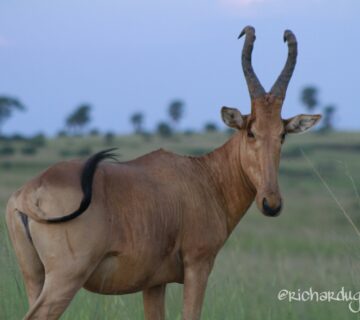
The topi is a large antelope, closely related to the tsessebe and the korrigum. It stands about a metre tall at the shoulder and weighs up to a hundred and fifty kilogrammes. Its coat is a rich, reddish-brown that glows like polished wood in the morning light. The face and legs are marked with dark blue-black patches that give it a striking, almost theatrical appearance.
Males and females both carry horns, though the males’ horns are thicker and more heavily ridged. The horns sweep backwards and then curve upwards, giving the topi a look of perpetual alertness.
But what truly sets the topi apart is its speed. It can reach up to eighty kilometres an hour, making it one of the fastest antelopes in Africa. Only the cheetah is reliably faster, and even then, the topi can match the cheetah’s pace for a while.
Why Is It So Fast?
The topi’s speed is not just for show. It lives in open grasslands where predators are always watching. There is nowhere to hide on the plains. A topi cannot melt into the bushes or disappear into the reeds. Its only defence is its legs.
This speed is also tied to its feeding habits. Topis are grazers, and they rely on the fresh, nutritious grasses that grow after the rains. In the dry season, they must travel long distances to find good grazing. Speed helps them cover ground quickly and efficiently.
Their social structure also plays a role. Topis live in large herds, sometimes numbering in the hundreds. When a predator approaches, the herd erupts into a chaotic stampede. In that kind of chaos, speed is everything. The slow ones do not survive.
Behaviour: A Life on the Plains
Topis are intensely social animals. They form large herds, but within those herds, there is a complex social structure. Males establish territories and defend them fiercely. They stand on elevated mounds or termite hills, scanning the plains for rivals and predators. When a rival approaches, the territorial male performs a display, prancing and leaping to show off his strength.
Females move between territories, and they are often followed by a dominant male who guards them closely. During the breeding season, the competition gets fierce. Males fight for dominance, locking horns and pushing each other in tests of strength.
Despite their speed, topis are not particularly aggressive. They rely on their numbers and their legs to stay safe. They are vigilant, always watching, always ready to run.
Where to See Topis in Uganda
Unlike other antelope species, topis are not widespread in Uganda. They are restricted to a few specific areas, which makes them a more challenging sighting.
Kidepo Valley National Park
This is the undisputed topi capital of Uganda. Kidepo’s vast, open plains are perfect for them. They are most common in the Narus Valley, where they graze alongside buffalo, kobs, and zebras. The park’s remoteness means fewer visitors, which means you can watch topis without the crowds. It is the best place in the country to photograph them.
Murchison Falls National Park
There is a small, isolated population of topis in Murchison Falls. They are found on the northern bank of the Nile, in the savannah grasslands. They are not as numerous here as in Kidepo, but they are still present. The open terrain makes them easier to spot, and they are often seen grazing near the river.
Queen Elizabeth National Park
Topis are absent from the main parts of Queen Elizabeth, but there have been occasional sightings in the Ishasha sector. They are not a resident population, but isolated individuals have wandered in from neighbouring areas.
Why Are They So Under-Photographed?
The answer is simple. Topis are shy and they are fast. They do not pose for the camera. They do not sit still and stare into the lens. They are always moving, always watching, always ready to bolt.
Their habitat also works against them. The open plains make them visible from a distance, but the heat haze and the vast distances make them difficult to photograph well. You need good light, a steady hand, and a lot of patience.
But the real reason is that they are just not famous. Tourists come to Uganda for the gorillas, the tree-climbing lions, and the chimpanzees. The topi is not on the bucket list. It is not on the posters. It is not in the brochures. It is just there, grazing quietly, waiting for someone to notice.
A Day with the Topis of Kidepo
Imagine this. You wake up before dawn in Kidepo. The air is cold and dry. You climb into the safari vehicle, wrapped in a jacket, still half asleep. The sun rises over the Narus Valley, and the grass turns golden. You drive out onto the plains, and there they are.
A herd of topis stands in the distance, their coats glowing in the early light. They are spread out across the valley, grazing in small groups. A territorial male stands on a termite mound, watching you with calm suspicion. He stamps his foot and snorts, a warning to the others.
You stop the vehicle and kill the engine. The topis relax. They resume grazing, and you watch them through your binoculars. The sun warms the air, and the valley comes alive. Zebras whistle in the distance. A leopard moves through the shadows. The topis stay where they are, a constant presence on the plains.
You take a photograph. It is not perfect. The light is tricky. The topi moved at the last second. But it does not matter. You saw them. You watched them. You understood them.
The Future of the Topi in Uganda
The topi is classified as Least Concern globally, but in Uganda, its population is fragile. Kidepo is its stronghold, and the park’s remoteness has protected it from the pressures of agriculture and development. But threats remain. Poaching is a risk, and climate change is altering the grasslands. The topi needs good grazing, and good grazing depends on rain.
Tourism can help. When visitors come to Kidepo to see topis, they bring revenue that supports anti-poaching patrols, habitat management, and community conservation programmes. The more people value the topi, the more resources go into protecting it.
Final Thoughts
The topi is not the most famous antelope in Uganda. It is not the most beautiful, the most elegant, or the most photographed. But it is fast. It is resilient. It is a survivor. And when you see it on the plains of Kidepo, with the sun at its back and the wind in its mane, you will understand why it has earned its place in the savannah.
So on your next safari, give the topi a second glance. Watch it run. Watch it stand guard on its termite mound. Watch it graze with its herd in the golden light. And if you manage to get a photograph, hold onto it. You have captured something rare, something most visitors overlook.
And that is worth more than any lion shot.