Jackson’s Hartebeest in Kidepo: The Northern Park’s Signature Animal
There is something ancient about the hartebeest. It has been around for millions of years, long before the first humans walked the savannah. Its face is long and narrow, its horns curve in a strange, twisted shape that seems almost impossible, and its gait is a loping, rocking motion that looks like it might collapse at any moment. It does not move with the grace of an impala or the elegance of a kudu. It moves like it has no time for appearances. And that is precisely its charm.
In Uganda, the hartebeest is a northern phenomenon. Specifically, it is a Kidepo phenomenon. The Jackson’s hartebeest, a subspecies found only in this corner of the country, is the signature animal of Kidepo Valley National Park. It is not the most famous animal in the park. The lions and the elephants get that honour. But if you ask the rangers, the guides, the people who know Kidepo best, they will tell you that the hartebeest is the heart of the place.
What Is a Jackson’s Hartebeest?
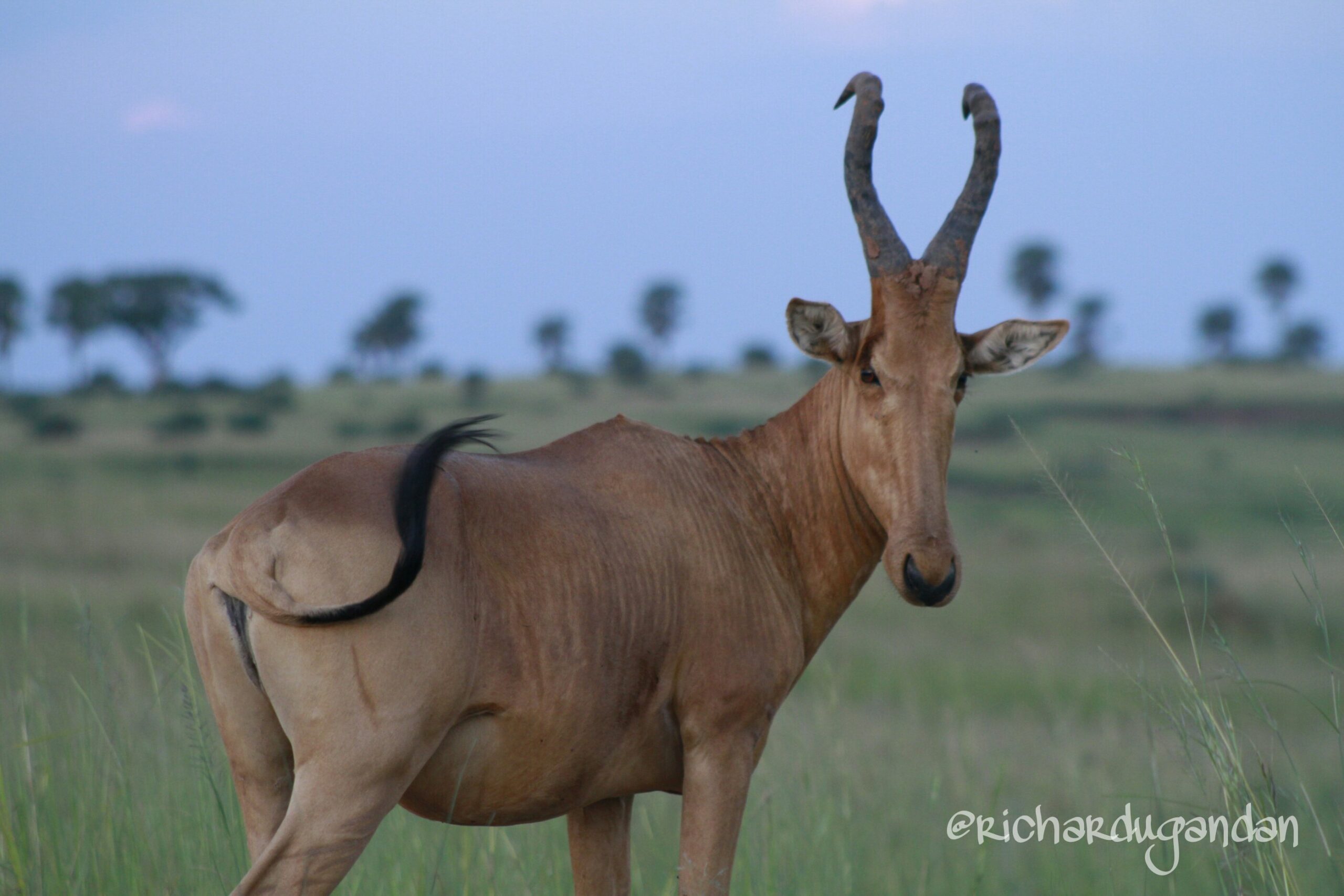
The Jackson’s hartebeest is a subspecies of the common hartebeest, found only in Uganda and parts of South Sudan. It is smaller than other subspecies, with a coat that ranges from sandy brown to a darker, almost tawny shade. Its most distinctive feature is its face. It is long and narrow, with a pronounced forehead that makes it look perpetually thoughtful.
The horns are the real showstopper. They grow in a shape that defies logic. They curve outward, then upward, then forward, then backward, ending in sharp points that look like they were designed by a committee. Both males and females carry horns, though the males’ horns are larger and more heavily ridged.
Standing at about a metre and a quarter at the shoulder, the hartebeest is a large antelope, weighing up to a hundred and sixty kilogrammes. It is built for endurance, with powerful shoulders and long legs that carry it across the plains with surprising speed.
Why Kidepo?
Kidepo Valley National Park is the only place in Uganda where you can reliably see Jackson’s hartebeest. The park’s vast, open plains are perfect for them. They need space to roam, and Kidepo has space in abundance. The Narus Valley, in particular, is their stronghold. Here, they graze alongside zebras, kobs, and buffalo, their strange faces standing out against the golden grass.
The population in Kidepo is stable but small. There are thought to be around a few hundred individuals, which makes them a special sighting. They are not as numerous as the kobs or the waterbucks, but they are not endangered. They are just localised, tied to this one special place.
Behaviour: The Social Life of a Hartebeest
Hartebeests are social animals. They form herds that can range from a handful of individuals to groups of over twenty. The herds are usually made up of females and their young, with a dominant male guarding the group. Bachelor males form their own herds until they are strong enough to challenge for dominance.
They are grazers, feeding almost entirely on grass. They are not picky eaters. They will eat whatever grass is available, which is a useful trait in Kidepo’s dry environment. They are also incredibly water-dependent. They need to drink daily, which means they are never far from water sources.
During the heat of the day, hartebeests rest in the shade, chewing their cud and watching the world go by. They are most active in the early morning and late afternoon, which makes them perfect for game drives.
When threatened, hartebeests do not panic. They are alert and watchful, but they are not skittish. They will stand their ground, sizing up the threat before deciding whether to run. And when they do run, they run with that strange, loping gait that looks so awkward but is actually highly efficient. They can maintain a steady pace for long distances, which makes them difficult for predators to catch.
The Strange Face and the Myths
The hartebeest has always been a creature of folklore. Its strange face has inspired stories across Africa. Some communities believe that the hartebeest is a trickster, a cunning animal that can outwit even the cleverest predators. Others see it as a symbol of endurance and resilience. It is not the fastest animal, and it is not the strongest, but it survives.
In Uganda, the hartebeest has a special place in the culture of the Karamojong people, who live around Kidepo. They have lived alongside the hartebeest for generations, and they have learned to respect it. The hartebeest is not hunted for sport. It is hunted for food, but only when necessary, and with great respect.
Best Spots for Seeing Hartebeest in Kidepo
Kidepo is a big park, and the hartebeests are not everywhere. You need to know where to look.
Narus Valley
This is the heart of Kidepo. The Narus Valley is a vast, open plain with a permanent water source, which makes it a magnet for wildlife. The hartebeests are here in good numbers, grazing alongside the zebras and the buffalo. They are easiest to spot in the early morning, when the light is soft and the animals are active.
Kidepo River Valley
The Kidepo River Valley is more remote than the Narus Valley, but it is worth the journey. The landscape is dramatic, with steep hills and scattered woodlands. The hartebeests here are less disturbed, which means they are more relaxed and easier to observe.
Open Plains
The open plains of Kidepo are good for hartebeest sightings, particularly during the dry season. The grass is shorter, and the animals are concentrated near water sources. Keep your binoculars handy and scan the horizon. The hartebeests’ strange faces stand out against the grass, even from a distance.
A Morning with the Hartebeests
You wake up early in Kidepo. The sun has just risen, and the air is cold. You drive out into the Narus Valley, and there they are. A herd of hartebeests stands in the distance, their strange faces catching the light. They are grazing peacefully, moving slowly across the grass.
You stop the vehicle and watch. One of the males stands on a termite mound, scanning the plains. He looks ancient, like he has been standing there for centuries. His horns catch the light, and for a moment, he is the only animal in the world.
The herd moves on, and you follow them. They are not bothered by your presence. They know the vehicles, and they know the rangers. They have learned that humans are not always a threat. They go about their business, and you watch. It is a quiet moment, a moment of connection between you and an animal that has been here long before the park was ever created.
Why the Hartebeest Matters
The hartebeest is not the most famous animal in Uganda, and it is certainly not the most photographed. But it is important. It is a symbol of Kidepo, and Kidepo is a symbol of Uganda’s wild places. The park is remote, untamed, and fiercely beautiful. The hartebeest fits that description perfectly.
Tourism matters for the hartebeest. When visitors come to Kidepo to see them, they bring revenue that supports conservation. They pay park fees that fund anti-poaching patrols and habitat management. They create jobs for local communities, which gives people a reason to protect the animals rather than hunt them.
The hartebeest is not endangered, but it is vulnerable. Its population is small, and its habitat is limited. It needs protection, and protection requires resources. Tourism is the most sustainable way to provide those resources.
Final Thoughts
The Jackson’s hartebeest is a quiet animal. It does not roar. It does not trumpet. It does not perform for the camera. It just lives its life, grazing on the plains of Kidepo, raising its young, and watching the world go by.
That is why it is special. It is a reminder that the savannah is not just about the big, dramatic moments. It is about the quiet ones too. It is about standing in the morning light, watching an ancient animal go about its ancient business, and feeling a small piece of that continuity.
So on your trip to Kidepo, give the hartebeest your attention. Watch it graze. Watch it move. Watch it stand on its termite mound, looking out over the valley like a king surveying his kingdom. It is not a lion. It is not an elephant. But it is Kidepo. And Kidepo would not be Kidepo without it.