Uganda’s Mongoose Species: The Small Carnivores Most Visitors Overlook
Uganda is renowned for its towering gorillas, tree-climbing lions, and massive elephant herds. Yet, scurrying beneath the notice of most safari-goers is a fascinating group of small carnivores: the mongooses. With their elongated bodies, quick movements, and complex social lives, these often-overlooked creatures are a vital part of Uganda’s ecosystems. This guide explores the mongoose species found in Uganda, their behaviors, where to find them, and why they deserve a second look.
What Are Mongooses?
Mongooses are small terrestrial carnivores belonging to the family Herpestidae. They are native to Africa, Asia, and southern Europe, but Africa holds the greatest diversity. Despite popular belief, mongooses are not rodents; they are closely related to civets and cats. They are characterized by:
Long, slender bodies with short legs
Tapered, pointed snouts
Small, rounded ears
Non-retractable claws (used for digging)
Thick tails, often longer than their bodies
Most species are diurnal (active by day), and many live in highly social groups, though some are solitary.
Why Are Mongooses Overlooked?
Several factors contribute to the mongoose’s low profile on Ugandan safaris:
Size: Most mongooses are small—ranging from 25 to 60 cm in length—making them easy to miss in tall grass or dense undergrowth.
Speed: They are quick and darting, often disappearing into burrows or rock crevices the moment they sense movement.
Camouflage: Their earthy browns, greys, and banded coats blend seamlessly with savanna soils and forest floors.
Focus on Big Game: Visitors naturally prioritize elephants, buffalo, and primates, leaving smaller fauna to the keen-eyed naturalist.Yet, for those who pause and look down, mongooses offer some of the most entertaining and socially complex wildlife viewing in the country.
Mongoose Species Found in Uganda. 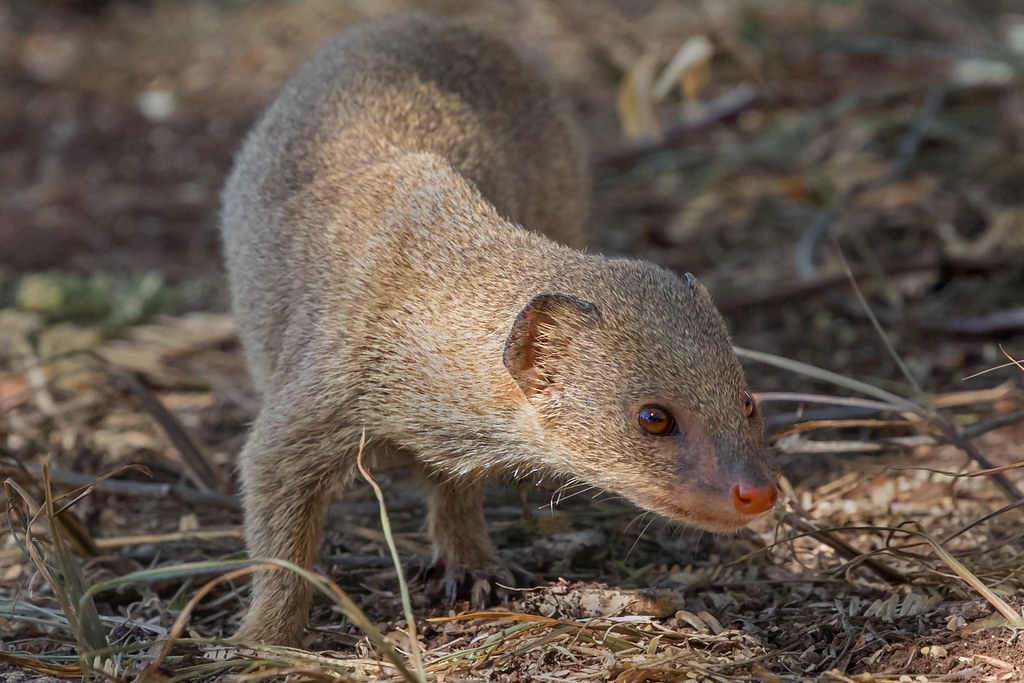
Uganda hosts at least eight mongoose species, spread across its diverse habitats—from dry savannas to rainforests and wetlands. Below are the most notable.
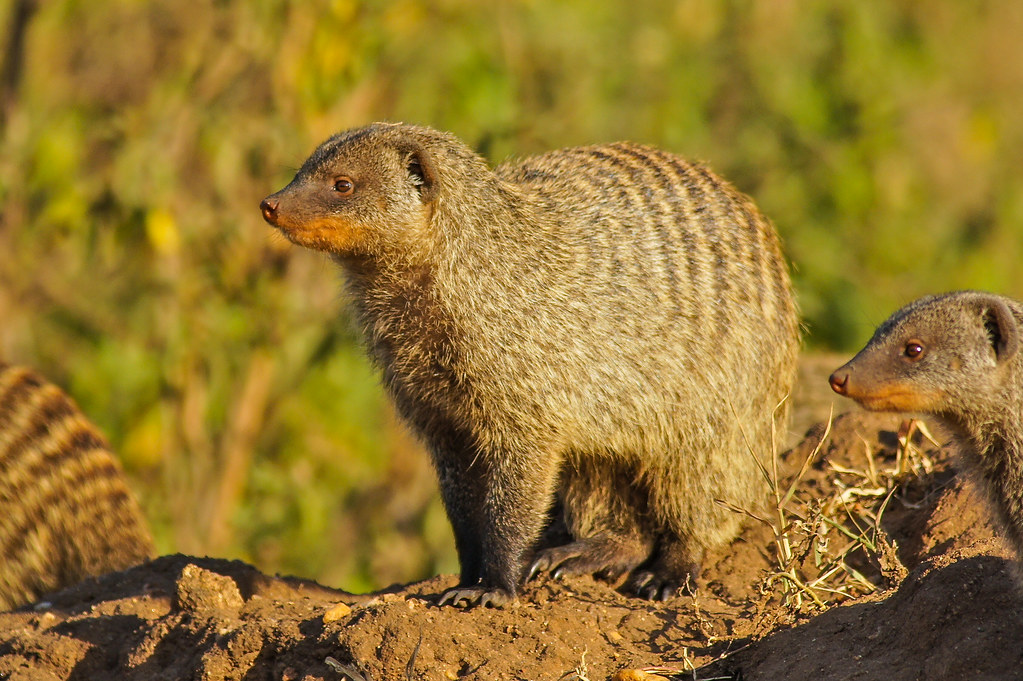
Banded Mongoose
The banded mongoose is one of the most widespread and socially advanced species in Uganda.
Appearance: Greyish-brown with dark transverse bands across the back and rump.
Size: About 30–45 cm long, with a 20–30 cm tail.
Social Structure: Lives in large groups of 10 to 40 individuals, with a strict hierarchy and communal pup-rearing.
Habitat: Savannas, woodlands, and grasslands, often near termite mounds or rocky outcrops.
Best Viewing: Queen Elizabeth National Park, Murchison Falls National Park, and Kidepo Valley National Park.
They are often seen foraging as a troop, digging for insects, small reptiles, and millipedes, all while chattering constantly to maintain group cohesion.
Dwarf Mongoose
Africa’s smallest carnivore, the dwarf mongoose, is a tiny but tenacious predator.
Appearance: Reddish-brown to dark brown, with a pointed snout and short tail.
Size: Only 18–28 cm long, with a tail of 12–18 cm.
Social Structure: Lives in groups of 2 to 20, often using termite mounds as dens.
Habitat: Dry savanna, scrubland, and open woodland.
Best Viewing: Kidepo Valley National Park, Pian Upe Wildlife Reserve, and Lake Mburo National Park.Dwarf mongooses often associate with hornbills—a classic mutualistic relationship where the birds give alarm calls while the mongooses flush out insects.
Slender Mongoose
The slender mongoose is a solitary and agile hunter, often seen alone or in pairs.
Appearance: Long, sleek body with a reddish-brown or grey coat and a distinctive black-tipped tail.
Size: 25–40 cm long, with a tail up to 30 cm.
Behavior: Diurnal and highly arboreal; it climbs trees readily to raid bird nests.
Habitat: Woodlands, forest edges, and riverine thickets.
Best Viewing: Budongo Forest, Kibale Forest National Park, and Semuliki Valley.Unlike social mongooses, the slender mongoose is secretive and relies on stealth to catch rodents, birds, and insects.
White-Tailed Mongoose
The largest mongoose in Uganda, the white-tailed mongoose, is also the most nocturnal.
Appearance: Dark grey to black body with a striking white or pale-grey bushy tail.
Size: 50–60 cm long, with a tail of 40–50 cm.
Behavior: Nocturnal and largely solitary; feeds on insects, crabs, small mammals, and fruit.
Habitat: Forests, wetlands, and riverine areas.
Best Viewing: Rarely seen on day safaris; best detected by night drives or spotlighting in Queen Elizabeth and Murchison Falls.Its powerful forelimbs make it an excellent digger, often excavating burrows for prey or shelter.
Marsh Mongoose
As the name suggests, this species thrives in wetland environments.
Appearance: Stocky build with shaggy dark brown to black fur and a white-tipped tail.
Size: 40–50 cm long, with a tail of 25–35 cm.
Behavior: Solitary or in pairs; active during the day and twilight.
Habitat: Swamps, marshes, lakeshores, and papyrus beds.
Best Viewing: Mabamba Swamp, Lake Mburo, and the fringes of the Nile in Murchison Falls.It feeds heavily on crabs, frogs, and fish, making it an ecological link between aquatic and terrestrial food webs.
Egyptian Mongoose
A rare and elusive species in Uganda, the Egyptian mongoose has a limited distribution.
Appearance: Grizzled grey-brown coat with a speckled appearance and a dark tail tip.
Size: 40–50 cm long, with a tail of 30–40 cm.
Behavior: Diurnal and territorial; often solitary or in pairs.
Habitat: Dry savanna, bushlands, and cultivated areas near water.
Best Viewing: Rare; occasional sightings in Kidepo Valley and along the eastern border near Kenya.It is known for its ability to prey on venomous snakes, using agility and thick fur to avoid bites.
Meller’s Mongoose
Meller’s mongoose is a large, social species found in Uganda’s eastern grasslands.
Appearance: Uniform reddish-brown to greyish-brown, with a thick, bushy tail.
Size: 45–55 cm long, with a tail of 30–40 cm.
Behavior: Lives in small family groups; active during the day.
Habitat: Open savanna, woodland mosaics, and rocky hills.
Best Viewing: Kidepo Valley National Park and Pian Upe Reserve.
This species is one of the least studied and most rarely photographed in Uganda, making any sighting special.
Ichneumon Mongoose
Also known as the large grey mongoose, this species was historically introduced to some regions but may have native populations in northeastern Uganda.
Appearance: Slender grey body with a long, tapering tail and a distinctive white-tipped tail.
Size: 45–55 cm long.
Behavior: Solitary, diurnal, and often found near water.
Habitat: Savanna and riparian woodlands.
Best Viewing: Extremely rare; possibly present in Kidepo Valley.
Ecological Roles of Mongooses
Mongooses are essential players in Uganda’s food webs:
Pest Control: They consume large numbers of insects, rodents, and reptiles, regulating populations that could otherwise damage crops or spread disease.
Seed Dispersal: Some species eat fruit and disperse seeds across habitats.
Prey Base: They are themselves prey for larger carnivores such as pythons, eagles, leopards, and jackals.
Ecosystem Engineers: Burrowing species aerate soil and create microhabitats for other creatures.
Best National Parks for Mongoose Watching
While mongooses occur countrywide, certain parks offer higher chances of observation.
Kidepo Valley National Park
Uganda’s most remote park is a mongoose hotspot. With its arid savanna and abundant rocky outcrops, Kidepo supports banded, dwarf, slender, Egyptian, Meller’s, and white-tailed mongooses.
Queen Elizabeth National Park
The park’s diverse habitats—from savanna to wetland—host banded, slender, marsh, and white-tailed mongooses. The Kasenyi Plains and Ishasha sector are particularly good.
Murchison Falls National Park
The northern savanna and riverine forests are home to banded, slender, white-tailed, and marsh mongooses. Early morning game drives often reveal troops on the move.
Lake Mburo National Park
This smaller park is excellent for dwarf and marsh mongooses, especially along the swamp fringes and acacia woodlands.
Kibale and Budongo Forests
These rainforests are prime territory for the slender mongoose and occasionally the white-tailed mongoose, though sightings require patience.
Behavioral Highlights
Sociality
Banded and dwarf mongooses live in cooperative groups with complex communication. They use over 20 distinct vocalizations for alarm, foraging, and social bonding. Group members groom each other, share food, and even babysit pups communally.
Mating and Reproduction
Most species breed once or twice a year. In social species, only the dominant pair typically breeds, while subordinates help raise offspring. Gestation lasts 60–80 days, and litters range from two to four young.
Foraging Strategies
Mongooses use a combination of olfaction and vision to locate prey. They dig with their foreclaws, flip stones, and probe crevices. Some species follow grazing ungulates to catch insects flushed from the grass.
Anti-Predator Tactics
When threatened, mongooses may:
Stand on hind legs to scan
Emit loud alarm calls
Mob predators collectively
Use burrows or rock fissures as refuges
Threats and Conservation
Although most Ugandan mongooses are not globally threatened, they face localized pressures:
Habitat Loss: Conversion of savanna and wetlands to agriculture reduces foraging grounds.
Road Mortality: Many are killed on park roads, especially nocturnal species.
Pesticides: Insecticide use may reduce prey availability.
Exotic Pets and Bushmeat: Though limited, some trapping occurs for local trade.
All mongoose species are protected within Uganda’s national parks and wildlife reserves. However, outside protected areas, they receive little conservation focus. Citizen science and ecotourism can help raise their profile.
Tips for Spotting Mongooses
Go Early: Dawn is peak activity time for diurnal species.
Scan Open Areas: Look along termite mounds, roadsides, and rocky slopes.
Listen: Mongoose troops are noisy—follow chattering and squeaking.
Use Binoculars: Their small size requires magnification from a distance.
Take a Guide: Local rangers know den sites and habitual foraging routes.
Be Patient: Stay still for 10–15 minutes in a promising area; mongooses often emerge after a period of silence.
A Photographer’s Challenge
Mongooses are skittish subjects, but with the right approach, they offer rewarding photography:
Use a telephoto lens (300mm or more)
Shoot in burst mode to capture rapid movements
Focus on the eyes—their bright, alert expressions make portraits
Look for interaction shots: grooming, playing, or foraging as a group
In the wet season, morning light is golden and soft
Conclusion
Uganda’s mongooses are small in stature but large in ecological significance and behavioral intrigue. They are the unsung heroes of the savanna and forest floor, turning over soil, controlling pests, and living out rich social dramas that rival those of better-known mammals. For the traveler willing to slow down and look closely, these small carnivores offer a unique window into the intricate web of life that makes Uganda one of Africa’s premier wildlife destinations.
On your next safari, spare a moment for the streak of grey or the banded troop darting across the track. You may just discover that the smallest creatures leave the biggest impressions.