LHOESTS MONKEY IN UGANDA – GROUND-DWELLING PRIMATE OF THE ALBERTINE RIFT
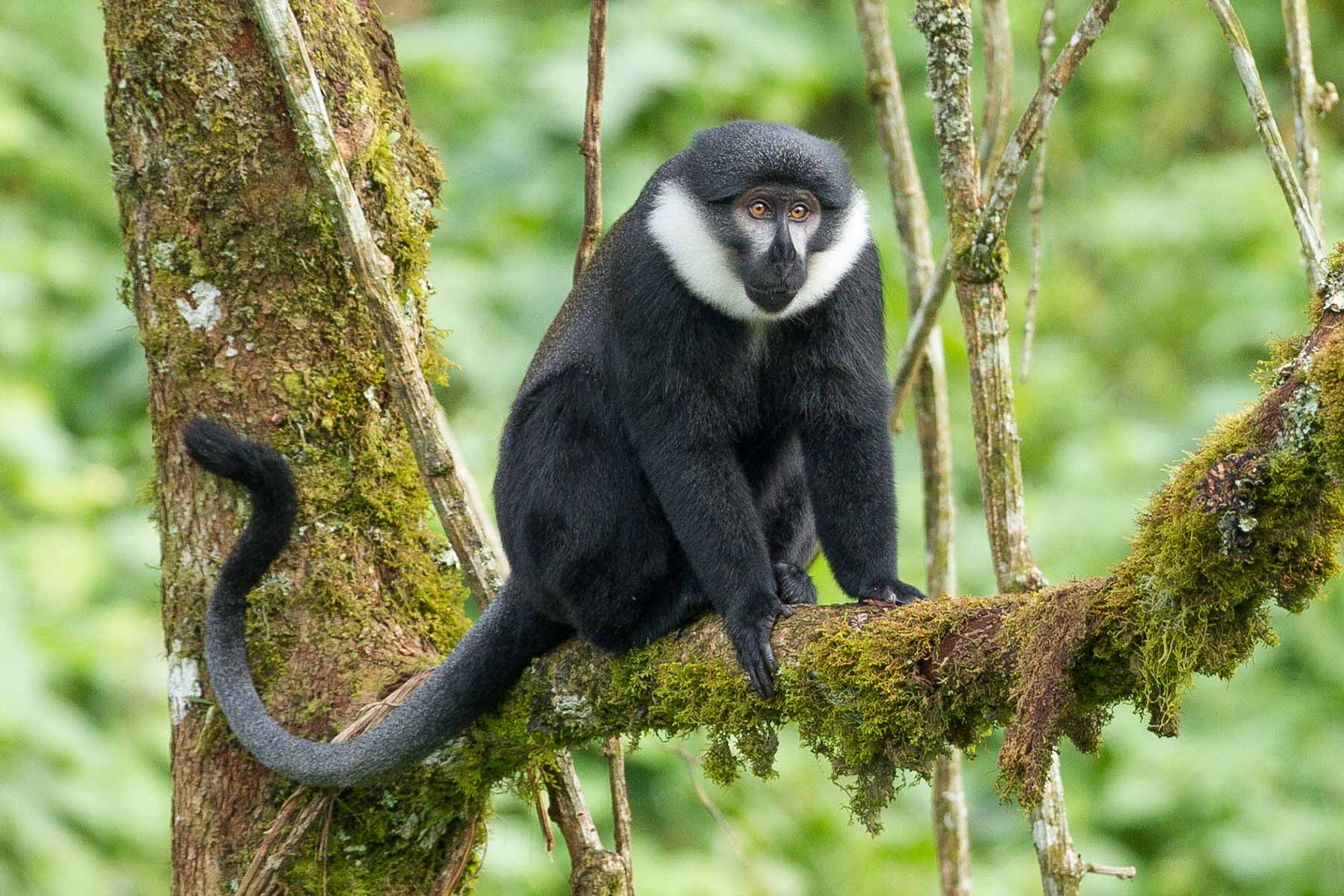
LHoest’s monkeys (Cercopithecus lhoesti), also known as the mountain guenon, are one of Uganda’s most distinctive and lesser-known primates. Characterized by a striking black face with white cheek markings, a long, bushy tail, and a dense, dark coat, these monkeys are adapted to life in the montane forests of the Albertine Rift. Unlike many other guenons that primarily inhabit the mid-canopy, LHoest’s monkeys exhibit semi-terrestrial behaviour, spending significant time foraging on the forest floor while retaining remarkable climbing abilities.
Endemic to the Albertine Rift, LHoest’s monkeys are found in the highland forests of southwestern Uganda, including Bwindi Impenetrable National Park, Mgahinga Gorilla National Park, and Virunga Forest. Their specialized habitat preferences make them an important species for understanding montane forest ecology and the biodiversity significance of the Albertine Rift.
A Detailed Study of LHoest’s Monkeys in Uganda
Habitat Preferences and Distribution
LHoest’s monkeys are strongly associated with montane and bamboo forests, often at elevations ranging from 1,200 to 3,000 meters above sea level. They favour dense undergrowth, steep slopes, and areas with abundant leaf litter, which supports their semi-terrestrial foraging habits. These habitats provide both food resources and protection from predators, allowing LHoest’s monkeys to thrive in relatively isolated forest patches.
Their distribution is largely restricted to the Albertine Rift, a biodiversity hotspot that encompasses parts of Uganda, Rwanda, Burundi, and the Democratic Republic of Congo. The Rift’s montane forests are rich in endemic species, making LHoest’s monkeys important ecological indicators for forest health and conservation.
Behaviour and Social Structure
LHoest’s monkeys are diurnal and exhibit a mix of arboreal and terrestrial behaviours. They spend mornings foraging on the forest floor, searching for fallen fruits, seeds, and invertebrates, and retreat to trees during midday or when threatened by predators. This ground-dwelling tendency distinguishes them from most other guenon species and makes their observation both challenging and rewarding.
Socially, LHoest’s monkeys live in relatively small troops, usually 10 to 30 individuals, composed of multiple adult females, juveniles, and one or a few adult males. Female-led hierarchies dominate the troop’s social organization, with males assuming protective roles and mediating conflicts. Grooming remains a central activity for maintaining social bonds, while vocalizations—ranging from alarm calls to social grunts—coordinate group movement and alert troop members to threats.
Feeding Ecology and Diet
LHoest’s monkeys are omnivorous, feeding primarily on fruits, seeds, leaves, and occasionally invertebrates. Their ground-foraging behaviour allows them to exploit food resources unavailable to strictly arboreal primates, giving them a unique ecological niche within montane forests. Seasonal variation strongly influences diet; during fruiting seasons, fallen fruits form the bulk of their intake, while in lean periods, leaves and small insects supplement nutrition.
Their feeding habits contribute to seed dispersal, aiding forest regeneration and maintaining plant diversity. By consuming fallen fruits and defecating seeds across the forest floor, LHoest’s monkeys support ecological processes that benefit both plant and animal communities.
Predation and Threats
LHoest’s monkeys face predation from leopards, eagles, and other carnivorous forest species. Their semi-terrestrial lifestyle increases vulnerability, prompting behavioural adaptations such as retreating into trees when sensing danger and maintaining tight troop cohesion during ground movement. Alarm calls are highly developed and allow rapid communication, increasing the survival rate of the group.
Human-induced threats, including habitat loss, deforestation, and hunting, pose significant challenges to local populations. Their restricted montane distribution makes them highly sensitive to forest fragmentation, emphasizing the need for protected areas and conservation measures in Uganda.
Best Parks and Viewing Opportunities
Bwindi Impenetrable National Park is one of the prime locations for observing LHoest’s monkeys. Dense montane forests, steep valleys, and bamboo zones provide ideal conditions for troops, and guided forest walks increase the likelihood of sightings. Observers often encounter LHoest’s monkeys along trekking routes, particularly in areas less frequented by gorilla tourists.
Mgahinga Gorilla National Park also hosts LHoest’s monkeys, particularly in bamboo and montane forest zones. Here, the semi-terrestrial monkeys can often be observed moving along forest floors in small troops, foraging among leaf litter, and interacting socially within the group.
Occasionally, parts of the Virunga Forest extending into Uganda offer suitable habitats, but accessibility is limited, and sightings are rare. Engaging with local guides familiar with troop locations is essential for maximizing observation opportunities.
Behavioural Observation Tips
Observing LHoest’s monkeys requires patience, quiet movement, and early morning excursions when they are most active. Troops often move in tight formations to minimize predation risk, so following from a respectful distance ensures both safety and minimal disturbance.
Binoculars and telephoto lenses are recommended for photography due to dense vegetation and limited line of sight. Guides provide crucial insights into troop behaviour, feeding patterns, and interactions with other forest species, enhancing both educational and safari experiences.
Conservation Status and Ecological Importance
LHoest’s monkeys are currently classified as vulnerable in some areas due to habitat fragmentation, hunting, and restricted distribution. Conservation efforts in Bwindi and Mgahinga protect both the monkeys and the critical montane forest ecosystems they inhabit. These initiatives include anti-poaching patrols, community engagement, habitat restoration, and ecotourism programs that generate revenue for forest protection.
As an endemic species of the Albertine Rift, LHoest’s monkeys serve as ecological indicators. Their presence reflects forest health, the integrity of undergrowth and bamboo zones, and the effectiveness of conservation practices in protecting montane biodiversity.
Complementary Wildlife in Montane Forests
LHoest’s monkeys share their montane habitats with other primates, including mountain gorillas, black-and-white colobus monkeys, and chimpanzees, although direct interactions are rare due to differing habitat niches. The forest also hosts birds, small mammals, reptiles, and invertebrates, contributing to the rich biodiversity of the Albertine Rift.
Observing LHoest’s monkeys within this context allows visitors to appreciate the interdependence of species in montane ecosystems, highlighting the role of semi-terrestrial primates in maintaining ecological balance.
Accessibility and Travel Logistics
Access to LHoest’s monkey habitats involves travel to southwestern Uganda. Bwindi Impenetrable National Park is reachable by road from Kampala or via domestic flights to Kisoro. Mgahinga Gorilla National Park is accessed from Kisoro town, while guided forest walks increase the likelihood of sightings.
Visitors should wear muted clothing, sturdy shoes, and carry waterproof gear due to damp forest conditions. Coordination with trained guides ensures safe tracking, adherence to conservation protocols, and informative wildlife interpretation.
Enhancing the Montane Primate Experience
Observing LHoest’s monkeys provides insights into arboreal and terrestrial adaptations, social behaviour, and ecological interactions within Uganda’s montane forests. Combining this experience with gorilla trekking, birdwatching, and forest ecology tours enhances understanding of Albertine Rift biodiversity.
Patience, ethical observation, and guidance from experienced rangers maximize both the educational and aesthetic value of encounters with these unique primates.
Exploring Uganda’s Rare Montane Primate
LHoest’s monkeys offer a rare glimpse into the biodiversity of Uganda’s Albertine Rift montane forests. Their semi-terrestrial habits, social complexity, and ecological importance make them a fascinating subject for wildlife enthusiasts, researchers, and conservationists alike.
For those exploring Bwindi, Mgahinga, or other montane forest zones, encountering LHoest’s monkeys provides an unparalleled opportunity to witness a ground-dwelling primate adapted to a unique ecosystem, highlighting Uganda’s rich primate diversity and the critical importance of forest conservation.