BLACK-AND-WHITE COLOBUS MONKEYS IN UGANDA – HABITS & WHERE TO SEE THEM
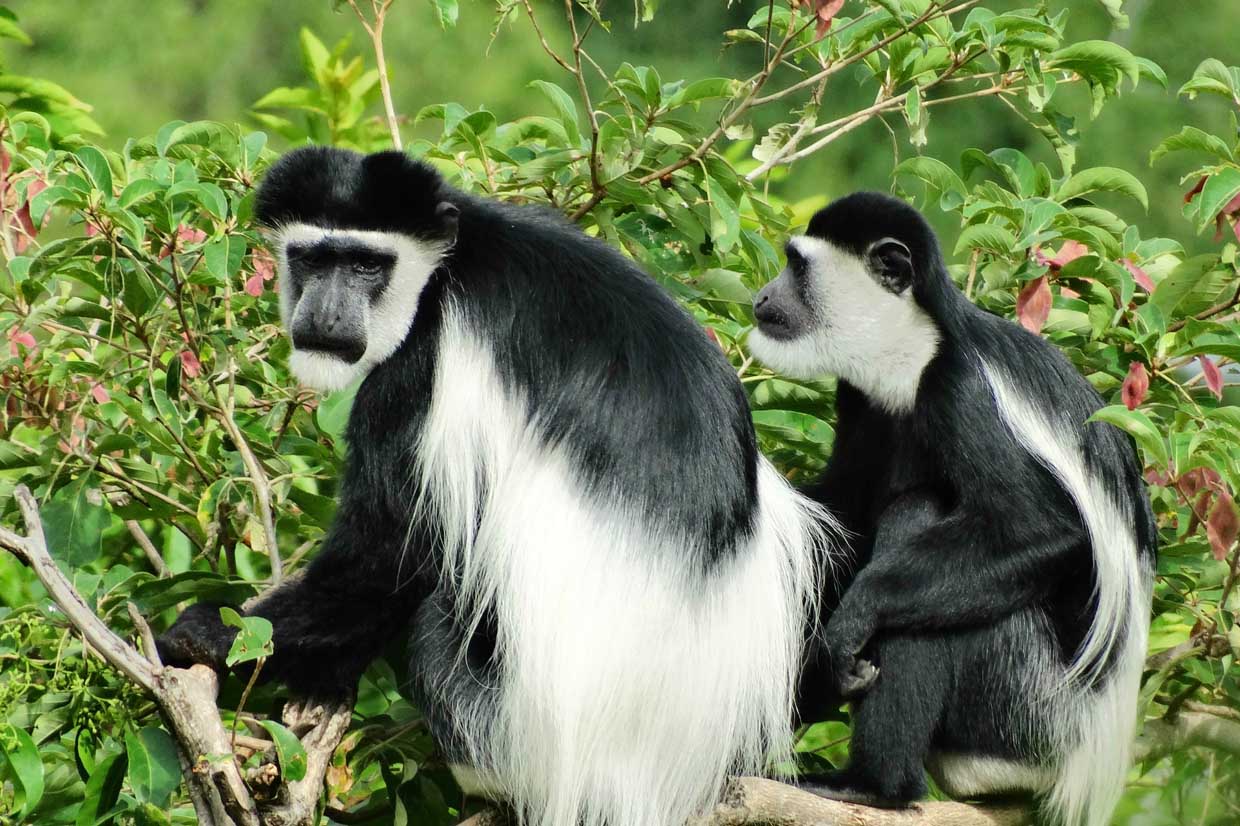
Black-and-white colobus monkeys (Colobus guereza), sometimes referred to as mantled colobus monkeys, are among Uganda’s most striking primates. Easily recognized by their contrasting black fur with flowing white mantle-like hair along the back and a distinctive bushy tail, these monkeys are visually captivating and highly arboreal. Unlike olive baboons, colobus monkeys rarely descend to the ground, preferring the high canopies of Uganda’s dense forests, riverine areas, and protected woodland patches.
These primates are herbivorous folivores, feeding primarily on leaves, fruits, seeds, and flowers. Their specialized multi-chambered stomachs allow them to digest fibrous plant material efficiently, supporting their survival in a variety of forested ecosystems. Black-and-white colobus monkeys are social creatures, living in troops that can range from 10 to 30 individuals, providing opportunities for observing complex social interactions, grooming behaviours, and vocal communication.
Uganda’s extensive forest reserves and national parks provide ideal habitats for colobus monkeys, making the country one of the best locations for primate observation in Africa. Their presence adds significant ecological and aesthetic value to forested regions, making them a must-see species for wildlife enthusiasts and researchers.
A Detailed Study of Black-and-White Colobus Monkeys in Uganda
Social Structure and Behaviour
Black-and-white colobus monkeys are highly social, forming cohesive troops with defined hierarchies. Typically, one adult male leads the group, while multiple adult females and their offspring constitute the main social units. Grooming is central to troop cohesion, reinforcing bonds and establishing trust among individuals. Juveniles engage in playful activities such as swinging from branches and mock-chasing, which helps develop physical skills and social awareness.
Troops communicate through a combination of vocalizations, visual cues, and body postures. Loud roars and alarm calls alert group members to predators, while softer coos and grunts facilitate social bonding. Observing these communication patterns provides insight into primate intelligence and social coordination, highlighting the complex interactions that maintain troop stability.
Feeding Habits and Ecological Role
Black-and-white colobus monkeys are primarily folivorous but exhibit dietary flexibility depending on season and resource availability. Their diet is dominated by young, tender leaves, supplemented by fruits, flowers, and seeds. By consuming foliage and dispersing seeds, colobus monkeys play an essential role in forest regeneration and plant diversity.
These monkeys are highly adapted to canopy life. Their long, slender limbs and prehensile hands allow them to navigate dense tree networks efficiently, feeding on leaves at different heights without descending to the ground. This arboreal lifestyle reduces predation risk and minimizes competition with terrestrial species.
Best Locations to Observe Colobus Monkeys
Uganda offers several prime locations for observing black-and-white colobus monkeys in the wild.
Bwindi Impenetrable National Park is one of the best destinations, where colobus troops inhabit forest edges and tree canopies along trekking trails. Visitors often encounter them during gorilla treks, providing complementary primate viewing experiences in the same excursion.
Mgahinga Gorilla National Park also hosts colobus monkeys, particularly in montane and bamboo forest zones. The dense canopy offers natural protection while allowing for exciting sightings during guided hikes.
Budongo Forest Reserve in western Uganda is renowned for its large primate populations, including colobus monkeys. Trails in this reserve provide excellent opportunities for primate tracking, photography, and behavioural observation.
Other sites include Semliki Wildlife Reserve and Kibale Forest National Park, where black-and-white colobus monkeys coexist with other primates such as chimpanzees, red-tailed monkeys, and mangabeys, offering rich biodiversity for ecotourists and researchers alike.
Behavioural Observations and Interaction
Observing colobus monkeys provides insights into arboreal adaptations, social structures, and predator avoidance strategies. Troops maintain spacing between individuals to reduce competition for food while staying close enough to coordinate alarm responses. Their vocal alarms are particularly informative, as they can signal different types of threats, from leopards in the canopy to human presence near the forest edge.
Colobus monkeys are generally peaceful and less aggressive than baboons, but adult males may display dominance behaviours to defend the troop or challenge rivals. Watching these dynamics offers a nuanced understanding of primate hierarchies and conflict resolution strategies.
Photography and Ecotourism Tips
Photography of black-and-white colobus monkeys can be challenging due to their high-canopy habitat and dense foliage. Telephoto lenses are essential for capturing clear images without disturbing the animals. Observers should move quietly, avoid direct sunlight in the camera lens, and use binoculars to study troop behaviour from a distance.
Guided forest walks with experienced rangers enhance both safety and viewing opportunities, providing insights into feeding habits, grooming patterns, and ecological context. Visitors are advised to wear muted clothing to blend into the forest environment and minimize disturbance.
Seasonal Patterns and Wildlife Visibility
Colobus monkey behaviour and visibility can vary seasonally. During the dry season, leaves may be scarcer, prompting monkeys to feed on a wider variety of plant materials and move more extensively through the canopy, which can increase sighting opportunities. The wet season brings lush foliage, offering abundant food but sometimes reducing visibility due to dense vegetation.
Daily activity patterns also influence sightings. Colobus monkeys are most active in the morning and late afternoon, resting or digesting food during midday. Observing these patterns helps visitors plan the timing of excursions for optimal viewing.
Conservation Status and Challenges
Black-and-white colobus monkeys are currently classified as a species of least concern, but local populations face pressures from deforestation, habitat fragmentation, and hunting. Protected areas in Uganda provide critical refuges that safeguard both monkeys and their forest habitats.
Ecotourism and research projects contribute to conservation by funding park management, anti-poaching patrols, and community engagement. Promoting awareness of the species’ ecological importance helps ensure sustainable tourism and long-term protection of Uganda’s forest ecosystems.
Complementary Wildlife and Ecological Context
Colobus monkeys often share their habitats with other primates such as chimpanzees, red-tailed monkeys, and grey-cheeked mangabeys. Observing interspecies interactions provides insights into niche partitioning, dietary overlaps, and territorial behaviours.
In addition, the forest ecosystem supports birds, reptiles, and small mammals that contribute to a rich ecological tapestry. For ecotourists, colobus monkeys act as flagship species for broader forest conservation and provide a gateway to understanding Uganda’s complex biodiversity.
Accessibility and Travel Logistics
Accessing prime colobus monkey habitats requires travel to Uganda’s forested national parks and reserves. Bwindi Impenetrable National Park is reachable from Kampala via a scenic drive or domestic flight to Kisoro or Kabale. Mgahinga Gorilla National Park is accessible from Kisoro town, while Budongo Forest Reserve and Kibale National Park are in western Uganda, reachable from Fort Portal or Masindi.
Guided forest walks are the best way to ensure safe and effective observation. Accommodation ranges from luxury lodges to community-run eco-camps, providing convenient access to forest trails and supporting local communities through tourism.
Enhancing the Primate Viewing Experience
Observing black-and-white colobus monkeys offers more than a wildlife encounter; it provides an opportunity to understand forest ecology, social behaviour, and interspecies dynamics. Combining colobus sightings with birdwatching, guided nature walks, and ecological interpretation enriches the experience, fostering a deeper appreciation for Uganda’s forest ecosystems.
Responsible tourism, guided observation, and adherence to park regulations ensure that interactions remain safe for both humans and wildlife while supporting long-term conservation efforts.
A Must-See Arboreal Primate
Black-and-white colobus monkeys are among Uganda’s most charismatic and ecologically significant primates. Their distinctive appearance, arboreal agility, and complex social behaviour make them fascinating subjects for observation, study, and photography.
From Bwindi and Mgahinga to Budongo and Semliki, these monkeys offer accessible yet exclusive wildlife experiences that complement Uganda’s more famous safaris. For primate enthusiasts, ecotourists, and researchers alike, observing black-and-white colobus monkeys is a compelling window into the richness and complexity of Uganda’s forest ecosystems.