RED COLOBUS MONKEYS IN KIBALE – ECOLOGY & THEIR CHIMPANZEE PREDATORS
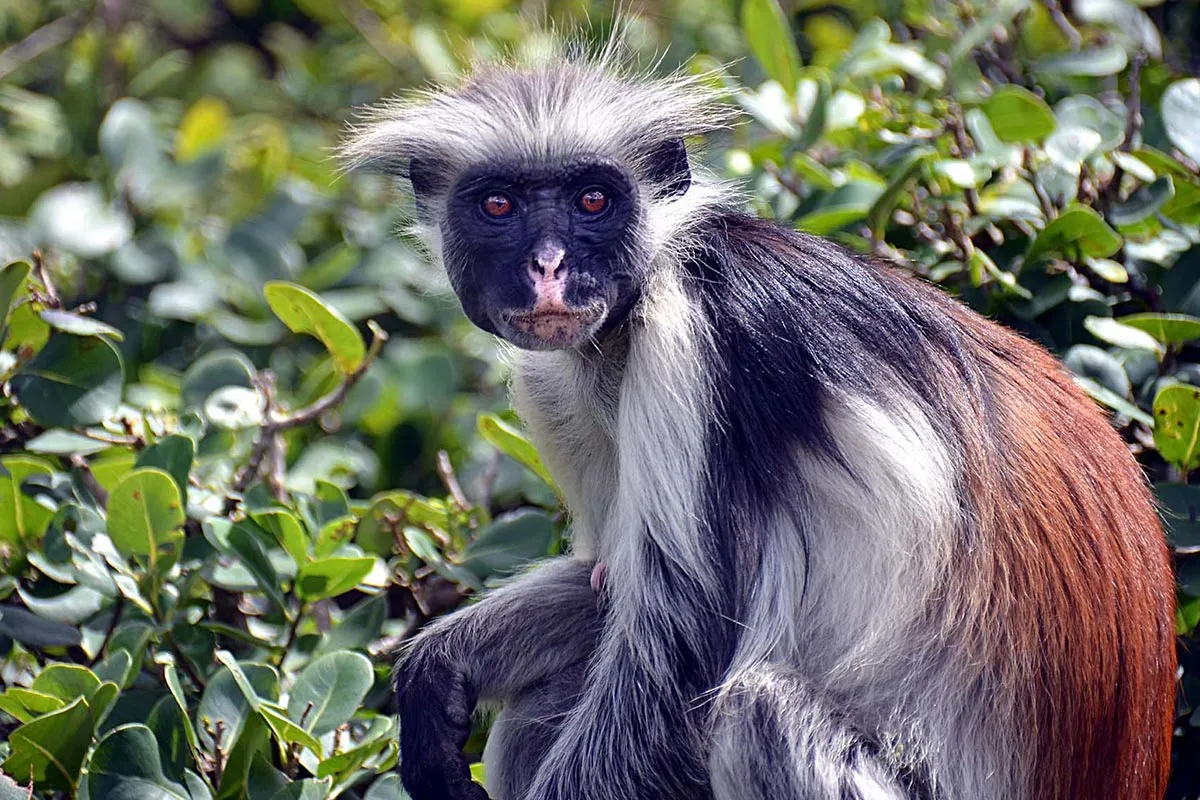
Red colobus monkeys (Procolobus rufomitratus) are among Uganda’s most fascinating and specialized primates, primarily inhabiting the dense tropical forests of Kibale National Park. Known for their striking reddish-brown fur and distinctive black-and-white markings on their face and tail, these arboreal monkeys are highly social and display complex behaviours that attract researchers and wildlife enthusiasts alike.
Kibale National Park, often referred to as the “Primate Capital of the World,” provides an ideal habitat for red colobus monkeys. The park’s 795 square kilometers of evergreen, semi-deciduous, and swamp forests support one of the largest populations of this species in Uganda. Unlike the more adaptable olive baboons or black-and-white colobus monkeys, red colobus monkeys are extremely forest-dependent, making them sensitive indicators of forest ecosystem health.
Red colobus monkeys are also notable for being a primary prey species for chimpanzees, adding an intriguing predator-prey dynamic to their ecological role. Observing these monkeys in Kibale offers insights into social organization, forest ecology, and the natural behaviours of both prey and predator species.
A Detailed Study of Red Colobus Monkeys in Kibale
Social Structure and Group Dynamics
Red colobus monkeys live in large, cohesive groups typically ranging from 20 to 60 individuals, though groups in Kibale can occasionally exceed 100. Their social structure is female-centered, with females forming the stable core of the troop and males often migrating between groups to maintain genetic diversity. Grooming, vocal communication, and coordinated movement are central to maintaining group cohesion.
Troop hierarchy is less rigid than in baboons, with adult females maintaining stable social bonds, while dominant males establish territories and mediate conflicts within the group. Juveniles engage in social play and exploration, which is critical for developing skills needed for navigating the complex forest canopy and establishing future social positions.
Feeding Ecology and Forest Adaptations
Red colobus monkeys are primarily folivorous, feeding on a diet rich in leaves, young shoots, flowers, and unripe fruits. Their specialized, multi-chambered stomach allows them to digest fibrous foliage effectively, enabling survival in dense forests with limited fruit availability.
These monkeys spend most of their lives in the canopy, moving efficiently along interconnected branches. Their long limbs, prehensile hands, and agile locomotion make them adept at avoiding predators and exploiting food resources across various forest strata. Seasonal variations influence their feeding patterns; during wet seasons, they consume more fruits and flowers, while in dry periods, leaves and buds become more important.
Red colobus monkeys contribute significantly to forest ecology by dispersing seeds and controlling foliage growth. Their browsing activity affects plant community composition, which indirectly influences other arboreal and terrestrial species.
Predator-Prey Dynamics with Chimpanzees
One of the most fascinating aspects of red colobus monkey ecology is their role as prey for chimpanzees (Pan troglodytes), also abundant in Kibale. Chimpanzee predation shapes the behaviour and group dynamics of red colobus monkeys. Troops adopt anti-predator strategies, including moving in tight clusters, vocal alarm calls, coordinated escapes, and utilizing higher canopy levels where access is limited for predators.
Predation pressures influence foraging decisions, daily movement patterns, and sleeping site selection. Observing red colobus monkeys provides insight into predator-prey interactions in tropical forests, highlighting the evolutionary adaptations that enable prey species to survive in a landscape dominated by intelligent predators.
Communication and Behavioural Observations
Red colobus monkeys employ a sophisticated system of vocalizations, body postures, and facial expressions to maintain social cohesion and alert troop members to threats. Alarm calls are specific and can signal the presence of predators such as chimpanzees or leopards. Soft grunts and coos facilitate group coordination during foraging or resting.
Behavioural studies in Kibale show that troop members rely heavily on social learning; juveniles mimic adult behaviours to navigate complex forest structures and respond appropriately to predation risk. Observing these interactions provides a unique window into primate cognition, social intelligence, and survival strategies.
Best Viewing Spots in Kibale
Kibale National Park’s network of forest trails, including the Sebitoli and Bigodi Wetland areas, provides excellent opportunities for observing red colobus monkeys. The park’s dense canopy makes sightings challenging but rewarding, often requiring patient tracking by experienced guides.
Guided forest walks allow for safe observation while minimizing disturbance to the monkeys and their habitat. Early morning and late afternoon are optimal times for sightings, as red colobus monkeys are most active during cooler parts of the day. The Bigodi Wetland Sanctuary, adjacent to Kibale, offers additional opportunities for observing semi-habituated troops in a more open forest edge environment.
Seasonal and Environmental Considerations
Seasonal changes in Kibale influence red colobus behaviour and visibility. The wet season enhances food availability, which can disperse troops and make them slightly harder to locate, but the lush green foliage provides beautiful photographic settings. During the dry season, food scarcity may concentrate monkeys in areas with abundant foliage, increasing observation chances.
Environmental factors, such as rainfall, temperature, and canopy density, affect predator-prey dynamics. During periods of high chimpanzee activity, red colobus monkeys may exhibit heightened vigilance, climb higher in the canopy, or alter movement patterns to reduce predation risk.
Conservation Status and Threats
Red colobus monkeys face several conservation challenges. They are classified as endangered in some regions due to habitat loss, deforestation, and hunting. Kibale National Park serves as a critical stronghold for the species, protecting both the monkeys and the complex forest ecosystems they inhabit.
Ecotourism and research projects in Kibale play a pivotal role in conservation. Funds generated through guided primate tracking, wildlife photography, and community-based tourism support anti-poaching patrols, habitat restoration, and environmental education programs for local communities. By protecting red colobus monkeys, these initiatives help preserve Uganda’s broader forest biodiversity.
Complementary Wildlife and Ecological Context
Red colobus monkeys share their forest habitat with other primates, including chimpanzees, black-and-white colobus monkeys, red-tailed monkeys, and mangabeys. Observing interspecies interactions provides valuable insights into competition, niche partitioning, and arboreal community structure.
The forest also hosts a rich array of birds, reptiles, and small mammals, contributing to an interconnected ecosystem. Studying red colobus monkeys offers a gateway to understanding the broader ecological web of Kibale, highlighting the importance of forest conservation for multiple species.
Accessibility and Travel Logistics
Kibale National Park is accessible from Kampala via a scenic drive or domestic flight to Fort Portal. Accommodation options near the park range from luxury lodges to community-run eco-camps, providing convenient access to trails for primate observation.
Guided forest walks, typically led by experienced rangers, ensure safe and productive wildlife encounters. Visitors are encouraged to wear muted clothing, carry binoculars, and follow park regulations to minimize disturbance to wildlife.
Enhancing the Primate Viewing Experience
Observing red colobus monkeys provides more than a wildlife encounter; it offers an immersive experience into forest ecology, social complexity, and predator-prey dynamics. Combining these observations with birdwatching, chimpanzee tracking, and educational interpretations creates a comprehensive understanding of Kibale’s tropical forest systems.
Patience, respect for natural behaviour, and guidance from trained rangers maximize the observational and photographic potential of this unique primate species.
A Unique Window into Uganda’s Forest Ecosystems
Red colobus monkeys in Kibale National Park offer a rare glimpse into the delicate balance of tropical forest life. Their arboreal agility, complex social structures, and interactions with chimpanzee predators make them fascinating subjects for wildlife enthusiasts, researchers, and conservationists.
For visitors to Uganda, tracking and observing red colobus monkeys in Kibale provides an unforgettable opportunity to explore the richness of forest biodiversity, understand ecological relationships, and appreciate the intricacies of primate behaviour in one of Africa’s most important conservation landscapes.